
Make coat maintenance part of the decision
Persians have long coats and a distinctive facial structure; CFA and TICA provide breed descriptions and standards [1,2]. A quiet breed reputation does not reduce the importance of regular care or prove that a particular cat is comfortable. Before bringing one home, ask who will maintain the coat and how help will be arranged when needed.
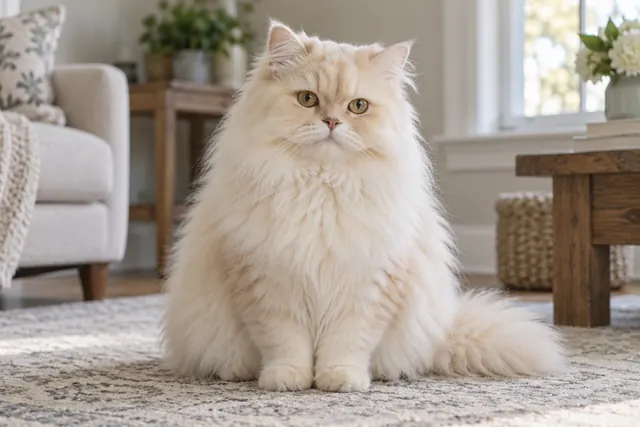
This is a companion-care planning guide, not a show-grooming procedure. The generated portrait cannot establish breed identity, facial health or the quality of a coat.
Ask for a demonstrated grooming routine
Have the current caregiver or an experienced cat groomer show the tools and technique used on the individual. Work in a calm location and begin with short sessions the cat can tolerate. Check sections systematically rather than brushing only the top layer until it looks smooth.
Pay attention to friction areas and the hindquarters, and inspect for tight tangles or altered skin. If a mat is close to skin, painful or extensive, seek professional help. Pulling through a knot or cutting near the skin with scissors can cause injury; ask your veterinary team or groomer about a safe approach.
Keep notes on difficult areas and changes in self-grooming. A previously tolerant cat that now resists touch needs assessment rather than firmer restraint.
Treat facial observations as observations
Ask your veterinary team to demonstrate appropriate routine cleaning if needed and which changes should prompt a call. Note new discharge, discomfort or changes in breathing rather than describing them as normal for a flat-faced cat.
Do not choose eye medication, aggressive stain treatment or a breathing remedy from cosmetic advice. If breathing appears difficult, obtain urgent veterinary assistance. A breed description should never reassure you about an individual symptom.
Check health records before commitment
TICA discusses conditions including polycystic kidney disease and respiratory, eye and heart concerns for the Persian group [2]. Ask for relevant screening records and known history, including the animal identified on each test and the date. Your veterinary team can explain which evidence applies and what remains uncertain.
Avoid relying on “healthy line,” a photograph or one genetic result as a complete health assessment. Ask how veterinary findings and ongoing care needs are disclosed and what support follows adoption or purchase.
Build a comfortable home routine
Offer accessible litter, stable rest and play that the cat can choose. Keep long fur and hygiene observations in mind when checking toilet use; a mess in the coat should prompt a practical care discussion, not punishment.
A small daily planning review might include food intake, comfortable grooming, litter access and a brief offered activity. The frequency and method of care should fit the actual cat and professional advice, not a fixed internet score.
Use indoor home planning and record measurements consistently with the weight record guide. A thick coat can make visual guesses about body condition unreliable; ask for individual assessment.
Questions to resolve before choosing a Persian
Can you maintain the coat comfortably, and who can help with mats? What veterinary history and screening documents are available? What face-care routine is already used? How does this cat respond to handling and household noise? Write down concrete answers and compare the commitment with your actual schedule.
Do Persians need baths on a universal schedule? Ask about the individual coat and circumstances; this guide does not prescribe one. Are they inactive? Offer appropriate enrichment and watch the response. Should you choose by the flattest face? Appearance alone cannot establish comfortable breathing or suitable health.
Plan for daily coat attention before collection
TICA describes daily combing as part of Persian coat maintenance [2]. Ask an experienced caregiver to demonstrate how they reach the underlayers comfortably and what help is used for difficult areas. Discuss face-care technique with your veterinary team rather than copying a cosmetic stain-removal routine.
Choose the person responsible for daily care and arrange backup during travel or busy periods. Ask a local professional about help and actual charges if the cat cannot tolerate your routine; this page does not invent a universal grooming price. If nobody can maintain the coat safely, resolve that support need before adopting or purchasing.