
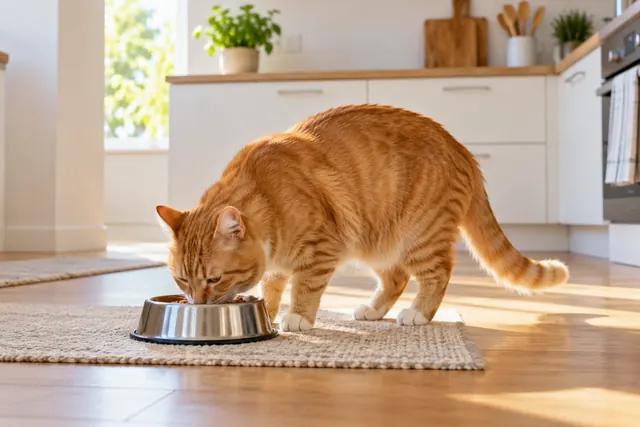
Read the food label before choosing a portion
Start with the exact product, not “a bowl of dry food.” Record its name, life-stage statement, calorie information and recommended storage. Cornell explains that commercial foods differ in moisture and calorie density and that a complete diet should provide the required nutrients [1]. A food intended as a complementary treat is not automatically a complete main diet.
Ask your veterinary team about the appropriate diet and allowance for your cat's age, body condition and health. Do not add supplements simply because they sound beneficial; Cornell advises discussing them with a veterinarian [1]. This guide helps you organize a feeding routine, not prescribe one.
Keep grams and calories separate
Grams describe food weight. Calories describe energy. The same gram weight of two foods need not provide the same calories. Use the calorie value for the product you actually serve, and keep the label's basis alongside it: per kilogram, per 100 grams, per can or another stated amount.
For an illustrative dry food labeled 360 kcal per 100 g, 35 g contains 126 kcal: 360 ÷ 100 × 35. A different hypothetical food labeled 90 kcal per 85 g can supplies 45 kcal in half that can. Together those example portions contain 171 kcal. This is arithmetic, not a suggested daily ration.
Use the food-label calorie converter separately for each food. Do not enter one product's calorie number and another product's grams.
Build a feeding record you can check
- Weigh the portion in grams using the same scale and a tared bowl.
- Record the food, amount offered, time and cat receiving it.
- Record leftovers without assuming missing food was eaten by that cat in a shared household.
- Include treats and other extras when discussing the overall plan.
- Note the agreed daily allowance and who advised it, so another caregiver can follow the same routine.
Once an allowance is established, the meal portion planner can divide it into equal meals. It does not choose how much the cat needs or decide an appropriate feeding frequency.
Mixing foods or changing a routine
If you feed wet and dry food, keep separate entries and convert each using its own label. Equal grams are not interchangeable. Follow storage and discard instructions for the specific product; do not apply dry-food handling to an opened wet product.
Before changing diet, ask about a suitable transition for your cat, especially if a therapeutic diet is involved. Keep a note of what changed and when. Changing product, portion, location and schedule simultaneously makes the result harder to interpret.
Check who can reach the meal
Provide fresh water and a feeding location the cat can approach calmly. If another cat takes food or watches the route, use separate feeding arrangements. A full communal bowl does not establish that every cat ate.
If appetite decreases or a cat stops eating, contact your veterinarian promptly. Cornell's anorexia guidance explains why loss of appetite needs attention [2]. Do not withhold food to force acceptance of a new diet or wait for a calculator to resolve the problem.
Questions to take to the appointment
Bring the label, measured portions, extras, recent weight measurements and any appetite change. Ask: Is this diet appropriate for this life stage? What total allowance should we use? How should mixed foods fit into it? What changes should trigger a call? These specific inputs make advice easier to apply than a breed-based feeding guess.