
If your cat vomits repeatedly, cannot keep food or water down, seems unwell or may have eaten something harmful, contact your veterinarian promptly. Do not begin with a color chart, a fasting recipe or an assumption that it is another hairball. The next useful decision depends on the whole episode and the cat's condition.
PDSA advises veterinary contact if vomiting repeats or other symptoms appear, and straight-away contact for a cat unable to keep food or water down, a very young or old cat, or signs such as low energy, abdominal pain, blood or black dots in vomit. [1] This guide does not require waiting for a set number of episodes or a full day before calling.
Put the concerning features in the first call
Tell the clinic when vomiting began, how often it happened and whether the cat is eating, drinking and behaving normally between episodes. Mention blood or dark material, weakness, pain, diarrhea, changes in drinking or urination and recent medicines. PDSA and Merck identify these kinds of accompanying changes as reasons for assessment. [1][2]
If you suspect access to a toxic plant, medication, chemical or unsuitable object, say that immediately. Do not wait to see whether vomiting clears the substance. Cornell advises immediate veterinary contact for suspected toxic ingestion and says not to induce vomiting unless specifically instructed, because some substances cause more harm on the way back up. [3]
Keep the relevant package or a safe photograph and estimate the time of access if you know it. If the exposure is uncertain, explain the uncertainty. “A tablet is missing from the floor” is useful information even when you did not see it swallowed. Do not delay the call while trying to prove the exposure.
Record the event rather than only its color
If it is safe and does not delay care, note the time, the preceding meal and what you saw the cat do. A brief video can help the veterinary team understand an event you find hard to describe. Do not provoke a repeat episode to obtain one.
Merck distinguishes vomiting, which involves effort such as retching and abdominal contractions, from regurgitation, which is passive. [2] A report of food coming back up immediately after a meal does not by itself establish either the mechanism or the cause. Describe the effort, timing and material rather than deciding the cat simply ate too fast.
A photograph of the expelled material can preserve an observation before cleaning. Note food, fluid, visible hair, blood or an unusual object without converting appearance into a diagnosis. Yellow fluid, foam or recognizable food cannot identify the underlying illness on its own. Tell the team if you are unsure whether the event was coughing, retching or vomiting.
In a multi-cat home, record which cat you actually saw. A puddle discovered later has an unknown source unless you have reliable evidence. Keep that distinction in the vet-visit record; an accurate uncertainty is more useful than assigning every episode to the cat with a previous problem.
Decide whether home monitoring fits this episode
PDSA says an otherwise well cat that vomits once may sometimes be monitored closely at home, with normal feeding and access to fresh water. If vomiting recurs or the cat becomes unwell, contact the vet. [1] This narrow situation is different from repeated episodes, suspected harmful ingestion, reduced intake or a vulnerable cat.
If you are uncertain whether your cat is otherwise well, call for advice. A cat hiding quietly is not automatically comfortable, and a normal-looking interval does not explain recurring vomiting. Do not use this page to overrule existing return instructions for a cat already receiving treatment.
Keep track of whether food and water stay down and whether appetite, activity or litter-box observations change. If another episode occurs, report the update rather than repeatedly restarting the same observation period. Make sure the household knows who is monitoring and what should prompt another call.
Get feeding and medication instructions for this cat
Online vomiting advice often supplies a fixed fasting period and a homemade bland diet. The sources used here do not give one uniform approach: PDSA's advice for an otherwise well cat is normal feeding, while Merck describes food withholding within its discussion of short-term treatment. [1][2] These cannot be combined into a universal home prescription.
Ask your veterinary team what to feed, how much, how often and what to do if it is vomited again. Do not withhold water on your own; Merck warns that withholding water can worsen dehydration and describes any water restriction in the context of veterinary fluid support. [2] An individual illness, age or prescribed diet can change the plan.
Do not start a human anti-nausea medicine, leftover pet prescription, dewormer, oil or supplement to stop vomiting without the team's advice. Treatment depends on the cause. [2][3] If a prescribed medicine was vomited or a dose may not have been retained, ask what to do for that drug rather than automatically repeating it. Use the tablet guide to organize administration questions, not to change a dose.
If food intake has fallen, say so explicitly. Our reduced-appetite guide explains why a few licks or treats do not prove adequate intake and how to report what was consumed. Do not let efforts to settle the stomach become prolonged inadequate nutrition.
Visible hair does not close the investigation
Merck advises veterinary assessment for frequent hairballs or repeated vomiting because something more serious may be responsible. [2] Finding hair in the material does not prove that every recurring event is harmless, and retching without bringing up hair is not a reason to add a hairball remedy repeatedly.
Brushing can reduce loose fur swallowed during grooming, as Merck explains. [2] Use the long-haired coat-care guide for a comfortable routine, while keeping the vomiting pattern separate. Grooming is not a treatment for a suspected blockage or underlying illness.
Do not give mineral oil, laxatives or other hairball products from an internet recipe. If the team recommends a product, confirm the exact preparation and directions. Do not encourage grass eating to provoke vomiting; the cat-grass guide distinguishes optional enrichment from an unsupported treatment protocol.
Recurring episodes need a timeline, not repeated explanations
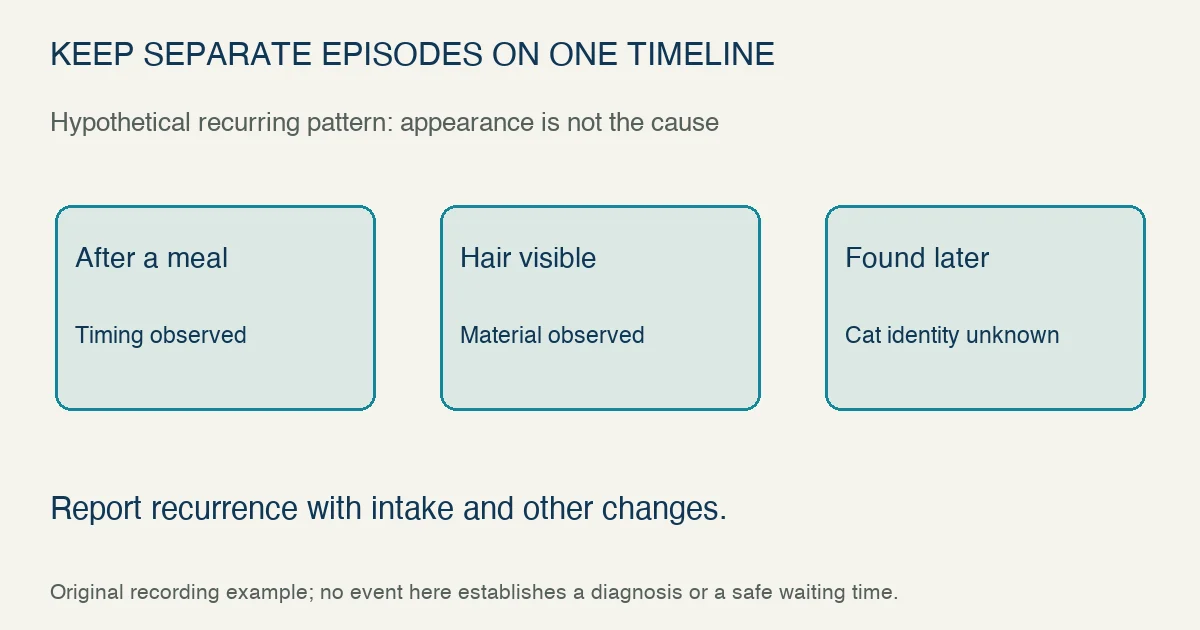
A hypothetical cat has several separated episodes across a month. One followed a meal, one contained hair and one was discovered when the caregiver returned home. Labeling them “fast eating,” “hairball” and “probably grass” can conceal the recurring pattern. Record them together, including what you actually witnessed and what remains unknown, and discuss the pattern with the clinic.
Include food changes, weight observations, medicines, appetite and access to plants or household materials. Merck describes a veterinary examination and potentially further tests for long-term or severe vomiting. [2] A temporary improvement after changing food does not establish a food allergy or rule out another problem.
Ask what the team wants you to monitor while waiting for results or following treatment, and when persistent symptoms should trigger reassessment. The food-change guide helps keep a planned transition and actual intake visible; it is not an elimination-diet diagnosis.
Clean up after preserving the useful information
Once the cat's care and any relevant photograph or package are addressed, keep pets away from the soiled area while cleaning. Follow the cleaning product's instructions and prevent access to residues or wet treated surfaces. Do not add a strong chemical mixture because the stain is unpleasant. If the carrier is soiled, the carrier-cleaning guide covers its components and cleaning checks.
If the clinic asks for a sample, follow its collection and storage directions rather than keeping an unsealed household container by the feeding area. Report a recurrence even if it leaves no visible stain. Your evidence is the cat's course over time, not the size of the cleanup.
This is an AI-assisted practical synthesis, not veterinary-reviewed advice, a vomiting diagnosis or a prescribed feeding plan. The timeline and illustration are hypothetical. Source differences about short-term feeding are retained rather than turned into a one-size fasting rule.