
Check the mouth before starting a brushing routine
Home toothbrushing is a preventive care task, not a way to diagnose or treat a painful mouth. Before introducing a brush, ask your veterinary team whether brushing is appropriate for your cat and have them demonstrate the technique. After dental treatment, follow their specific instructions about when and how home care should resume.
Cats Protection notes that cats may continue eating normally despite dental problems. Changes such as bad breath, drooling, discomfort while eating, pawing at the mouth, bleeding gums or reduced appetite warrant a veterinary visit [1]. Do not assume an eating cat has a comfortable mouth, or interpret resistance to brushing as simple stubbornness.
Cornell explains that brushing can be painful with severe gingivitis and recommends veterinary advice before brushing a cat with gingivitis [2]. If you notice pain, bleeding or another new concerning change, pause home handling and contact the clinic. If your cat is not eating or appears acutely unwell, seek veterinary advice promptly rather than waiting to complete a training programme.
This guide helps you prepare and practise the care your veterinary team recommends. It does not tell you whether visible redness is gingivitis, whether a tooth needs removal or what medication to give.
Prepare a small kit and a workable place
Use toothpaste or tooth gel specifically intended for cats and a suitable cat toothbrush. Both Cats Protection and Cornell advise against human toothpaste [1][2]. A pleasant flavour or a “natural” label does not establish that a human product is suitable. Ask the clinic which product and brush are appropriate for the cat's mouth, especially where there is a treatment history.
Read the actual product directions, including storage, amount, restrictions and cleaning of the brush. We have not tested or ranked toothpaste brands here. Avoid improvising with mouthwash, abrasive substances or tools for scraping hardened deposits. Home brushing is not professional scaling.
Pick a place where the cat can stay comfortably without slipping or being crowded. Keep the session calm and short enough that you can stop before a struggle develops. Prepare any agreed reward beforehand; if it is food, include it in the cat's feeding plan rather than adding an unlimited extra allowance. Do not withhold a normal meal to obtain cooperation.
Work within your own safety limits as well as the cat's comfort. Putting a finger in reach of teeth creates a bite risk. Ask the veterinary team for a demonstration or an alternative arrangement when you cannot safely handle the mouth. This article does not teach forceful restraint.
Separate familiarity from cleaning
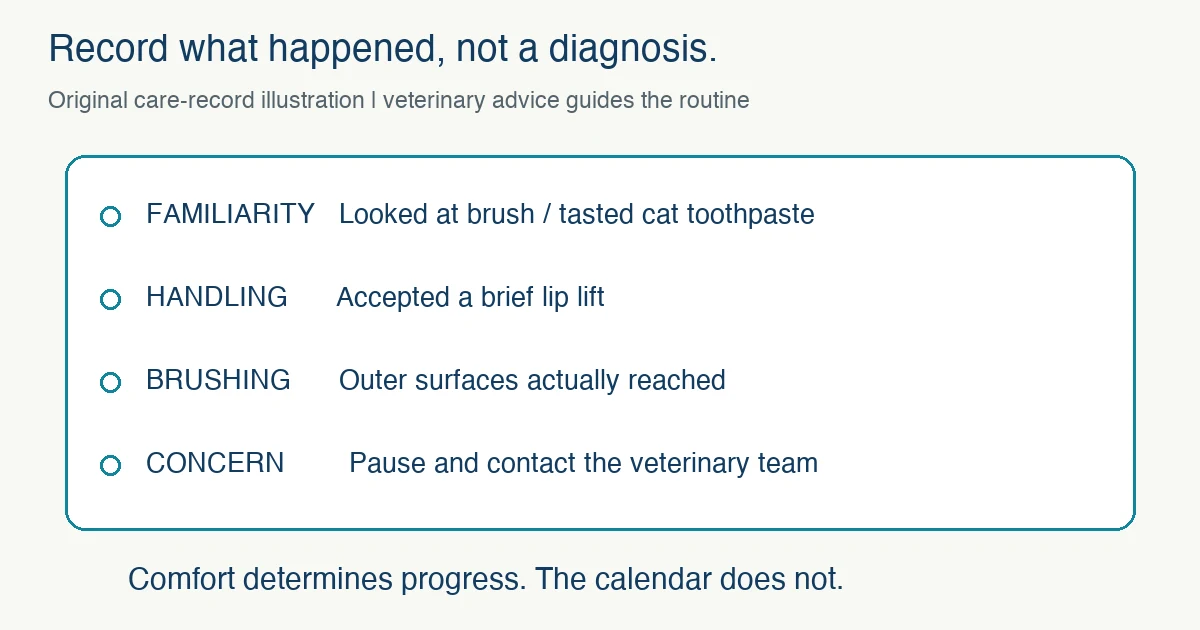
A cat investigating a brush is making progress with familiarity, but its teeth have not been cleaned. So is a cat licking cat toothpaste from a brush. Keeping those achievements separate helps you avoid both rushing the cat and recording a session as more than it was.
Cats Protection suggests introducing the taste of cat toothpaste, then gently introducing the brush, beginning actual brushing only once the cat is comfortable [1]. Cornell describes a four-week example progressing through toothpaste smell and taste, brush familiarity and then brushing [2]. That is a teaching sequence, not a deadline that every cat must meet.
For your cat, identify the smallest interaction it already accepts calmly. That might be seeing the brush nearby, accepting a brief lip touch or allowing the brush to touch an outer tooth. End positively at that level. If the cat retreats, becomes tense or struggles, do not increase handling simply because another day has passed.
If lip handling is accepted, gently lift the lip enough to see the outside tooth surface. Keep the mouth in a comfortable position rather than forcing it open to inspect every surface. The point is to practise the demonstrated access, not to conduct a dental examination at home. A change in tolerance from previous sessions is useful information to report, not proof of a particular diagnosis.
A hypothetical log could read: “Allowed brief lip lift on the left; moved away when brush approached; no brushing today.” That is clearer than “failed brushing.” It identifies what was accepted and where to resume or ask for help. An observation of bleeding, in contrast, belongs in a clinic discussion rather than a harder training attempt.
Brush the accessible outer surfaces gently
Once your veterinary team considers brushing appropriate and the cat accepts the preceding handling, use the small brush and cat toothpaste as demonstrated. Cornell and Cats Protection describe placing the bristles at about 45 degrees to the teeth, directed towards the tooth–gum junction, with gentle brushing [1][2]. Ask the team to show that angle in the actual mouth; do not force bristles under the gum or use greater pressure to compensate for awkward access.
Cornell's introduction focuses on the outside surfaces of the upper and lower teeth [2]. You do not need to prise the jaws open to reach inner surfaces during this home routine. Work on the surfaces you can reach safely, building coverage as comfort permits. Never turn a target duration or complete coverage into a reason to hold down a struggling cat.
Brushing removes plaque mechanically; licking paste is not equivalent to brush contact. Cornell describes daily brushing as the routine goal [2]. While learning, record whether brushing actually occurred, which side or area was reached and why you stopped. A brief accepted session is more informative than a tick claiming a complete clean when the brush never touched a tooth.
Follow the toothpaste and brush instructions after use, and replace damaged equipment as directed. Keep the routine practical enough to repeat. If you cannot make safe progress, bring the brush and product details to the clinic so the problem can be demonstrated and the plan adjusted.
If brushing is not currently workable
First decide whether the problem is handling, equipment or a possible health change. A cat that is newly reluctant to have its face touched needs a different response from a cat that has never been introduced to a brush. Tell your veterinary team what changed, how the cat is eating and what happened during the attempted session. Avoid repeatedly trying to brush through suspected discomfort.
The team may suggest another home-care arrangement or an adjunct product. To evaluate a dental-product claim, the Veterinary Oral Health Council's accepted-product list separates products for cats from products for dogs and identifies claims for plaque, tartar or both [3]. Match the actual product name and animal category. A similarly branded dog item or a different formulation is not automatically covered by a cat listing.
VOHC explains that acceptance follows review of trial data against its protocols; VOHC does not itself perform the product tests [4]. The seal concerns the stated plaque or tartar claim. It does not diagnose your cat, establish that a product fits every prescribed diet or mean professional dental care is unnecessary.
Use the current list and the actual product instructions, then discuss suitability with your veterinary team. A dental treat adds food; a dental diet changes feeding; a water additive changes what is offered to drink. None should be added casually to a clinical plan. Do not reduce access to plain drinking water to force use of an additive. This page does not provide a product dose or promise that an adjunct replaces brushing.
Keep a useful record for the next appointment
Record observations rather than a home diagnosis: date, food offered and eaten, a change in breath, visible drool, which handling was accepted and any concerning response. Note the exact toothpaste or adjunct product and how it was used. A photograph or short video can help only if it can be obtained without forcing mouth handling or delaying needed care.
For example, “Approached usual bowl, picked up food, then dropped several pieces; brushing paused and clinic contacted” conveys an observable event. “Teeth are fine because the cat ate” does not. Your veterinary team decides what examination and treatment are required.
Use the vet-visit record guide to organise that factual history. Continue the examination and follow-up schedule the clinic recommends. A regular home routine and professional assessment serve related purposes; completing one does not establish that the other is unnecessary.