
Before changing the routine, check what is new
A cat waking you early can be frustrating, but the sound alone does not explain the reason. Cats Protection notes that cats are often active around dawn and dusk and recommends ruling out medical problems when night waking, excessive crying, restlessness or disorientation is a concern [1]. Do not assume a new pattern is a training problem simply because it happens beside your bed.
Contact your veterinary team about changed or excessive vocalizing, especially if you also notice different eating, drinking, movement or toileting. ASPCA recommends a veterinary assessment even for a cat with a history of meowing for food [3]. Bring observations rather than a diagnosis: when the waking began, where the cat was, what it did and what else changed. A behavior seen in an older cat should not automatically be labelled dementia.
If the cat is acutely unwell, seek veterinary help for that situation rather than continue a sleep experiment. This guide is for reviewing a household routine after health concerns and access needs have been considered. It provides no sedative advice, medical treatment or promise of uninterrupted nights.
Record the event and your response separately
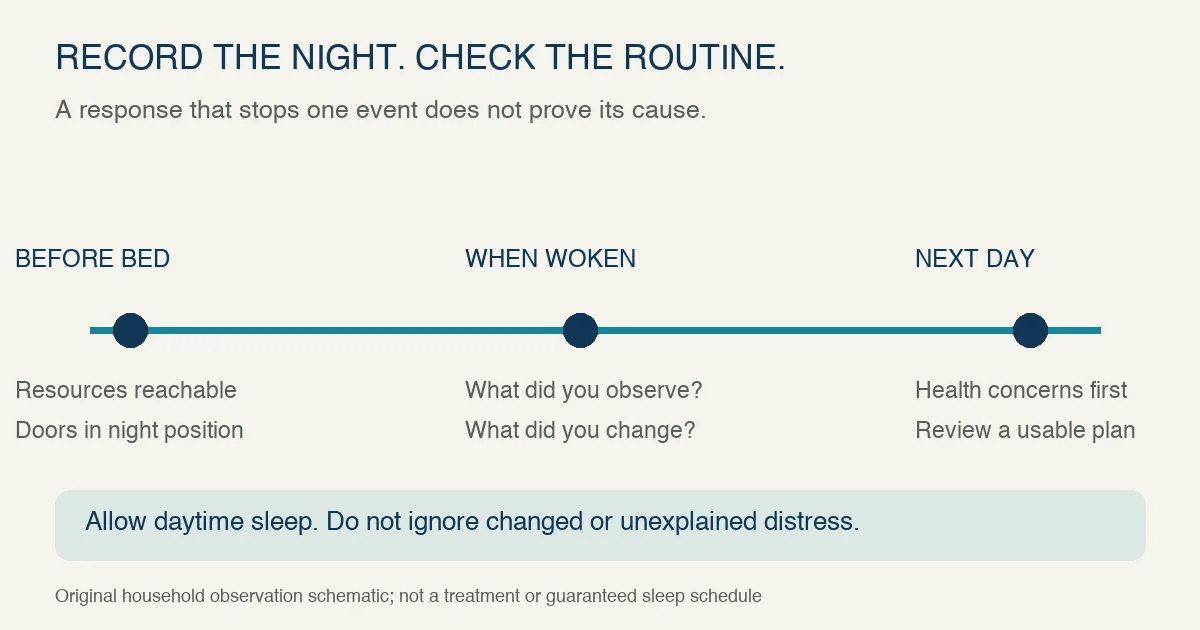
Make a brief note the next morning, without repeatedly waking or pursuing the cat to generate more data. Record the time you woke, what you heard or saw, the cat's location and what happened after you responded. “Meowed at the closed kitchen door, then ate when I opened it” contains more usable information than “being annoying.” It still does not prove that hunger was the only cause.
ASPCA recommends logging the circumstances of vocalizing and what appears to stop it [3]. Keep the observation separate from your interpretation. A person getting out of bed may open a route, provide food and give attention at the same time. If all three changed, you cannot confidently identify which mattered from one event.
Compare nights with the actual household schedule. Was a usual meal missed or delayed? Did a door close off the litter box? Did a guest use the room where the cat normally rests? Did the evening play routine change? Record differences that you can verify, not imagined reasons for a noise you did not witness.
A hypothetical diary shows a cat calling beside a door on nights when one household member closes it. Behind that door is its usual litter box. Checking and restoring resource access is the immediate task; this is not an occasion to train the cat to tolerate losing its toilet. The litter-box guide helps assess reachable arrangements.
Walk the overnight route before bedtime
Check water, usable litter, resting options and routes in the state the home will actually have overnight. Daytime access does not establish overnight access: a door, stair gate or another animal can change it. ASPCA warns against dismissing meowing before basic needs have been checked [3].
If you keep the bedroom separate, ensure the cat has a usable arrangement outside it and that the household agrees on the same setup. Do not move the only litter box behind the newly closed bedroom door. Where cats share a home, check whether one cat waits beside a doorway or prevents another from reaching resources. The multi-cat home guide discusses distributed resources and routes.
Cats Protection recommends keeping cats indoors at night [1]. That recommendation is not a reason to open an exterior door just to stop calling, nor permission to begin outdoor access for an indoor cat. For a cat already accustomed to going outdoors, discuss an indoor transition that provides suitable activity and resources. This page does not certify a curfew cat flap or assume that a device's exit setting guarantees the cat has returned.
A useful bedtime check has a named person and actual actions: confirm the cat's location, check essential resources and preserve appropriate indoor access. “The feeder is on” is not equivalent to knowing that its portion was delivered and this cat could eat it.
Test a feeding arrangement without adding an unplanned ration
If veterinary assessment and observations suggest that meal timing is relevant, review the existing feeding plan before adding a night snack. Cats Protection discusses smaller, more regular meals or a timed feeder as possible arrangements [1]. Those options do not determine the right total intake for an individual cat.
Decide which part of the planned ration will be available at the chosen time, who measures it and how you will check the outcome. Keep any prescribed diet or feeding instructions in place and ask the veterinary team before changing a clinical plan. Do not count food in a puzzle or feeder as separate from the daily ration. The feeding basics guide explains measurement and label limits.
If using a timed feeder, test the actual model while you are awake. Check the compatible food, opening or dispensing process, portion measurement, cleaning restrictions and what happens if the power or connection fails. Confirm the cat uses it comfortably and can reach it without interference. The automatic-feeder guide covers model-specific constraints; it is a purchasing and setup decision, not a guarantee that waking will stop.
For two cats, a successful opening does not establish that both ate their assigned food. Preserve separate access where needed and record uncertainty rather than treat an empty compartment as proof. Stop relying on an arrangement that leaves one cat without its expected food. Do not withhold meals to force acceptance of a device.
Offer activity while allowing daytime sleep
Arrange play and interaction at times you can maintain. Cats Protection recommends daytime play for cats that wake their owners, while its sleep guidance specifically advises against keeping a cat awake through the day to change nighttime activity [1,2]. A cat needs opportunities to rest as well as opportunities to engage.
Choose activity appropriate to the cat's ability and interest; this is not an exercise prescription. Observe voluntary engagement and stop if the cat disengages or seems uncomfortable. The play-and-enrichment guide offers ways to adapt activities. Leave only items appropriate for unsupervised use overnight, using the toy-safety guide to review small parts, cords and supervision requirements.
Do not wake a sleeping cat repeatedly, chase it around the house or escalate play until it is exhausted. A quieter night following that pressure would not establish that the routine was suitable. If movement, tolerance of touch or willingness to play has changed, include that in the veterinary conversation.
Agree on a response that does not ignore unmet needs
First distinguish a known, assessed attention pattern from distress or loss of access. ASPCA's advice about not rewarding attention-seeking is conditional; the same page warns against ignoring other meowing and against punishment [3]. “Ignore every sound until morning” removes those important conditions.
Once health and essential needs have been addressed, agree with the household on predictable opportunities for food and interaction, and ask a qualified professional for help with a persistent attention pattern. Do not shout, hit or spray the cat. A sudden or different episode deserves reassessment even if previous episodes appeared to involve attention.
Review the outcome in practical terms: the cat's resources remained accessible, its planned intake was delivered, opportunities for play and rest were available, and the household can sustain the arrangement. Record both improvements and continuing disruption. Change one manageable part of the routine at a time so that the next discussion is easier to interpret; this is a household observation method, not a clinical trial.
If sleep disruption continues, take the notes to your veterinarian and discuss referral to a qualified cat behavior professional, as Cats Protection advises [1]. The goal is a workable routine with the cat's needs met, rather than a claim that every cat can be made silent on a fixed schedule.