
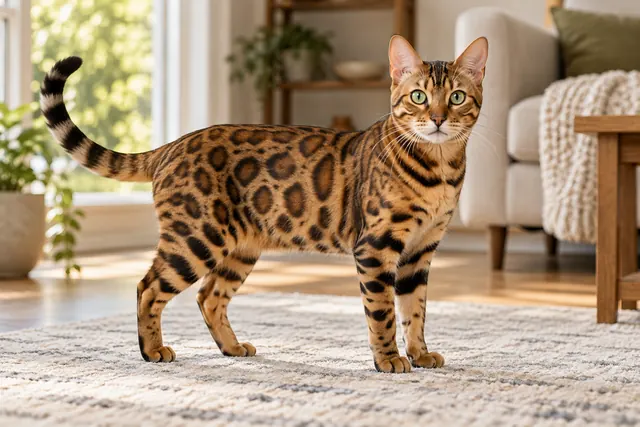
Decide whether you want the daily commitment
TICA describes Bengals as inquisitive, active cats that often enjoy climbing and investigation; their short coat can show spotted or marbled patterns [1]. CFA provides another breed reference [2]. The pattern may attract attention, but the more useful decision is whether your household can support the individual cat's activities and safe access.
Ask about the actual cat's energy, handling, previous environment and behavior around other pets. Do not treat “Bengal” as proof they need a particular toy, will enjoy water or are safe around every animal.
Plan usable activity stations
Choose stable height, a substantial scratching opportunity and interactive play with room to disengage. Check wall fixings, platform capacity and escape routes rather than creating an obstacle course merely for appearance.
Try one activity at a time. If a cat easily obtains food from a puzzle, adapt the challenge in small steps while retaining reliable meal access. If they leave it repeatedly, check difficulty, location and the food used. The objective is voluntary engagement, not forcing exercise or withholding meals.
See play and enrichment for practical trials. Record what worked so a substitute caregiver can offer familiar activities without inventing a new routine.
Review exits before expanding space
Inspect doors, windows and access to hazardous cupboards. Discuss safe installation before adding a secure outdoor enclosure. A cat's interest in exploration does not justify an unprotected balcony or unrestricted access to an unfamiliar area.
In a rental or shared home, confirm what can be installed and how doors will be managed. Plan around the actual household: equipment that cannot remain safely in place is not a sustainable enrichment option.
Understand background and restrictions
Ask for documented pedigree and background if those are part of a purchase. Requirements concerning hybrid ancestry or ownership can vary by jurisdiction. Before moving or buying, verify the relevant local authority and landlord or transport rules for the actual cat; this page does not provide a universal legal clearance.
Do not identify ancestry from a spotted coat or our generated illustration. Request records and have qualified people explain them before making a decision that depends on generation or registration.
Ask specific health questions
TICA identifies heart screening and genetic tests for progressive retinal atrophy and pyruvate kinase deficiency as topics for Bengal breeders [1]. Ask which tests were performed, on which animal, when, and what the results mean for this cat. Have your veterinary team interpret the evidence; screening is not a lifetime guarantee.
Use an individual food plan. A claim that an active breed needs a particular raw or high-protein product is not enough to establish nutritional suitability. Our feeding guide helps you document food and portions for a professional conversation.
A realistic household fit check
Can someone offer regular interaction? Is there safe space for climbing and rest? Can the cat's activity be managed without repeatedly confining another pet? Who will cover care when the usual person is away? Write actual answers rather than a breed enthusiasm score.
For other cats, use gradual introductions. For an energetic cat and a quieter resident, consider separate play sessions and usable routes before shared access.
Questions owners often ask
Do all Bengals love water? No; offer choice and never force exposure. Does a short coat mean easy overall care? Coat maintenance and daily activity are separate commitments. Is a cat wheel required? No universal product requirement follows from a breed label; select safe options the individual actually uses.
Check the coat type and the care plan together
TICA describes both shorthaired and longhaired Bengals. Its grooming guidance distinguishes the relatively light maintenance of a short coat from daily grooming for a long coat [1]. Confirm the actual coat and a demonstrated routine before treating every Bengal as the same maintenance commitment.
Write down how activity, safe height and quiet rest will fit your home. Ask which games the cat uses, whether equipment can be installed securely and who will provide care during absences. If these arrangements cannot be sustained, resolve the practical limitation before committing; a striking coat is not a substitute for a workable household plan.