
Not seeing your cat drink does not tell you their total water intake. Water comes from food as well as drinking, and a shared bowl does not tell you which animal used it. Start with the cat's usual pattern, diet and actual access to fresh water. A sudden change or concern about dehydration belongs with your veterinarian, not a sequence of home experiments.
Cornell advises prompt veterinary contact if you think your cat is dehydrated. It describes possible signs including lethargy, weakness and poor appetite, and explains that both reduced intake and increased losses can matter. [1] Do not wait for a home skin test or a new fountain to confirm the concern.
Separate a missing observation from a new change
A cat eating wet food may drink less from a bowl because some water is already in the food. Cats Protection and Cornell both make this distinction. [1][2] It does not mean every wet-fed cat gets enough water, that an untouched bowl proves dehydration, or that fresh water can be removed.
Write down what has actually changed: drinking more often, spending longer at a bowl, ignoring a familiar water source, eating less, changing food, or producing different litter-box observations. Include when you noticed it and whether other household members saw the same thing. Cats Protection recommends a veterinary check for suddenly drinking more or less than usual. [2]
If you are unsure because you rarely observe drinking, check the arrangement without assuming illness or assuming everything is normal. Is clean water available at all times? Can this cat reach it comfortably? Is the bowl behind a closed door, next to a noisy appliance or guarded by another animal? Those are practical questions you can answer while reporting a concern.
Read food moisture without turning it into a drinking quota
Look at the cat's actual food and feeding pattern. Wet and dry foods contribute different amounts of water, and a change between them may change visible drinking. Cornell's guidance explains that dry-fed cats generally take more of their water by drinking. [1] Do not compare two cats' bowl use without considering their diets.
This page does not prescribe a universal number of cups or milliliters for your cat. A general intake estimate is not a measured bowl target, especially when food, health conditions and losses differ. If the veterinary team wants intake measured, ask exactly what to record and how to account for food moisture and shared sources.
Adding water to food is one option Cornell discusses. [1] Ask about compatibility with the cat's prescribed diet and introduce a change only if the cat continues to eat it. Do not dilute a meal so much that the cat leaves it, or switch foods abruptly just to achieve a water number. Keep actual food consumption visible; our feeding guide and food-change guide help with that record.
Make several usable water options available
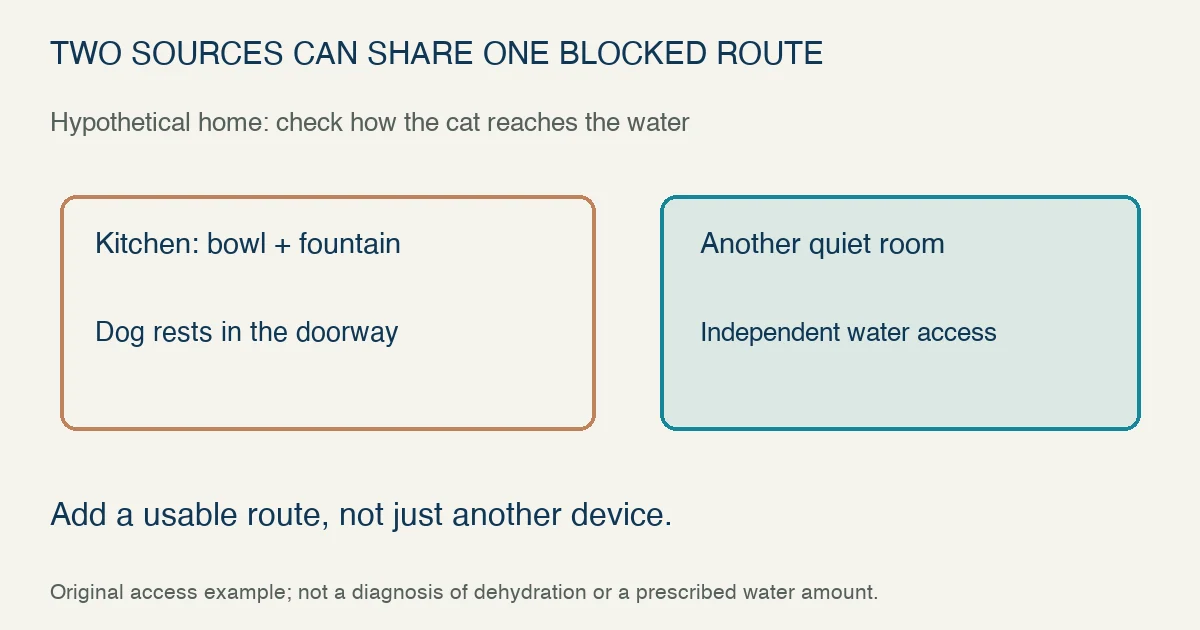
Provide clean, fresh water continuously. Cats Protection suggests water in more than one location and keeping it apart from food and litter trays. [2] Spread options across places the cat already uses, rather than putting several bowls together where one blocked route defeats all of them.
Choose stable, intact containers you can clean. Observe whether the cat can comfortably approach the water surface without an awkward posture or a difficult jump. Cats Protection suggests a wide bowl and describes preferences for different materials and moving water. [2] These are options to try, not proof that one material or bowl shape suits every cat. Keep the familiar working option while adding a different one.
A hypothetical home has a kitchen bowl and a fountain beside it. Both require passing the dog sleeping in the kitchen doorway. A second bowl in a quiet, reachable room creates another route; replacing the kitchen bowl with a more expensive fountain does not. Cornell specifically identifies conflict over water access as a reason a cat may drink less. [1]
For a cat with reduced mobility, bring a stable option into a usable floor-level area and check the whole route. A nearby bowl is not accessible if reaching it involves a slippery surface or a step the cat avoids. The arthritis home-care guide addresses those access questions.
Treat a fountain as an option, not a solution by itself
Cornell says some cats increase intake with fountains but individual preferences vary. [1] If you try one, retain another fresh-water option and observe whether the cat actually uses it. A running motor or falling reservoir level does not identify which cat drank, and a frightened cat should not be forced toward it.
Check the real cleaning instructions, components, water level and operation. Our fountain cleaning guide focuses on the parts and maintenance that a filter does not replace. A fountain that is difficult to keep clean may be less useful than bowls you reliably maintain.
Keep power cords and the water arrangement suitable for the home. Do not move all water onto a counter just because a cat likes a tap, or leave a tap running unattended as the only supply. Cats Protection advises supervising tap drinking and ensuring glass drinking containers cannot be knocked over. [2] A preference still needs a manageable, safe setup.
Record intake honestly when more than one animal drinks
If you measure water offered and remaining, also record spills, top-ups and whether other animals can use it. Water disappearing from a shared bowl is not an individual intake result. Do not assign a precise amount to one cat just because they were seen near it.
Ask the veterinary team whether a temporary individual observation arrangement is useful and how to make it without distress or restricting water. Avoid removing other drinking sources or isolating the cat for long periods to produce a tidy number. Brief factual observations can be more useful than a falsely precise total.
Keep a record of the food, drinking observations, urine changes, medications and other symptoms the team asks about. The vet-visit record guide helps organize that information. Report unknown amounts as unknown.
Avoid substitutions and home treatment
Plain fresh water remains the basic provision. Cats Protection advises against cow's milk and human milk substitutes, and says special cat milk should never replace water. [2] Do not use milk, a human sports drink or an electrolyte mixture as a home response to suspected dehydration.
Cornell discusses flavored water in some circumstances, while Cats Protection emphasizes water. [1][2] This guide does not recommend a generic broth or canned-food liquid: ingredients and the cat's medical diet vary. If your veterinary team suggests an additive, confirm the exact suitable product and preparation and continue offering plain water.
Do not force water into the cat's mouth or start fluid treatment from an internet recipe. If dehydration is suspected, Cornell describes veterinary fluid therapy and investigation of the cause. [1] A home change to bowl placement cannot establish or treat the underlying problem.
Know when setup changes are no longer the task
Contact the veterinary team promptly for suspected dehydration, sudden drinking changes or a cat that seems unwell. Mention vomiting, diarrhea, reduced food intake, medication changes and altered urination rather than reporting drinking alone. Cornell explains that diseases and some medicines can affect water losses or intake; this is a reason for assessment, not a list from which to diagnose your cat. [1]
A skin-tent check is not an all-clear test. Cornell notes that older cats can have reduced skin elasticity even when normally hydrated. [1] Do not repeatedly handle an uncomfortable cat or delay contact because one home observation seems reassuring.
For ordinary maintenance, the useful next step may be adding one genuinely independent water location and recording which cat uses it. For a sudden change, the useful next step is contacting the veterinary team with the actual pattern. Neither requires a product purchase before you act.
This is an AI-assisted practical synthesis, not veterinary-reviewed advice or a hydration treatment plan. The diagram is a hypothetical access example; no fountain, bowl or medical fluid regimen has been tested by PurrAtlas for this page.