
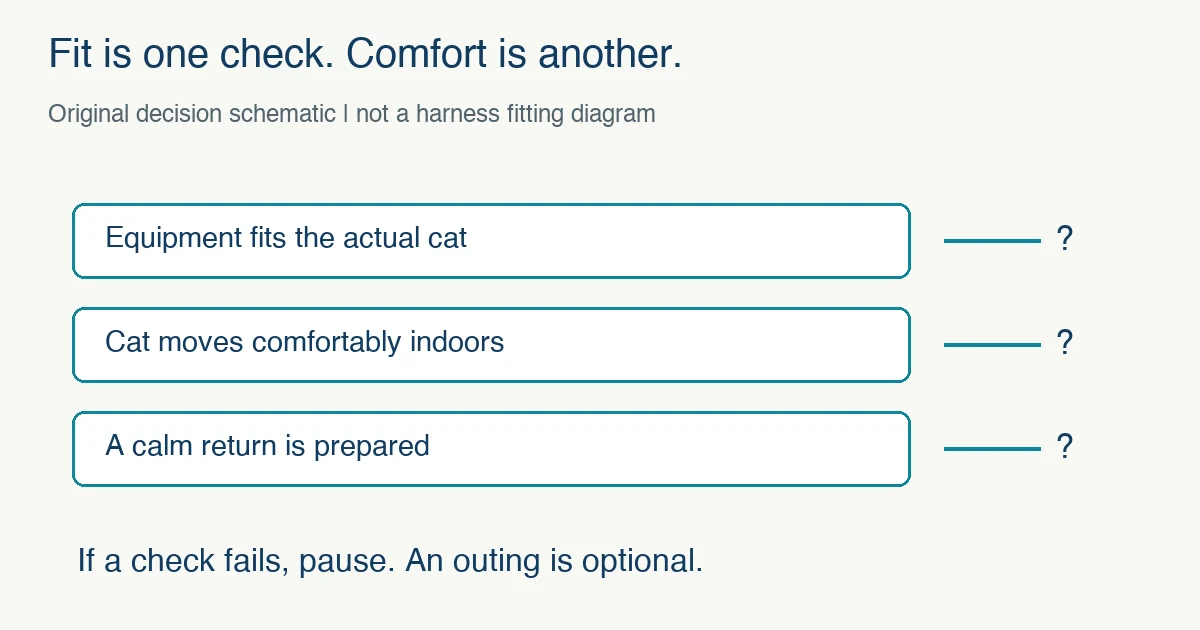
Decide whether this activity suits your cat
Harness training is an optional activity, not a requirement for providing a cat with exercise or enrichment. Being able to fasten a harness does not establish that the cat enjoys wearing it, moving with a lead or exploring outside. Start with the individual cat's comfort and the environment you can provide, rather than a target walking distance.
The sources take different approaches. Cats Protection's January 2024 article generally advises against harness walks because restraint, unfamiliar territory and encounters can be stressful. RSPCA NSW's March 2024 guide describes a positive training approach while acknowledging that not all cats suit it [1][2]. RSPCA Australia's current housing policy permits directly supervised harness outings only where they are safe, accepted by the animal and welfare risks are mitigated [3]. None makes a harness an obligation or a guarantee against escape.
For an indoor cat, improving indoor resources and play opportunities is a valid choice. You can decide against an outing without failing a training programme. If the cat becomes uncomfortable, change or stop the activity rather than trying to complete a route.
Ask your veterinary team about health and mobility considerations before adding an outdoor activity. This page does not prescribe vaccinations, parasite products or treatment. Those decisions depend on the cat, the area and its existing care plan.
Check the actual equipment before putting it on
Use a harness intended for cats, with the lead attached as its instructions specify. Cats Protection and RSPCA NSW both advise against attaching the lead directly to a collar because of escape or injury risks [1][2]. A collar used for identification has a different task from an outing harness.
Read the sizing and fitting instructions for the exact model. Measure where the manufacturer tells you to measure, confirm how adjustments lock and check the fastening and attachment points. An overall size name such as “small” is not a fit measurement. We have not tested models, established a universal finger-gap rule or verified an “escape-proof” claim.
Before each use, look for damage, insecure stitching, worn clips, a damaged lead or an adjustment that no longer stays in place. After fitting, check that the cat can move comfortably as demonstrated by a knowledgeable fitter or your veterinary team. An item that seemed to fit last season still needs checking now.
Plan retrieval and transport before leaving the house. RSPCA NSW advises a carrier for transport and as a secure space if the cat is startled [2]. Select one the cat can use comfortably and practise carrier entry. A loose cat on a lead is not a substitute for secure vehicle transport.
Separate indoor familiarity from accepting the harness
RSPCA NSW recommends letting the cat become familiar with the sight and sounds of the equipment, and using positive reinforcement rather than sudden lead tugs [2]. Present it in a familiar indoor space, without making the cat wear it immediately. A cat approaching the harness is showing familiarity with the object, not consent to every later stage.
Practise only the handling the cat accepts comfortably. If it can calmly tolerate the relevant touch, introduce the harness according to its fitting instructions, initially keeping the task small. Do not tighten equipment to prevent movement or use restraint to force the cat to accept it. If the cat is uncomfortable, Cats Protection advises going back a step [1].
Observe normal movement as well as whether the straps are fastened. Remaining still is not enough evidence of comfort. Can the cat choose to move away within the safe indoor setup, turn and move naturally, and take part without a struggle? If you cannot tell, stop and ask for help rather than treating immobility as a completed lesson.
Remove the equipment after the attended practice. Cats Protection advises against leaving a harness on between walks [1]. Keep the lead and harness out of reach when not in use so they do not become an unsupervised toy or restraint.
Introduce the lead without making the cat follow a route
Only add this part when the cat is comfortable in the correctly fitted harness. Work in the familiar, secure indoor area first. Keep the lead under your control, avoid jerking and allow the cat to choose a small movement rather than pulling it towards you. RSPCA NSW and Cats Protection describe a cat-led activity, unlike a dog walk organised around the person's route [1][2].
A reward can recognise a calmly accepted action, but it should not lure the cat through an experience it finds frightening. If using food, include it in the feeding plan. There is no fixed number of sessions, days or minutes that proves a cat is ready for the next setting.
Use an observation record, not a pass/fail score. A hypothetical note could say: “Harness fitted indoors; cat walked to its usual bed; stopped when the lead was added; lead removed.” That distinguishes equipment fit from acceptance of the lead. It does not establish that the cat is ready for a park or needs firmer handling.
Do not tie the lead to furniture and leave the cat. RSPCA Australia's housing policy opposes tethering companion animals, with a limited exception stated for dogs; it separately describes directly supervised harness activity [3]. Tethering is a different arrangement from holding a lead during an attended session.
Assess a location before considering an outdoor session
Cats Protection identifies a familiar back garden as a preferable starting location and advises avoiding busy areas, roads and places with dogs [1]. RSPCA NSW also recommends a quiet, safe start and checking whether cats are permitted at a proposed destination [2]. A location being legally accessible does not prove that it is suitable for your cat.
Check the actual surroundings before bringing the cat: possible dog access, vehicle routes, noise, escape gaps and places a frightened cat might become inaccessible. Decide how you will end the session and return to a secure carrier or home. If you cannot provide a workable exit, do not start the outing.
Keep identification details current. Cats Protection recommends an up-to-date microchip record in case of escape [1]. A chip is not a live location tracker and does not eliminate the possibility of losing a cat. Check with your veterinary team or registry how the actual chip is registered rather than assuming that implantation automatically provides current contact details.
Outdoor risks and animal-access rules vary by location. Australian examples in RSPCA NSW's guide are not presented here as US law. Check the rules of the actual property or destination, and agree the cat's preventive health plan with the veterinary team. Do not copy a routine from another country's article as if it were universal.
Stop while you can still end the session calmly
Stay present, keep the lead slack where safe and follow the cat's choices within the prepared area. RSPCA NSW advises avoiding sudden tugs and taking a break when the cat seems stressed; Cats Protection advises returning home when the cat becomes uncomfortable or wants to get away [1][2]. A brief, calmly ended exploration is more useful than achieving a distance goal.
If a new sound, person or animal makes the setting unsuitable, end the activity using the prepared return arrangement. Do not continue simply because the cat wore the harness successfully indoors. Comfort in one room is not proof of comfort in a different environment.
Review what happened before repeating: was the equipment comfortable, did the cat choose to explore, could you maintain safe control without pulling, and was the exit workable? An outing that repeatedly requires force is a reason to choose another activity and seek qualified help, not a reason to upgrade to stronger restraint.
If the cat escapes, use the lost-cat action guide rather than assuming it will retrace a walking route. For future enrichment, you can return to indoor play or investigate a properly designed contained area. Successful care means meeting the cat's needs; it does not require converting it into a dog-walking companion.