
Plan the journey around a contained cat
For a necessary car journey, use a sound cat carrier secured against movement, keep the cat contained while driving, and arrange stops and arrival before leaving. A journey is not ready just because the carrier fits on the seat. You also need a way to maintain a suitable temperature and meet the cat's needs without opening its escape route beside traffic.
First decide whether the cat needs to come. Cats Protection explains that travel and unfamiliar surroundings can be stressful and advises considering the destination and care arrangements [1]. For an optional holiday, compare staying home with a cat sitter or boarding. For a necessary move or veterinary appointment, focus on making that required journey manageable rather than expecting the cat to enjoy it.
This guide covers road journeys. It does not establish airline acceptance, legal entry requirements or crash-test performance of a carrier.
Resolve the cat's health and care requirements before booking
Ask your veterinary team whether your cat is fit for the intended journey, particularly if it is unwell, has previously vomited or become very distressed in the car, or needs timed medication. Blue Cross recommends addressing health and difficult travel with a veterinarian in advance [2]. Describe the actual journey: anticipated duration, overnight accommodation, current feeding and medication routine, and previous reactions.
Get individual instructions about meals, water, medication and what to do if a dose is missed or vomited. Do not apply an internet fasting schedule to every cat or borrow another animal's sedative. Record the clinic's advice and emergency contact in the travel notes. The vet-visit preparation guide helps assemble relevant observations without turning them into a diagnosis.
Keep a reachable veterinary contact near the destination as well as your usual clinic. Check accommodation directly for acceptance of cats; a general pet-friendly label may leave practical questions unanswered. Ask whether the room can remain closed and whether cleaners or other guests will enter.
Check the actual carrier and its position in the vehicle
Inspect the latches, doors, shell, handles and ventilation openings. Follow the instructions for the exact carrier and vehicle when positioning and securing it. A carrying handle is not automatically a restraint attachment. Blue Cross advises a robust carrier secured against movement and warns against transporting a cat loose or in the boot [2]. A belt around an unspecified bag does not establish crash protection.
Do a stationary setup check before loading the cat: can the carrier shift, tip or have its door pressed open? Are vents blocked by bags? Can a passenger observe it without interfering with the driver? Repack the luggage if it crowds the carrier. If the instructions do not explain a suitable arrangement, obtain clarification or choose a different carrier; do not improvise a claim that it is safe.
The carrier selection guide separates measurements and handling features from unverified safety claims. For a cat that struggles to enter, work on carrier familiarity before the departure day.
Rehearse the parts that are unfamiliar
Being comfortable inside a carrier at home does not prove comfort with lifting, engine noise or movement. RSPCA Australia describes gradual exposure to carrying, travel noises and short car trips, progressing according to the animal's response [3]. Use that distinction to find the difficult part rather than repeat a long drive hoping the cat will get used to it.
For an optional trip, begin with a manageable rehearsal and note what changed at each transition. If the cat is distressed by lifting, a longer engine session adds another challenge before the first is resolved. Reduce the challenge and discuss persistent difficulty with your veterinary team. Preparation should not delay urgent veterinary care.
A quiet cat is not automatically a relaxed cat. Record observable behavior, such as whether it settles, repeatedly tries to escape or becomes unwell. Avoid claiming a fixed number of practice trips will make any cat travel-ready.
Design stops before you need them
Long journeys require arrangements for food, water and toileting as well as containment [2]. Decide where these can actually happen. A roadside parking space is not a secure room, and a cat normally comfortable on a harness can still be startled in unfamiliar surroundings.
Do not open the carrier beside a road to offer a casual walk. Identify an enclosed, cat-appropriate place for any necessary transfer or overnight care. Bring familiar food, water, bowls, litter provisions, replacement bedding and waste bags suited to the plan. If a larger containment setup is being considered, check how the cat will transfer into it without access to an open door and whether it can itself be secured for travel. Extra space alone does not solve either problem.
Never leave the cat alone in the car. AVMA warns that parked vehicles can reach dangerous temperatures even in shade or with windows partly open [4]. A shopping or meal stop that requires everyone to leave the vehicle therefore needs a different arrangement. A phone alert or the dashboard temperature does not replace a workable care plan.
Think through a delay or vehicle failure too: whom will you call, where can the contained cat go, and how will you reach veterinary help? If excessive panting, drooling, unsteadiness, abnormal gum or tongue color, or collapse occurs, seek emergency veterinary care [4]. Do not finish the planned drive before responding.
Secure the destination before opening the carrier
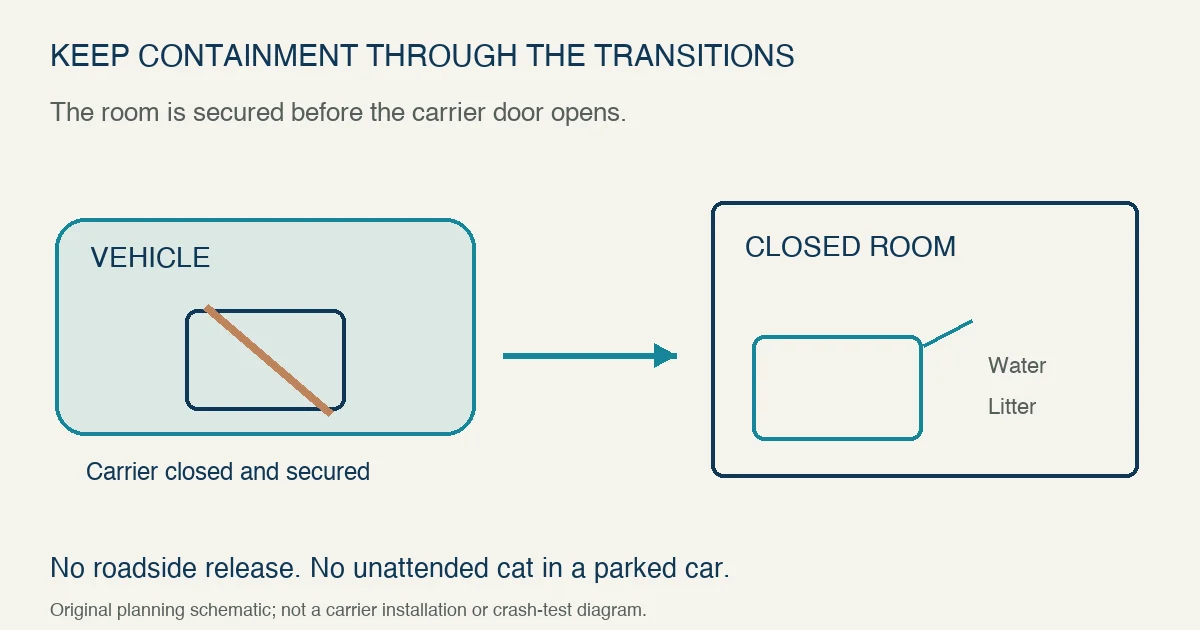
On arrival, carry the closed carrier into the prepared room before opening it. Check windows, exterior doors and access to other animals; tell the other occupants which door must remain closed. Blue Cross's relocation advice supports preparing a secure initial area with familiar resources before release [2]. The moving-house guide covers the wider settling process.
Put water, appropriate food, a litter tray and a resting or hiding option where the cat can reach them. Allow it to leave the carrier at its own pace rather than pulling it out to greet people. Avoid unpacking with the room door repeatedly open while the cat is loose.
After the journey, note eating, drinking, toileting and any vomiting or unusual behavior. Pass concerns to the veterinary team with the travel details. Keep microchip contact information current before departure; identification is a backup if containment fails, not a reason to relax it.
A departure note that another person can use
Write down the carrier's securing instructions, the cat's individualized care schedule, planned stops, destination room and veterinary contacts. Add a clear division of responsibilities: who drives, who observes the cat, and who confirms the room is closed before release. For a solo journey, plan around tasks you can perform while safely stopped.
If the plan depends on leaving the cat unattended, opening the carrier in an unsecured place or assuming an untested restraint will work, resolve that part before travelling. The useful result is a journey with workable transitions—not a longer packing list.