
New vision changes need veterinary advice first
If your cat has suddenly started bumping into furniture, cannot find familiar bowls or has changed-looking eyes, contact your veterinary team as soon as you notice the change. If an eye appears painful—for example, the cat keeps it closed or resists touch around the face—contact the vet immediately [1][2]. Do not wait to see whether rearranging the room makes the problem disappear.
Blindness has different causes, and some may be treatable if addressed early. An examination may involve the eyes, blood pressure and further investigations; appearance alone does not identify the cause [1]. A cloudy eye is not a diagnosis of a cataract, and a cat navigating well does not prove its vision is normal.
Tell the clinic when you first noticed the change, whether it appeared suddenly or gradually, and what the cat actually did. Describe bumping, missed jumps, difficulty finding resources, eye appearance and any apparent pain. Use the vet visit record to organize observations, not to decide which disease is present. Ask the clinic how urgently to attend and follow its instructions.
The home adjustments below are for a cat whose vision loss is being assessed or has been established by a vet. They support everyday access; they do not treat an eye problem or replace follow-up care.
Preserve routes the cat already knows
A cat losing vision gradually may adapt using familiar routes, hearing, smell and whiskers. Sudden loss can be much more disorientating [1]. Start by protecting the existing layout rather than buying accessories or making a complete room makeover.
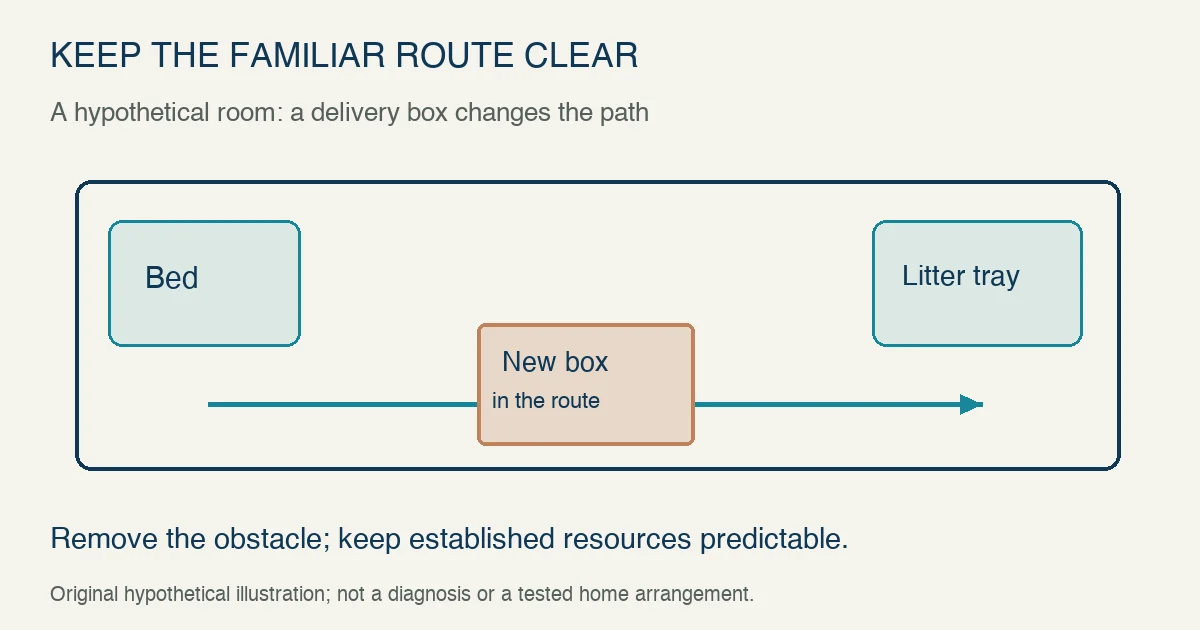
Keep food, water, litter trays, beds and furniture in predictable places [1][3]. Walk the route between the cat's usual resting place and those resources. Remove a shopping bag, laundry basket, vacuum cable or chair left in the route. These temporary obstacles matter even when the main furniture has not moved.
Consider an illustrative household where the cat normally follows a wall from its bed to a litter tray. A delivery box now blocks that route. Removing the box restores a familiar path; moving the tray to a different room creates another task for the cat to learn. This is a hypothetical planning example, not a report of a tested intervention.
If a change is unavoidable, introduce the new arrangement carefully and help the cat locate it. PDSA advises guiding the cat around a changed layout, and Cats Protection suggests using your voice to guide a disorientated cat back to a familiar space [1][3]. Avoid repeatedly carrying it between rooms as a substitute for learning its route.
Review falls, heat and escape routes at cat level
Do not lift a blind cat onto a raised surface and assume it can find a safe way down. Cats Protection specifically warns about falls after placing a blind cat high up [3]. Review beds, shelves, stair approaches and furniture the cat can reach. PDSA advises preventing access to raised places where the cat could become stuck or fall [1]. Discuss suitable access with the vet if the cat also has movement difficulties.
Cats Protection recommends temporarily blocking stairs until the cat knows their location and learns to use them [3]. Check the actual barrier and surrounding gaps: a product described as a child's stair gate is not automatically a suitable cat barrier. Keep a dangerous route inaccessible while the arrangement is uncertain, and preserve access to essential resources on the usable side.
Review sharp corners, trailing wires, fireplaces and other hot surfaces too [1]. Do this during ordinary household activities, not only when the room is tidy. An oven door opened during cooking or equipment left on the floor can change the route.
Both PDSA and Cats Protection recommend indoor living for blind cats, with any outdoor access contained appropriately [1][3]. Review the home's doors and windows using the opening safety guide. Supervision does not make an open balcony safe. If considering an enclosed outdoor area, assess its boundary and return route using the catio planning guide; do not assume an enclosure bought for another cat meets this cat's needs.
Announce touch and allow independent movement
Speak before touching or picking up the cat so it knows you are nearby [1][3]. Approach calmly and watch its response. Make this an instruction for visitors and carers as well, rather than something only its main caregiver remembers.
Encourage the cat to move around on its own where the route is safe. Cats Protection advises avoiding unnecessary carrying, explaining that walking helps retain familiar scent information [3]. Necessary handling for care is different from repeatedly relocating the cat because its movement looks cautious.
Do not interpret a startled reaction as the cat becoming unfriendly. Record what preceded it: a silent approach, unexpected touch, a changed route or another animal nearby. If behavior or comfort changes, discuss it with the veterinary team instead of assuming blindness explains every new problem.
Adapt play to cues the cat can find
Vision loss does not remove the need for activity and choice. PDSA suggests adapting games to hearing and smell; Cats Protection includes toys and puzzle feeders as indoor enrichment [1][3]. Choose an accessible, uncluttered place where the cat can locate the activity and retreat.
Try a suitable sound-making toy or an easy food-search activity, observing whether the cat can follow it without becoming distressed. Check the toy itself using the safe toy selection guide. Sound is a way to locate a toy, not proof that its parts, string or battery compartment are suitable.
A food puzzle should be introduced at a level the cat can actually use; see the food puzzle guide. Account for food used in play within its existing feeding plan. Do not make eating depend on solving an unfamiliar puzzle or assume a specific scent product is required for blind cats.
Give carers a usable map and report changes
Write down the established locations of bowls, litter trays and resting places, the routes that must remain clear, and which stairs or openings are closed. Explain how to announce an approach and where the cat can return if unsettled. Include the actual veterinary care instructions and contact details in the sitter handover.
Describe observations rather than rate success by how quickly the cat moves. Can it locate food and water, reach a tray, rest comfortably and engage in an activity it chooses? Has a previously manageable route become difficult? PDSA emphasizes that outlook depends on the cause, other health problems and how the individual cat copes [1]. There is no universal adjustment deadline or lifespan promise.
If the cat is struggling, keep essential access predictable and contact the veterinary team to review comfort, underlying health and the home arrangement. Do not decide that a cat is fine solely because many blind cats adapt well, or that blindness alone determines its quality of life.