
First establish whether the cat can pass urine
If your cat is repeatedly trying to urinate but cannot pass urine, call your veterinarian immediately. PDSA describes inability to urinate as a life-threatening emergency and advises against waiting or attempting home treatment [1]. Tell the clinic what you have seen, including straining, painful vocalizing, vomiting or collapse. Do not postpone that call to buy litter, clean the room or collect a sample.
Passing a little urine while struggling is not reassurance that the problem is harmless: PDSA still advises veterinary contact [1]. If you cannot tell whether this cat is passing urine, explain that uncertainty. A used tray in a multi-cat home does not establish that the affected cat has urinated.
For a new pattern of peeing outside the box, arrange veterinary assessment even if the cat otherwise appears well. Cornell notes that a cat with a medical cause may not look ill [2]. A visible environmental change can also matter, but does not rule out a medical problem. This page helps you record the event and review household access; it does not identify a disease or prescribe a urinary treatment.
Describe the event without assigning blame
Record the location, surface, approximate time and what you actually saw the cat do. A puddle found later is evidence of a soiled location, not a complete account of the event. Avoid labelling it revenge, deliberate disobedience or proof that the cat has rejected its box.
Cornell describes urine spraying as commonly involving a standing cat with an upright, quivering tail and urine deposited on an upright surface, contrasting with squatting to urinate [2]. Report posture and direction if you witnessed them. Those clues help the veterinary or behavior discussion; a mark on a wall alone is not a diagnosis, and marking does not exempt a cat from a health assessment.
For several cats, write down which animal you saw and leave the identity unknown when you did not see it. An ordinary recording device may help observe a known area without chasing a cat, but it is not a medical monitor. Keep household privacy in mind, and do not make urgent care depend on obtaining a clip. This guide does not recommend dyes, substances added to food or other home experiments to identify the animal.
Useful notes can remain short:
- Where the urine was found, and when the area was last known to be clean.
- Whether you observed a specific cat, its posture, an attempt to urinate and visible output.
- Recent changes to litter, trays, doors, routines, animals or furniture.
- Any changed drinking, eating, movement or apparent discomfort.
Keep the actual observation separate from what you think caused it. The vet-visit record guide explains how to organise existing facts. Ask the clinic whether it wants a sample and how to collect and store it; Cats Protection recommends getting collection instructions and suitable containers from the veterinary practice [3].
Recheck the toilet route in the conditions the cat uses it
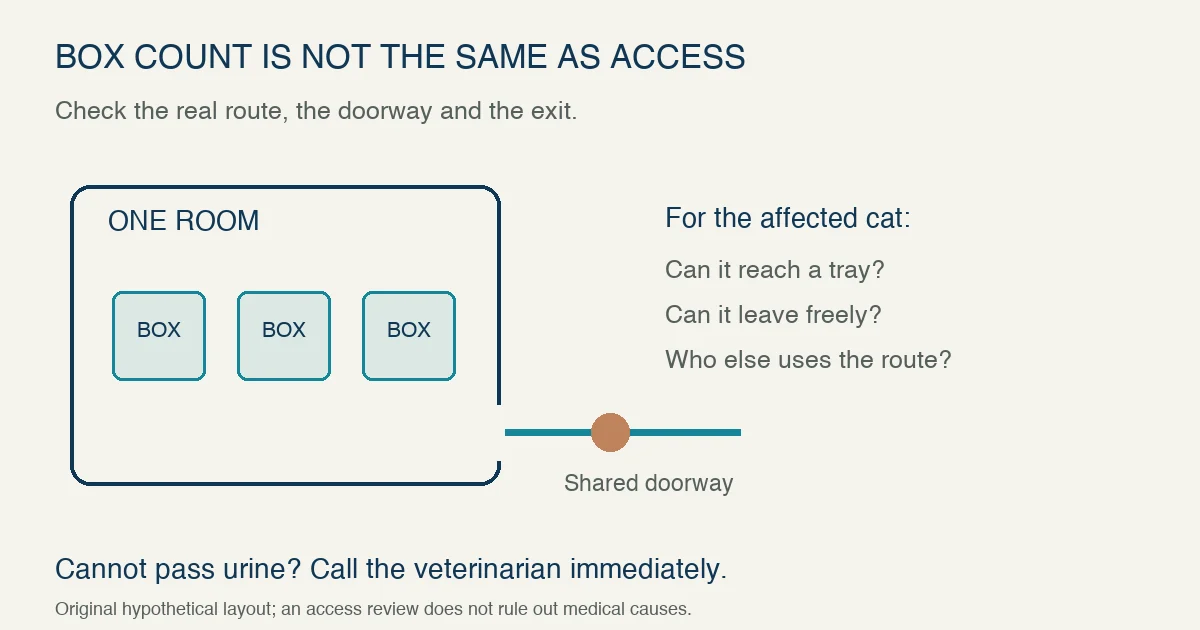
Inspect the path from the cat's usual resting area to each tray. Do not stop at counting boxes. Is a door closed at night? Is the tray reached by stairs the cat now hesitates to climb? Does another animal wait at the entry or exit? Cat Friendly Homes explains how blocked access and being cornered can contribute to house-soiling [4].
Walk the route at the time associated with the event. A utility-room tray may be quiet at midday and beside a noisy appliance in the evening. A box behind furniture may be physically reachable but leave the cat with one easily blocked exit. Record the setup before moving everything, so that the veterinary team can understand the change you made.
For a hypothetical two-cat home, three boxes are all in one utility room, reached through one hallway. One cat regularly waits in that hallway. The useful question is whether the other cat has an independent toilet option, not whether three is a reassuring number. The multi-cat home guide discusses distributed resources and routes.
The litter-box care guide covers dimensions, entry and cleaning, and the box-choice guide helps compare actual usable space. Do not buy a covered, automatic or high-sided box as though its product category establishes a solution. Follow the individual cat's access needs and any instructions from its clinical or behavior assessment.
Preserve a working option while reviewing preferences
List what changed before the problem started: a different litter texture or fragrance, a new liner, a relocated tray, a new cleaning product or loss of a familiar entry. Cats Protection notes that location, cleanliness and litter preferences can matter [3]. A timeline is useful, but coincidence alone does not prove the change caused the problem.
Avoid replacing every tray and litter simultaneously while trying to learn what the cat uses. Preserve a familiar usable option where practical and introduce a manageable alternative with professional guidance. The litter-change guide explains gradual transition and why an immediate forced switch makes acceptance harder to assess.
If the cat repeatedly toilets in a new location, Cat Friendly Homes describes adding a box there as one possible option [4]. First check whether the site is suitable and whether the cat can safely reach and leave it. A box placed where it blocks a household passage or exposes the cat to another animal needs a different arrangement. Moving the only reliable box away immediately can remove the working option you hoped to build on.
Do not place the cat in a tray and keep it there to demonstrate the expected behavior. Cat Friendly Homes identifies negative experiences near the box as a possible factor and advises against punishment [4]. Toileting arrangements should support voluntary access, rather than become another reason to avoid the area.
Clean the affected material without creating a new hazard
Clean promptly, but make a brief note of the site first if doing so will not delay care. Cats Protection describes absorbing urine before cleaning [3]. Keep the cat away from the cleaning work, preserve another usable route and follow the cleaner's instructions for the actual surface.
Check what material was affected: washable bedding, upholstery, flooring, an underlay or an adjacent baseboard may need different treatment. A stain on the surface does not show how far liquid travelled. Cat Friendly Homes recommends a urine odor and stain remover appropriate to the surface and an inconspicuous test, while advising against ammonia-based cleaners [4]. This is not an endorsement of a particular brand or a guarantee that one application removes every trace.
Follow the product's amount, contact, removal and drying instructions, together with the material manufacturer's restrictions. Do not mix cleaners, soak an electrical device or cover a damp area with bedding and call the job finished. If contamination extends into material you cannot clean adequately, seek appropriate cleaning or replacement advice.
This page does not reproduce a universal homemade chemical recipe, recommend deterrent shock mats or advise spraying the cat with water. Removing an odor, treating an infection and resolving a blocked toilet route are different tasks. A freshly cleaned carpet cannot demonstrate that the underlying cause has been addressed.
Review recurrence with the veterinary team
Keep the agreed plan and record whether the cat uses the available trays, where any new event occurs and what else changed. Do not stop monitoring the cat's condition because one environmental adjustment appears to help. Recurrence, changed output or discomfort needs discussion; urgent inability to pass urine needs the immediate call described above [1].
Ask the veterinary team what to do next if examination or treatment has not resolved the problem. Cats Protection describes referral to a qualified cat behaviorist when appropriate [3]. Bring the household layout and observations, including uncertainties, rather than only a list of products already purchased.
The useful outcome is a cat whose medical needs are addressed and whose toileting options are accessible and acceptable, with a household that can maintain them. Do not promise that a new litter, diffuser or cleaner will end every case, or interpret a setback as the cat refusing to cooperate.