
Give the cat a usable alternative at the scratched spot
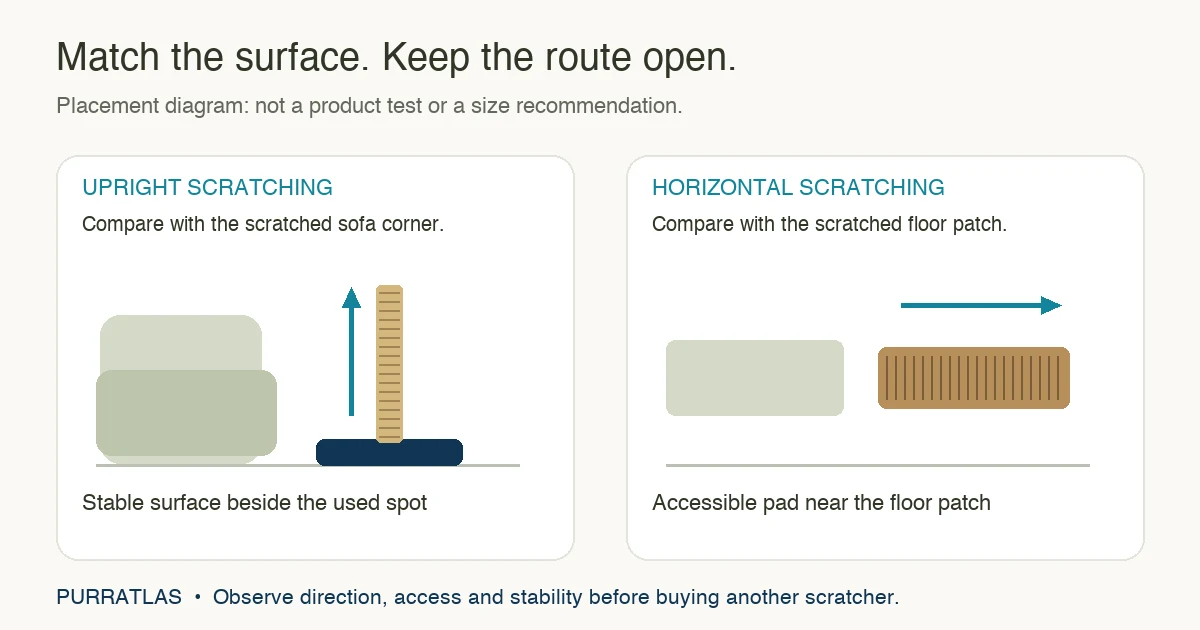
The aim is to redirect scratching, not remove it. Begin at the sofa corner, carpet patch or other place the cat actually uses. Put a stable alternative nearby and match the observed direction: upright scratching needs an upright surface; floor scratching needs an accessible horizontal one. Cats Protection recommends a firm base, room for a full stretch and a pad for cats who scratch horizontally [1].
A scratcher in a spare room does not answer the same problem as an appealing sofa beside the cat's usual route. Before buying another one, compare the location, usable surface and stability of the one you have. Protect the furniture while leaving an acceptable scratching outlet available. Do not expect a single placement change to establish a permanent preference.
Read the scratch marks before changing the setup
Make a small record from observations rather than assigning a motive. The ASPCA describes variation in preferred materials and orientations, recommends sturdy surfaces, and advises against forcing a cat's paws onto a post [2]. Translate that into questions you can actually answer:
| What you observed | What to check at the alternative | What the observation does not prove |
|---|---|---|
| Claw marks running down a sofa corner | Is there a secure upright surface beside that corner, with enough usable height? | It does not establish that every vertical post will be accepted. |
| Scratching a flat carpet patch | Is a horizontal pad accessible there rather than hidden under furniture? | A horizontal preference does not tell you which material will work. |
| Cat approaches a post, which shifts when touched | Check the base and assembly against the manufacturer's instructions before offering it again. | An unused moving post is not proof that the cat dislikes scratching posts. |
| One cat waits while another occupies the approach | Map the routes and offer separate access points. | Waiting alone does not diagnose aggression or identify which cat caused damage. |
Write down the object, exact spot, direction, cat identity if observed, and what happened immediately beforehand. If nobody saw the scratching, record “identity unknown.” A photograph of old damage cannot tell you who did it or when.
Work through an existing scratcher that is being ignored
Illustrative sofa case: a cat scratches the outside corner of a sofa after getting up. The household already owns a tall post, but it stands behind a partly closed office door. Buying a taller version would leave the access problem unchanged.
First note the actual sofa corner and the available floor space. Check the existing post for safe assembly and stability. Offer it next to the scratched area if it fits without obstructing the route. Keep a record of voluntary use and new furniture damage. If the post is used there, you have evidence that this arrangement was usable on those occasions; you have not proved which single feature caused the change.
Illustrative carpet case: an upright post is ignored while a flat carpet edge is repeatedly scratched. Try an accessible horizontal alternative near the observed spot rather than treating an upright post as the only acceptable shape. Compare what the cat uses, not the product's marketing claim.
These are invented household examples, not customer tests. They show how to separate an access question from a surface question. If you change location, material and shape together, note all three; do not later describe the result as a controlled test of material alone.
Protect the furniture without frightening the cat
Cats Protection suggests covering the damaged area and providing the nearby scratching alternative; once that alternative is being used, its position can be changed gradually [1]. Choose a cover compatible with the furniture and follow its instructions. Check any loose or damaged protection rather than leaving it in place unattended indefinitely.
Never hold the cat at the scratcher or drag its paws along the surface. Keep a familiar usable scratcher when it becomes worn instead of replacing it solely for appearance; the ASPCA cautions against discarding a favorite simply because it looks untidy [2]. Inspect it for structural damage separately from cosmetic wear.
Do not spray water, shout or clap to startle the cat. Cats Protection's behaviour guidance advises against punishment because it can increase stress [3]. Some published advice, including the ASPCA scratching page, mentions startling as a last resort. This guide does not use that approach: an environmental trial should not depend on making the cat afraid of the person conducting it.
Check whether the wider environment needs attention
Scratching around entrances or windows may require looking beyond the scratcher. Cats Protection discusses communication and insecurity as possible reasons and recommends addressing the underlying worry rather than only adding a surface [1]. The location of a mark is a starting observation, not a diagnosis of stress.
For several cats, review separate routes and resources. Consider which cat can reach each outlet without passing another cat's resting place. A single shared item may be available on paper but difficult to approach in practice. Use the home resource checklist for a broader resource review; it does not diagnose behaviour or certify an arrangement.
If scratching changes abruptly or is accompanied by other unusual behaviour, contact your veterinary team. Cats Protection recommends veterinary advice for behaviour that is out of character before treating it solely as a household training problem [3]. Ask for qualified behaviour support when environmental changes have not addressed the concern.
Keep a record that helps you decide the next adjustment
Use your own notes with one line for each observed event: date, cat or “unknown,” surface, location, alternative offered, voluntary use, and any furniture damage seen. Compare new observations with your starting record. Existing marks do not disappear when scratching changes, so distinguish old damage from damage you actually saw appear.
Keep the conclusion narrow. “The horizontal pad was used twice beside the carpet” is useful. “This brand stops all scratching” is not supported. If you move an accepted outlet, record the new position and whether it remains accessible. There is no fixed number of days in this guide that guarantees success.
Your next action is to check one actual scratched spot, offer a safe accessible alternative, and observe its use. For general enrichment rather than furniture scratching, continue to play and enrichment. This page does not provide a product ranking or claim that scratcher purchases alone solve every behavioural concern.