
Start with the change, not with getting the cat out
A cat using its familiar covered bed is different from a cat that has suddenly stopped joining its usual routines. Cats Protection describes hiding as normal behavior in some situations, but recommends a veterinary check when a cat hides more than usual [1]. Your first task is to establish what changed and whether the cat can still meet its needs, not to make it appear in the room for reassurance.
If the cat is struggling to breathe, breathing through an open mouth or has collapsed, contact your veterinarian immediately. PDSA treats these as urgent signs and advises keeping the cat calm during transport [4]. Tell the clinic where the cat is and whether it is difficult to reach. Do not keep trying toys, food or a new hiding bed before making that call.
For other changed behavior, contact your veterinary team and describe what you actually know. Hiding alone cannot establish fear, pain or a particular illness. Cats Protection identifies increased withdrawal, changed eating or drinking and movement changes among possible signs of pain [3]. A familiar trigger such as visitors may be relevant, but its presence does not rule out a health problem.
This guide helps you protect a usable refuge and prepare observations for a conversation. It does not diagnose the cat or prescribe a waiting period. A newly arrived cat may need time to settle; uncertainty about its eating, drinking or toileting still needs veterinary advice [1].
Check essentials without surrounding the hiding place
Locate the cat calmly and confirm that the hiding place is accessible and free of an immediate hazard. Keep household members informed before closing a cupboard, disposing of a box or operating equipment near a place the cat may be using. If you cannot locate the cat, do not label it “hiding” as though its location is known. The missing-cat guide covers a different task: finding a cat whose whereabouts are uncertain.
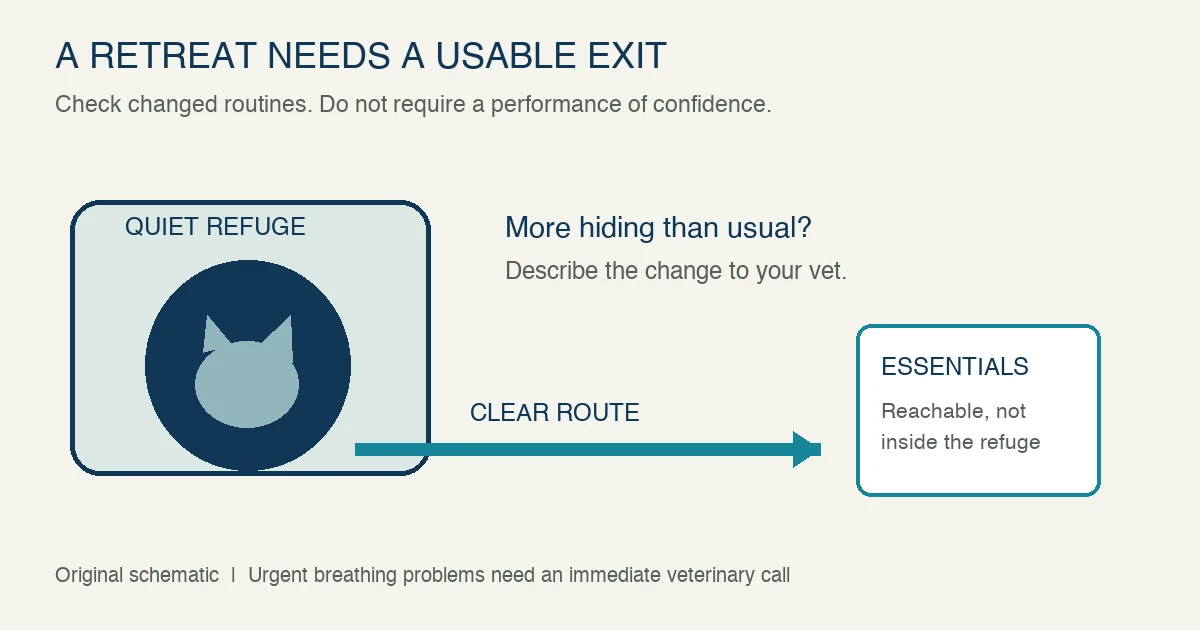
Review the route from the refuge to food, water and litter. Cats Protection recommends nearby access for a new hiding cat, but keeping these resources out of the hiding place itself [1]. Putting a bowl deep behind a sofa can make checking it harder and crowd the retreat. Provide resources in an accessible quiet area, rather than require the cat to cross a busy doorway or approach a person waiting to pick it up.
Write down what you can and cannot attribute to this cat. In a two-cat home, an empty bowl or a used litter box does not identify which cat ate or toileted. Use the existing separate-feeding guide for arranging observable access. Avoid a new separation arrangement that prevents the hiding cat from reaching its own resources.
| Observation you can report | What remains uncertain |
|---|---|
| You saw this cat eat part of its usual food at a recorded time. | One observed meal does not rule out illness or prove its total intake is unchanged. |
| Food disappeared while more than one cat could reach the bowl. | Which cat ate it and how much this cat consumed. |
| You saw the cat leave the refuge, but did not see it drink or use the box. | Whether those activities happened unobserved. Record that uncertainty. |
These are recording examples, not a scoring system. If the cat's routine has changed or you are worried about its basic needs, give the veterinary team the observations and gaps. Do not delay seeking advice until you have completed every line of a diary. The vet-visit record guide can help you assemble existing facts without guessing missing details.
Make the refuge usable, rather than remove the option to hide
Check the refuge as a physical place: can the cat enter and leave, rest without being disturbed and avoid a person or another animal waiting at the exit? A covered place in a busy walkway may look secluded from above while still expose the cat to constant approach. Cats Protection recommends quiet covered options and separate retreats where cats share a home [1].
Offer an alternative if the chosen location is difficult to monitor or unsafe, without forcing the cat straight into the new option. A stable covered bed or suitable box in a quieter position can be available alongside a familiar safe refuge. Check the opening and the cat's ability to use it. A high location is only useful if this cat can reach and leave it comfortably; a changed willingness to jump is also information for the veterinarian [3].
A hypothetical household notices that a cat leaves its box when the room is empty but retreats whenever someone stands beside the opening. The practical change is to stop waiting at the exit and preserve the route to its resources. This observation does not prove the cat is medically well or identify why the pattern began.
Do not block a safe hiding place merely to make the cat more sociable. If a refuge contains a genuine hazard or the cat must be moved for urgent care, explain the specific situation to the veterinary team and ask how to proceed safely. Respecting a retreat does not mean ignoring a cat that needs help.
Agree on what people will do when the cat retreats
Ask visitors and household members to leave the cat undisturbed in its refuge. Cats Protection's shy-cat guidance advises against forcing interaction and recommends letting the cat approach [2]. An invitation to interact should leave the cat able to decline; surrounding it with people or repeatedly reaching into its refuge changes that choice.
Choose a calm routine that household members can follow consistently. If you sit nearby, leave the exit open and avoid turning each appearance into an attempt to touch or lift the cat. A voluntary approach does not obligate the cat to remain for stroking. Stop when the cat withdraws rather than follow it back into the hiding place. Children need an adult to manage this arrangement; the children-and-cats guide explains protected retreats and supervision.
Look for an actual change in the household: unfamiliar visitors, building work, a different daily schedule or access by another cat. Record when it began and what you can reasonably change. One household member turning the room quiet cannot compensate for another repeatedly disturbing the refuge. If there is an obvious temporary trigger, protect the cat's resources and undisturbed retreat during it. Persistent or changed hiding still belongs in the veterinary discussion [1,2].
Avoid treating a diffuser, toy or treat as a diagnostic test. A cat responding to an item does not prove that pain or illness is absent. Do not withhold its normal food to make it come out, or use a frightening sound to drive it toward people. Those actions replace the task of understanding access and changes with pressure to produce a visible response.
Review progress as function, not compulsory sociability
Useful progress is that the cat can reach its resources, use an undisturbed refuge and choose interactions without losing its exit. It does not have to greet every visitor or sleep in the open to satisfy a household's expectations. Cats Protection recommends patience and predictable routines for shy cats [2]; this is not a guarantee about how quickly an individual will change.
Keep a short record of observed eating, drinking, toileting, movement and the times the cat uses different areas. Distinguish “not seen” from “did not happen.” If it is newly adopted, ask the adoption organisation about its previous routine and known preferences. That history may improve the setup, but should not be used to explain away new health concerns.
Follow the veterinary team's advice about examination and follow-up. If medical causes have been assessed and a behavior problem remains, Cats Protection recommends qualified behavioral help through a veterinary referral [1,2]. Take the household observations to that conversation: the place used, available routes, other animals' access and the situations in which the cat retreats. A workable plan addresses those details rather than simply demand that the cat hide less.