
Hearing changes deserve an examination, not a louder test
A cat that does not respond to its name may have a hearing problem, but that observation alone cannot establish deafness. Cats Protection describes varying degrees and causes of hearing loss, including conditions that may be treatable [1]. Note what has changed and contact your veterinary team rather than repeatedly making louder noises behind the cat.
Ear discharge, swelling, an unpleasant smell, persistent scratching, head shaking or disorientation are useful observations to report [1][2]. Cornell advises consulting a vet promptly about ear changes or persistent scratching and specifically warns owners against probing into the ears to identify the cause [2]. Do not make home cleaning or an assumed ear-mite treatment your hearing test.
Explain whether the cat previously responded to particular sounds, when the change became apparent and whether there are other ear or behavior changes. The vet visit record can help you take factual notes. Ask the clinic what assessment and follow-up are appropriate; do not decide that every older cat's hearing loss is simply aging.
Coat and eye color also cannot diagnose an individual cat. These features may be associated with congenital hearing loss, but a white cat should not be treated as necessarily deaf, or a differently colored cat as necessarily hearing normally [1][2]. This guide focuses on daily care after hearing impairment has been assessed.
Make your presence visible before contact
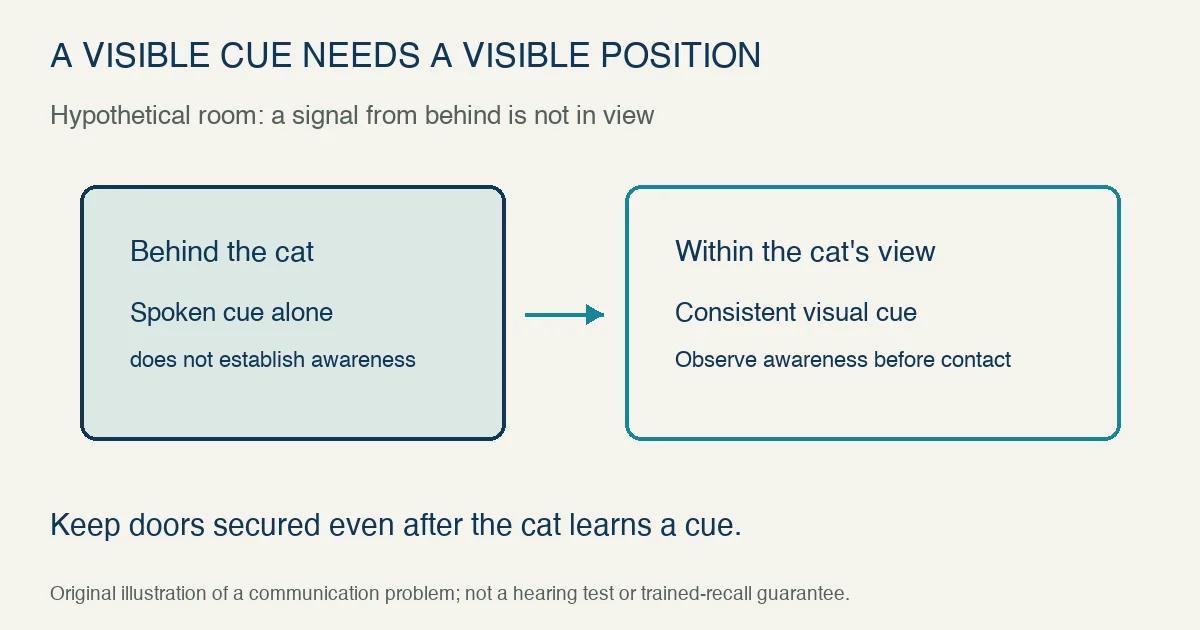
A deaf cat may not hear someone coming from behind. Cornell advises signaling your presence and replacing verbal commands with visual cues [2]. Before touching the cat, move into its view where practical and give it a chance to notice you. Do not assume calling its name across the room has prepared it for a hand arriving on its back.
Both Cornell and Cats Protection describe using floor vibration to attract attention [1][2]. Treat that as a possible cue to observe, not a guarantee that every surface or cat will detect it. If the cat has not noticed you, do not escalate into repeated frightening stomps or grab it suddenly to finish the interaction.
For a sleeping cat, Cats Protection suggests touching the area around the cat rather than the cat itself to reduce startling [1]. Tell carers about this distinction. If a routine requires waking or handling the cat, approach patiently and check its response instead of relying on the same audible cue you used before hearing loss.
Consider a hypothetical visitor approaching a sleeping cat from behind a chair. Saying hello does not establish the cat has noticed the visitor. The visitor can move into view, allow the cat to notice an appropriate nearby cue, and wait for awareness before attempting contact. This is an illustration of the communication problem, not a tested training method or a promise against scratches.
Use a small set of consistent visual signals
Cats Protection notes that deaf cats can learn hand signals or a light cue and recommends keeping a chosen calling signal distinct and consistent [1]. Choose the signal you will actually use at home, and write down what it means so other carers use the same cue.
Begin where the cat can see you, in an ordinary calm interaction. A signal made in another room or behind the cat is not visible communication. If using a light cue, observe the cat's comfort and ability to notice it; do not turn flashing into a repeated startling event. Hand signals are an alternative rather than requiring a particular device.
Distinguish a learned indoor cue from a safety guarantee. A cat recognizing your signal at feeding time does not mean it can see you through a doorway, respond outside or leave a hiding place whenever asked. Keep physical access controls in place even after communication improves.
Manage entrances without relying on a call
Cornell and Cats Protection advise keeping deaf cats indoors because they cannot hear outdoor warnings such as approaching vehicles [1][2]. Examine how doors actually open during deliveries, cleaning and visitors' arrival. Calling the cat away from an open entrance is not a reliable substitute for containment.
Use the door and window safety guide to review openings and the household sequence for securing them. If considering outdoor enrichment, assess a contained area and its return route with the catio planning guide. An enclosure still needs secure boundaries and appropriate supervision; deafness does not certify any garden fence as suitable.
Keep microchip registration and contact details usable in case of escape, as Cats Protection recommends [1]. The microchip information guide explains the record checks. A microchip helps identification after a scan; it does not provide a live position or replace secured doors.
At home, keep enrichment available using visual interaction, suitable toys and accessible food puzzles [1]. Choose activities the cat can engage with and stop if it becomes distressed. The play and enrichment guide covers activity choices; do not remove play simply because an audible toy is no longer useful.
Separate hearing-related care from other new problems
Cats Protection notes that vocal behavior varies among deaf cats [1]. A louder or quieter cat is not, by itself, proof of its hearing status or its comfort. Record when calling happens and accompanying changes rather than label every new nighttime problem as deafness. Use the night activity guide for routine observations, and contact the vet about new or concerning changes.
Give a sitter the actual communication cues, approach and waking instructions, door rules, familiar resources and veterinary care plan. Add these to the sitter handover, rather than leaving only a note saying the cat is deaf.
Review what the cat can do comfortably: notice an approach, choose contact, reach resources and engage in activity. If these become harder, discuss the change with the veterinary team. Do not assume established hearing impairment explains new disorientation, pain or a loss of ordinary function.