
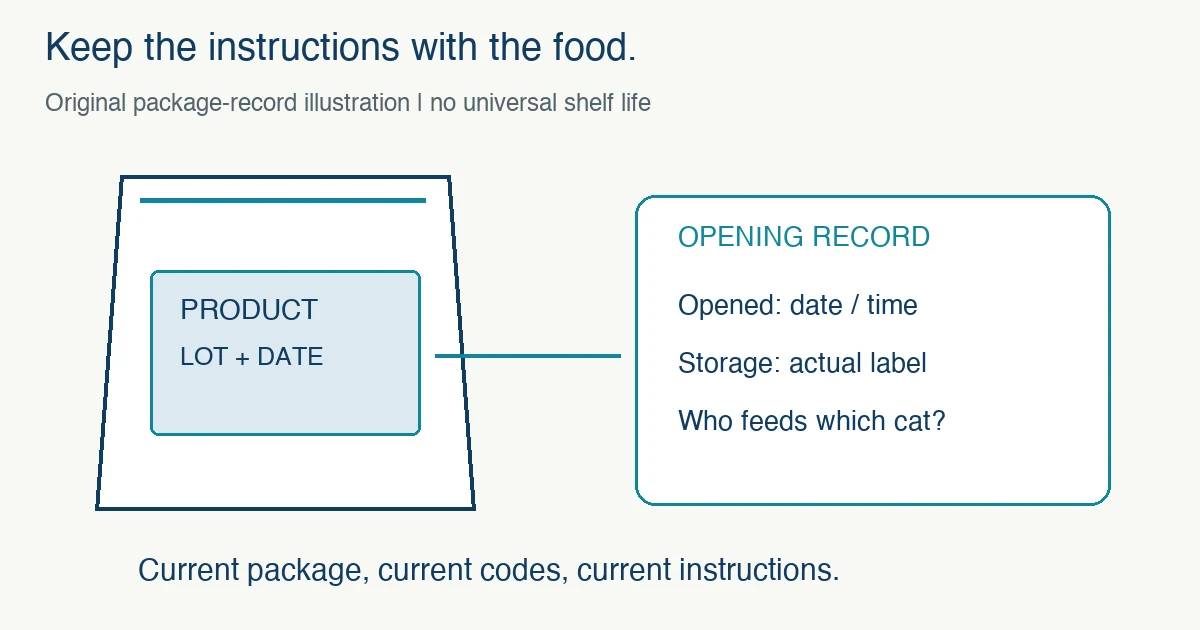
Store the food and keep the instructions with it
Good cat-food storage preserves both the food's condition and the information needed to use it correctly. Start with the actual package: identify whether it is dry, canned, pouched, fresh or raw, then read its unopened and after-opening instructions. An attractive container cannot supply a missing storage direction.
CDC advises following pet-food label storage instructions and avoiding recalled or contaminated food [2]. This page helps organise that process. It does not certify that a food is safe by its smell, prescribe a diet or provide one universal shelf life for every product.
If you cannot read the instructions or distinguish the product, ask the manufacturer before relying on a general article. Photograph the whole label, including the regional product name and pack size. A search result for a similar-looking pouch may refer to another formulation.
Keep the original bag inside a dry-food container
FDA recommends retaining dry food in its original bag, including when placing it inside another storage container. If you must decant it, use a clean, dry container with a well-fitting lid and retain the product identification. Wash and dry the container between bags [1].
Before buying a bin, check whether the actual bag fits, whether the lid closes properly and whether you can remove the bag and clean the interior. “Holds a large bag” is not a measured fit for your package. We have not tested container seals or ranked brands here.
Do not endlessly top up one anonymous supply. Finish and clean the container as appropriate before refilling, and make the current bag's information accessible. If different cats have different prescribed foods, use unmistakable labels and separate handling arrangements rather than relying on container colour alone.
Choose a location that meets the label requirements and prevents pets from accessing the whole supply. Check the real room conditions, not just whether the cupboard looks shaded. An outside storage area, hot utility room or damp cupboard should not be assumed suitable because the food is dry.
FDA's general advice is a cool, dry place below 80°F, approximately 26.7°C, for dry food and unopened canned food [1]. That is not a guarantee of freshness up to that temperature, and it does not replace more restrictive directions on the product.
Separate unused wet food from food already served
When you open a can or pouch, prepare the intended portion with a clean utensil and deal with the remainder promptly. FDA advises promptly refrigerating or discarding unused or leftover canned and pouched food, covering refrigerated food tightly and setting the refrigerator at 40°F or below, approximately 4.4°C [4].
Read the product's after-opening directions for its retention period. The date printed for an unopened pack does not answer how long a portion remains usable after opening. A generic search result offering several days is not proof that your specific food can be kept that long.
Mark when you opened it and identify the food if it is transferred to another suitable container. Decide where the caregiver will find that information before they prepare the next meal. A lid protects the food's storage arrangement; it does not reset the opening time.
Distinguish the unused portion you refrigerated promptly from food that has been sitting in a feeding bowl. Note when it was served. Follow the product's instructions and discard food that should no longer be used; do not make an unknown period on the floor disappear by refrigerating it later.
If the label is silent or your arrangement is unusual, ask the manufacturer about that product, the room temperature, time exposed and storage method. For a feeder with cooling features, check its exact instructions too. The fact that a device is sold for wet food does not establish the safe holding time for every food or condition.
Make the current package traceable
FDA explains that lot codes identify batches and may appear on the bottom, side, tear-off strip or lid. A UPC identifies a product but is not the same as its batch code. If a code is unclear, preserve a photograph and all the codes rather than inventing which one is the lot [3].
Keep enough information for another person to match a notice to the food actually in use:
| Record | What to preserve | Why it is useful |
|---|---|---|
| Product | Full name, form and pack size | Similar names may refer to different foods |
| Package codes | Clear photos of lot and other codes | A batch can differ within one product |
| Printed date | Exact date and its label | Do not confuse it with your opening date |
| Opening record | Date/time and storage instructions | Makes the current handling history visible |
Update the record when the package changes. Keeping last month's photo attached to this week's food defeats the identification task. If you use several packages at once, keep a clear association between each package and its stored contents.
A hypothetical handover: a caregiver finds two covered pouches in the refrigerator, both labelled only “cat food.” Neither tells them which cat receives it or when it was opened. The useful correction is a product-and-opening record with the applicable instructions, not a guessed freshness test. Do not count unidentified leftovers as an available meal.
Clean the utensils as well as the container
FDA advises clean hands before and after preparation, washing bowls and scooping utensils after use, and using a dedicated clean scoop rather than the feeding bowl to collect food [4]. Include these items in the routine; a clean storage bin does not make a used scoop clean.
Keep food preparation separate from chemicals, dirty utensils and waste handling. Follow the cleaning directions for the particular bowl, bin or appliance and let parts dry as required before storing dry food. “Dishwasher safe” must refer to that actual component, not every part of a feeder.
For a dispensing device, use its exact model's food and cleaning requirements. Our automatic-feeder guide shows why removable bowls, food-contact parts and electrical bodies need different checks. Do not use an ordinary dry-food hopper for wet or moistened food unless the manufacturer explicitly permits it.
Treat fresh and raw foods as different storage tasks
CDC distinguishes cooked fresh food requiring refrigeration from shelf-stable dry or canned products. It also advises against feeding raw pet food because of risks to pets and people; freezing, dehydrating or freeze-drying does not eliminate all germs [2]. A dry-looking raw topper is not automatically equivalent to ordinary cooked kibble.
If your product is fresh, frozen or raw, retain its specific cold-storage, thawing and handling instructions and discuss the diet with your veterinary team. Do not borrow an ordinary unopened-can rule for a chilled delivery. This page does not provide a home raw-food preparation plan or claim refrigeration removes the risks.
When the food or storage history is questionable
If food appears defective, packaging is swollen or leaking, or your cat becomes ill after eating it, stop using the suspect product and seek veterinary advice as appropriate. FDA recommends reporting potential problems to the manufacturer and FDA [1]. Save the identity and handling record without leaving suspect food accessible to animals.
A normal appearance cannot establish the absence of contamination [2]. Likewise, a food-related illness cannot be diagnosed solely because symptoms followed a meal. Give the veterinary team the exact food, dates and observed signs; contact them promptly about illness instead of waiting to complete a product complaint.
When the accepted food must be discarded or is unavailable, explain the situation to your veterinary team and arrange an appropriate replacement. The food-transition guide covers routine changes, but a gradual schedule is not a reason to keep feeding unsuitable food. End the storage check with identified food, readable instructions, known opening history and a caregiver who can find all three.