
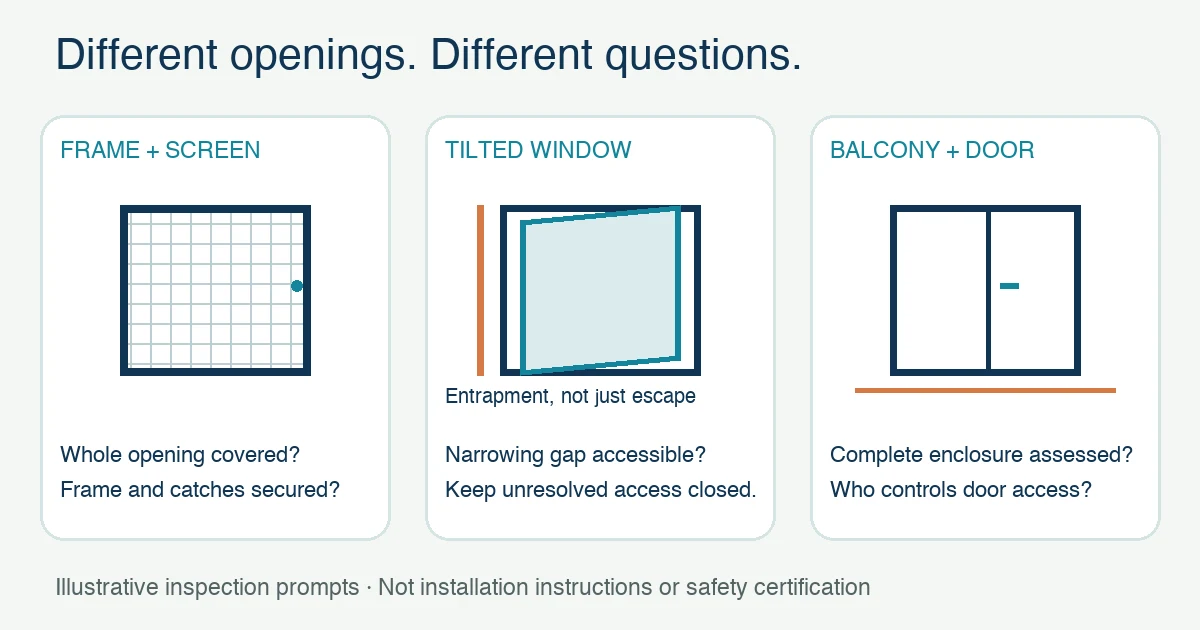
Check the opening before relying on the barrier
For an opening you have not assessed, keep the cat away while you establish how access will be controlled. A screen being present does not answer whether its frame fits, its fixings are secure, or another opening is exposed when the window moves. This page helps you inspect and discuss those questions; it does not certify a window guard or balcony installation.
There are three separate problems: a cat leaving through an opening, falling from an exposed edge, and becoming trapped in a narrowing gap. A solution for one may leave the others unresolved. A child's window guard, for example, is not automatically suitable for a cat: ASPCA warns that cats can pass through those gaps [1].
If a cat has fallen from a window or balcony, seek veterinary care immediately [1]. Do not treat walking afterward as an all-clear. If a cat is trapped in a tilted window, urgently contact a veterinarian and appropriate local rescue assistance; explain the entrapment and follow their instructions. This is not a situation to leave until a routine appointment [3].
Walk through each usable opening
Make the inspection specific to the actual window or door. Record its location, opening mechanism, what the cat can reach from nearby furniture, what separates the cat from the opening, and who controls access. A general note such as “all windows have mesh” misses changes in frames, latches and opening positions.
| Opening | Question to resolve before cat access | Unresolved arrangement |
|---|---|---|
| Sliding or outward-opening window | Is the whole accessible opening covered by a securely fitted barrier in every position you intend to use? | Keep cat access separated until fit and mounting are confirmed. |
| Tilt-and-turn window | Can the cat reach the narrowing side or lower gap in tilt mode? | Do not use an accessible tilted opening as a presumed safe ventilation gap. |
| Balcony door | Does opening the door give access to an exposed balcony, or is a suitable complete enclosure in place? | Keep the door closed to the cat while the enclosure question is unresolved. |
| Exterior door used by visitors | Who locates the cat and controls the door during entry, deliveries and departure? | Establish the handoff before the door is opened. |
This is an inspection worksheet, not a product test. Do not deliberately push your cat against a screen, coax it through a gap or expose it to an edge to check the arrangement. If mounting or the building structure is uncertain, ask an appropriately qualified installer rather than improvising an attachment.
Inspect the screen and frame as a system
ASPCA recommends sturdy, securely fitted screens and checking that adjustable screens fit their frames securely [1]. Inspect the frame seating, edges, catches and attachment points, as well as the mesh. A tear is visible, but a frame that lifts out or an opening left around its edge can also defeat the barrier.
Ask the supplier what the exact product is designed to do and how it must be installed in your window type. “Pet mesh” on a listing is not evidence about the surrounding frame, fasteners or the whole installed system. If a product gives no relevant installation or suitability information, leave that question open rather than guessing from a photograph.
Check again after window cleaning, screen removal, repairs or moving furniture near the opening. Include checks in the instructions for anyone who operates the window. Do not presume the other person knows that one latch or opening position is different.
An invented household example: a kitchen screen is removed for cleaning, then loosely rested back in place. The useful correction is a controlled reinstallation and check before cat access resumes, not a reminder that the cat normally ignores that window. This example is not an observed accident or a claim about a particular screen.
Treat tilted windows as an entrapment risk
A tilted window can create a gap that narrows toward the bottom. The University of Veterinary Medicine Hannover describes cats becoming caught by the abdomen or hind limbs when attempting to pass through, with potentially severe injury [3]. This differs from simply falling out of a wide-open window.
Do not infer safety from a small-looking opening. If the cat can reach an unresolved tilt opening, keep access separated and use another ventilation arrangement while obtaining suitable advice. Discuss the exact window mechanism with the supplier or installer; this guide provides no universal millimetre gap, guard dimension or DIY fixing method.
Hannover's first-aid guidance calls for immediate veterinary attention after freeing a trapped cat and warns that a painful animal may bite or scratch [3]. Avoid putting yourself at risk or attempting an improvised extraction based on an internet diagram. Tell the veterinary or rescue contact that the animal is trapped so they can give situation-specific instructions.
Assess a balcony beyond the railing
Blue Cross advises that cats may climb, jump or squeeze through balcony gaps and recommends a professionally installed enclosure for cat balcony access [2]. A railing, stair gate or supervision alone should not be described as a complete cat enclosure. The assessment must consider sides, overhead access, doors and attachments as well as the obvious front edge.
Its guidance describes floor-to-ceiling mesh for a balcony doorway and cautions against leaving pets unattended on balconies [2]. Do not turn that description into a promise that any mesh hung across a door makes the entire balcony suitable. Ask a professional about the actual layout and installation, including relevant building or tenancy restrictions.
Keep the cat's return indoors available within the agreed arrangement, and consider heat, shade and water [2]. A chair placed next to the railing changes the route to the edge; stored furniture and drying racks deserve review too. If you cannot establish suitable protection, provide viewing and resting opportunities indoors through a closed window instead.
ASPCA also warns that falls from lower stories can cause injury [1]. “It is only one floor” is not a reason to remove an unresolved opening from the review.
Make door control an ordinary household habit
Door management needs a named person at the moment of use. Before a delivery or visitor arrives, establish where the cat is and whether its usable care area is separated from the exterior route. Decide who opens the door, who confirms it is closed and what happens if someone needs repeated trips.
Use a simple instruction that a visitor can carry out: “Please wait outside while I close the inner door,” for example. A vague warning that the cat is quick does not tell the visitor what to do. This is an illustrative communication choice, not a tested escape-prevention protocol.
When work or moving changes the route, revisit it rather than relying on the ordinary arrangement. Home renovation planning covers changing contractor access; moving-house handoffs covers transfer between homes. Neither replaces an assessment of the physical opening.
Keep a record of unresolved items and the person responsible for each. Separate “screen inspected,” “installer asked” and “cat access restored” instead of collapsing them into a single safety tick. Indoor-life planning can then help you provide usable resting, climbing and hiding options within the area the cat can actually access.