
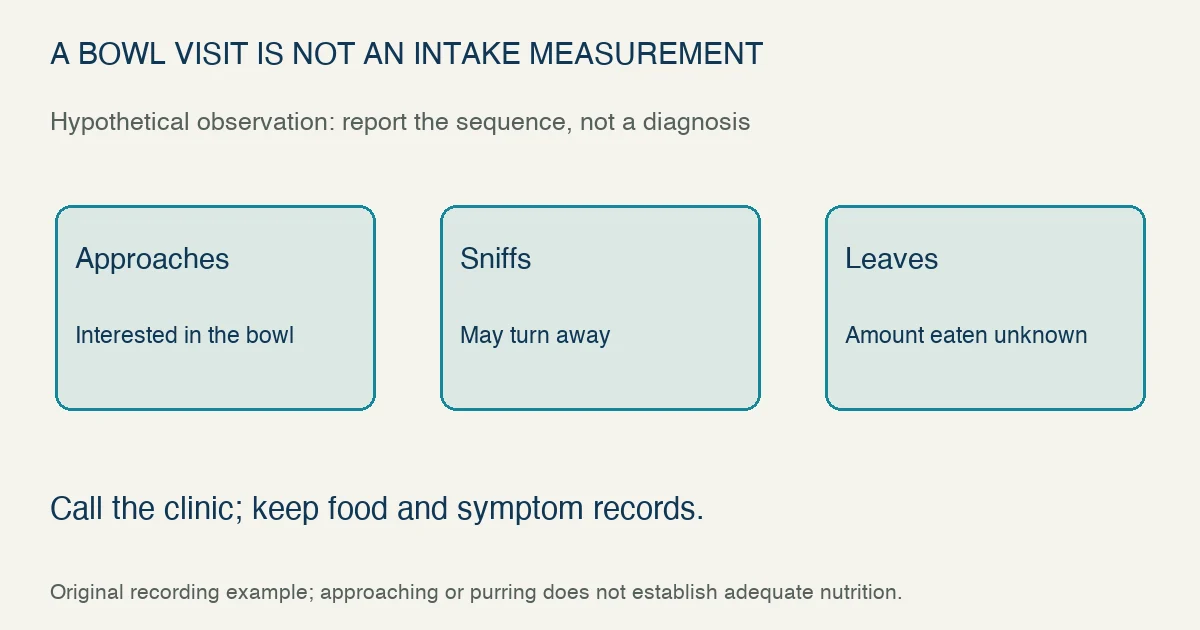
If your cat is eating less, refusing meals or eating differently, contact your veterinary clinic promptly. Do not wait through a series of new foods to see whether the problem disappears. Cornell recommends immediate consultation for signs of appetite loss, and International Cat Care includes reduced intake, increased selectivity, dropped food and one-sided chewing among changes to report. [1][3]
Cornell warns that sustained food avoidance can seriously affect an adult cat within as little as 24 hours and can threaten a very young kitten sooner. These are warnings about harm, not safe waiting periods. [1] A cat that purrs, approaches the bowl or drinks some water may still be eating inadequately. Tell the clinic what is happening and let the team decide the urgency for this cat.
Describe eating behavior without diagnosing the cause
“Not eating” can mean nothing consumed, less consumed, only licking liquid, asking for food then turning away, or trying to chew but dropping it. Give the clinic the pattern you can observe. International Cat Care explains that illness, pain, nausea, medicines, stress and learned food aversion can act alone or together. [3] Approaching a bowl does not prove that the cat is merely fussy.
Report when the change began, the last meal you actually saw consumed, relevant recent treatment and other changes. Include vomiting, drinking, litter-box observations, activity and any suspected access to harmful materials. If the cat seems very unwell, is struggling to breathe or has another urgent concern, describe it at once rather than spending time weighing leftovers.
A new pet, hospital stay or house move may be relevant, but a stressful event does not exclude illness. Cornell describes appetite loss as a broad clinical sign requiring examination and investigation rather than a diagnosis itself. [1] Do not choose a cause from an online list and start treating it at home.
Make the intake record more useful than “a few bites”
For each offering, record the exact food, amount offered and what remained. Weighing before and after can help, as International Cat Care recommends, but note any spills, drying or access by another animal that makes the difference uncertain. [3] Do not report a shared bowl's disappearance as this cat's intake.
Keep the packaging and record any treats, food used for medication and other foods actually eaten. Licking gravy or eating a few treats is not evidence that the normal nutritional intake has returned. Ask the clinic what information and monitoring frequency it wants; collecting a perfect record must not delay the first call.
| Observation | What you can report | What it does not establish |
|---|---|---|
| The cat sniffed the meal and left | Food, time and repeated approach or withdrawal | A preference problem rather than nausea or pain |
| Only liquid was licked | Which food and what solid food remained | A complete meal was consumed |
| A shared bowl became empty | Which animals had access and what you witnessed | This cat ate the missing amount |
These are hypothetical recording examples, not clinical tests. Use the vet-visit record guide to keep the timeline together. If an amount is unknown, write unknown instead of guessing.
Ask for a specific home plan after assessment
If the veterinary team advises home care, confirm the food, amount, offering schedule and when inadequate intake should trigger another call or reassessment. Ask what to do if the prescribed food is refused and whether an initially familiar food is appropriate. International Cat Care emphasizes that diet and tempting foods must be checked against the individual illness and recommends contacting the clinic when a newly prescribed diet is not eaten. [3]
Do not decide that a therapeutic diet must be accepted by withholding all alternatives until the cat gives in. Equally, do not replace it with a human-food menu without asking. The immediate nutrition plan and the longer-term diet may need to be coordinated by the team.
Ask how the plan will be reviewed: actual intake, weight, hydration, symptoms and the response to treatment may all matter. An appointment or medicine prescription is not the end of the problem if the cat still cannot eat enough. Report that clearly and follow the team's return instructions.
Make voluntary eating easier without forcing it
Within the agreed plan, offer fresh food in a clean, well-rinsed dish in a quiet, reachable place. Keep other animals away from that feeding opportunity and avoid busy doorways or noisy appliances. International Cat Care discusses food location, familiar routines and individual preferences; Cats Protection also suggests clean bowls, fresh smaller offerings and separate feeding after medical assessment. [2][3]
A cat with limited mobility may need food brought into a usable resting area rather than being asked to cross the house or climb. Keep the dish stable and the approach comfortable. Use our separate feeding guide for household access and the arthritis home-care guide for mobility observations.
Do not hover insistently, repeatedly push the bowl toward the face or place food directly into the mouth. Some cats welcome familiar company while others eat more comfortably alone. International Cat Care advises observing the individual and avoiding active interference. It warns that force or syringe feeding can cause stress, worsen food aversion and risk inhaling food into the lungs. [3] Do not follow an online force-feeding tutorial.
Stronger smell and more choices are not always better
Warming food can increase aroma, but International Cat Care explains that a stronger smell may be counterproductive when food has become associated with feeling ill. It also cautions against a buffet of many foods presented at once. [3] There is no single preparation trick that resolves every refusal.
Ask the team whether to offer a familiar food, change temperature or texture, or try another option. If warming is advised, check the whole serving is not hot and follow safe preparation instructions. Do not repeatedly microwave the same untouched meal or keep adding unapproved toppers. Our food-storage guide addresses freshness and handling, not treatment of appetite loss.
A hypothetical cat recovering at home sniffs a warmed meal and withdraws each time the caregiver brings several more bowls. The useful record is the repeated withdrawal and the foods offered. The next step is to report it and review the plan, rather than conclude the cat needs an even stronger scent.
Keep medication problems visible
Tell the clinic if a medicine seems to affect appetite, if administration is difficult or if you are uncertain a dose was swallowed. Do not stop, double or alter medication on your own. Ask what to do for that medicine and that missed or uncertain dose.
International Cat Care warns that hiding medicine in a main meal can deter eating and leave the dose unconsumed. It recommends discussing formulation and administration options with the team. [3] Before mixing a drug into food, confirm whether that is permitted and how the amount can be kept identifiable. A full bowl containing medication can create two unknowns: how much food and how much medicine reached the cat.
Do not crush a tablet, refrigerate a preparation or substitute a human appetite stimulant based on a general suggestion. The tablet-administration guide helps organize questions and safe handling within the actual prescription; it does not authorize a drug change.
Reassess when home encouragement is insufficient
Contact the clinic again if the cat does not meet the agreed intake, continues to refuse food, becomes less well or you cannot implement the plan. International Cat Care describes veterinary treatment of pain and nausea, appetite medicines and sometimes hospitalization or feeding-tube support. [3] Those options address more than finding a flavor the cat likes; they require an individual clinical plan.
A feeding tube is not a failure by the caregiver or a procedure to improvise. If the team recommends one, ask for demonstrated care instructions, the prescribed feeding plan, what to do if a problem occurs and whom to contact out of hours. This page does not provide tube feeding amounts, placement or troubleshooting instructions.
Continue reporting actual intake even if the cat begins taking a little food. A return to the bowl is encouraging but does not by itself prove adequate nutrition or resolution of the cause. Follow the team's monitoring and recheck plan rather than announcing recovery from one observed bite.
This is an AI-assisted practical synthesis, not veterinary-reviewed advice or a diagnostic tool. The table and illustration are hypothetical recording examples. No appetite medicine, food or feeding technique has been tested or prescribed by PurrAtlas for this page.