
If your cat has diarrhea and is also vomiting, not eating, unusually quiet, painful, or passing blood or black stool, contact your veterinary team promptly. Kittens and older cats need earlier advice because dehydration is a particular concern. A cat that still plays can nevertheless have a problem that needs assessment; start with the whole cat, not a stool-color diagnosis. [1][2]
This page helps you make that call with useful observations, avoid changing several things at once, and prepare a sample if the clinic wants one. It does not prescribe a diet, probiotic, antibiotic or dewormer.
Decide whether observation is appropriate
PDSA describes home observation only for mild diarrhea in a cat that is otherwise bright and well, with no other symptoms. It advises contact if there is no improvement within 24 hours, deterioration, or additional signs, and always for a kitten or elderly cat. Cats Protection describes persistent diarrhea beyond a day or two and diarrhea with concerning signs as reasons for veterinary attention. These are conditional descriptions, not permission to wait while a cat worsens. [1][2]
Call now if you are uncertain whether your cat meets the mild, otherwise-well description. Mention age, existing disease, current medicines and any possible ingestion of a plant, chemical, thread or other object. Cats Protection treats suspected intestinal obstruction as an emergency. Do not explain away diarrhea as stress or a recent food change without considering the cat's condition. [1]
If the clinic recommends monitoring, ask for a specific review point and the changes that should bring you back sooner. Put that instruction beside the phone number. A planned call is more useful than repeatedly searching for another remedy.
Describe what actually happened
Loose stool found on the floor does not automatically mean a behavior problem. A cat may have urgency, discomfort or soiling of the coat; punishment cannot determine or treat the cause. Note whether the stool was formed but softer than usual, unformed, or watery. Describe visible blood or mucus without using them to identify an infection. Diarrhea has many possible causes, including problems outside the intestine. [2][3]
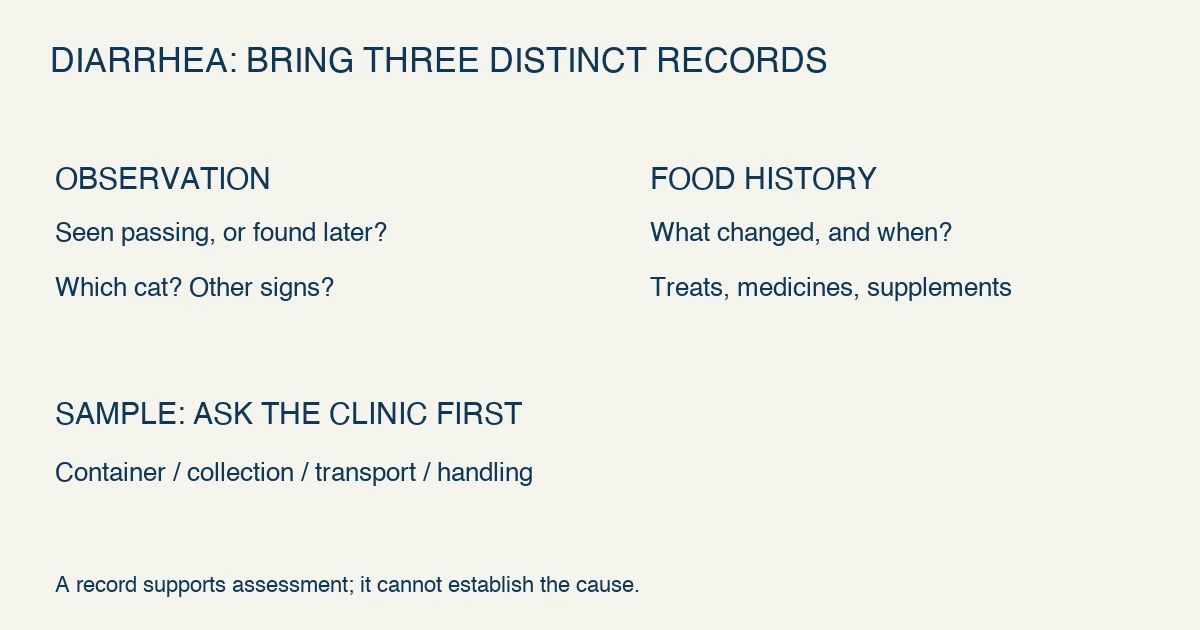
Write down the first known abnormal stool and each further observation. Record approximate amount, frequency, appetite, vomiting, activity and any measured weight change. If you found it later, record the discovery time and say that the passing time is unknown. A photograph can preserve appearance, but should not delay contacting the clinic or caring for the cat.
In a multi-cat home, distinguish “one cat was seen passing watery stool” from “watery stool found in a shared box.” Unknown identity is useful information. Report whether other cats have changes too. Do not repeatedly shut a frightened cat alone in a room simply to force proof; ask the team how to observe and whether separation is needed for the suspected problem. Read about shared resources.
Preserve a sample without postponing the appointment
Cats Protection lists stool analysis among possible investigations. Ask the clinic whether to bring a sample, how much it needs, what container to use, and how soon it should arrive. Different investigations may have different handling requirements. A general article cannot set one collection and refrigeration rule for every test. [1]
Tell the team if the material was collected from litter, outdoors, a shared box or after cleaning. Label it with the cat's name if known, collection date and time, and any uncertainty. Keep it away from food preparation and wash your hands after handling feces or contaminated items. Do not miss an urgent appointment while waiting for a perfect sample; the team can decide what is possible.
Keep the observation record separate from the sample label. The sample shows one event; the record explains recurrence, food changes and how the cat has been functioning between events. Bring both if requested.
Make the food history interpretable
List the actual foods, treats, milk, supplements and medicines given before the change, with when each was introduced. Include food supplied by another family member or sitter. An abrupt diet change can cause an upset, but timing alone does not establish causation. Infection, intestinal inflammation and other illnesses can have similar signs. [1][3]
For example, in a hypothetical household, new food began on Monday and a probiotic was added on Tuesday. By Wednesday stool is firmer. That sequence does not show which change helped, whether the illness resolved independently, or whether the probiotic is suitable for future episodes. Give the timeline to the veterinarian rather than turning it into a permanent supplement recommendation.
Ask what to feed during assessment, how much and how often, and how the plan relates to any prescribed diet. Cats Protection includes small, frequent portions of the usual food for an otherwise-well cat; PDSA describes small bland meals and says not to starve the cat. Neither makes a homemade chicken-only diet a complete long-term food. Do not create a fasting plan or permanently replace a balanced diet from an online recipe. Contact the team if the cat refuses food. [1][2] Reduced intake needs its own record.
Fresh water should stay readily accessible. Drinking more does not prove that losses have been replaced, and looking at a bowl in a shared home cannot tell you what one cat drank. Water access and observation can help describe the setup, but does not assess dehydration or replace treatment. [1][2]
Keep cleanup practical without concealing the pattern
Remove soiled material promptly and keep comfortable litter access. If fur around the back end is dirty or painful, ask how to clean it safely; do not begin cutting close to skin or forcing a bath. Preserve any requested photograph or sample first when it is safe to do so. Note what you cleaned and which cat was affected.
If the team suspects an infectious cause, ask about other animals, litter equipment, handling and the appropriate cleaning product and contact time. The word “diarrhea” does not identify an organism, so this page cannot promise that one household disinfectant kills every possible cause. Keep medicines, cleaners and contaminated materials away from the cats. Accessible boxes still matter while investigation continues; see litter-box care.
Recheck the outcome rather than just the stool
Ask what improvement should look like: stool consistency and frequency, appetite, energy and any other clinical signs. A temporarily firmer stool is not enough if the cat is losing weight or eating less. Recurrent episodes should be reported as a recurring pattern, with quiet intervals included; Cornell explains that extended or recurrent diarrhea can have important underlying causes. [3]
Do not restart leftover antibiotics, human antidiarrheal medicine or a previous dewormer. Treatment depends on the cause, and some over-the-counter products can harm cats. PDSA also notes that antibiotics are not usually required for diarrhea and may be inappropriate. Ask about any proposed probiotic's suitability for this cat rather than assuming all products work alike. [2][3]
Before ending the call, confirm the next review, what to do if food or medicine is not retained, and whom to contact outside opening hours. Bring your timeline to that review even if the cat seems better. It makes the decision about further investigation less dependent on memory.