
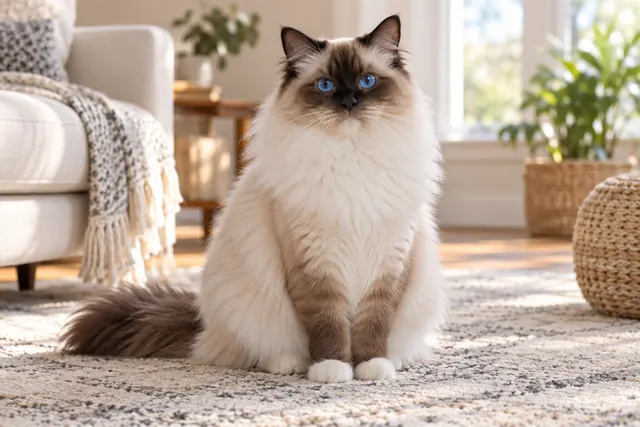
A companion with an individual response to handling
The CFA describes Ragdolls as medium-to-large, blue-eyed pointed cats with moderately long coats [1]. TICA emphasizes their affectionate breed character [2]. These are descriptions of a breed, not permission to assume every cat enjoys being carried or will remain relaxed around every child or pet.
Before choosing one, ask how the particular cat behaves during grooming, lifting, unfamiliar visits and time alone. Meet them in a calm setting where they can move away. This page's generated illustration is not a pedigree or health assessment.
Translate a long coat into a manageable routine
CFA recommends regular combing to find loose hair and tangles [1]. Ask the current caregiver to demonstrate their tools and technique, then introduce brief sessions at a comfortable time. Pay attention to the areas that rub during movement or are difficult for the cat to groom.
Do not treat a description of a relatively manageable coat as a guarantee against matting. Check the skin and record a change in grooming tolerance. If combing hurts or a mat sits tightly against skin, stop and ask a professional how to proceed rather than pulling or cutting.
For a household with a busy schedule, identify who will do the coat checks and what happens if the usual person is away. A grooming plan that depends on someone who rarely has time is not a dependable plan.
Keep affection voluntary
Offer contact and let the cat decide whether to remain. Children can learn to sit quietly and allow the cat to approach; an adult should supervise. Avoid passing a cat from person to person because the breed is called relaxed.
Plan undisturbed rest and a retreat from visitors. If another pet lives in the home, provide separate resources and follow an introduction process. A reputation for friendliness does not remove the need for staged introductions.
Choose equipment for the actual cat
Check the opening and interior of the carrier, tray dimensions and stable resting platforms. Observe entry and turning rather than buying solely by the breed name. A young cat's familiar equipment may need reassessment as they grow.
Make windows and exits secure. An affectionate indoor companion still needs the same safety checks as other cats; do not expect trust in people to protect them outdoors.
Turn health assurances into specific questions
CFA identifies hypertrophic cardiomyopathy as a hereditary health issue discussed in Ragdoll breeding [1]. Ask for the actual screening documentation associated with the individual and their parents where relevant, and have your veterinary team explain its scope. A negative result for a particular test is not a blanket lifetime health guarantee.
Bring the known food and portion routine, and discuss body condition for the individual. Do not assume a large frame makes any weight or appetite pattern normal.
A practical handover to a new caregiver
Leave the food label and agreed amount, grooming tool, tolerated handling routine, familiar resting places and veterinary contact. Specify which observations matter: for example, whether combing a previously comfortable area now prompts retreat. Record what was seen rather than “Ragdolls are easy.”
Use private care notes for dated observations and food-label conversion only for arithmetic.
Common decision questions
Is a Ragdoll suitable for children? Consider supervised handling and this cat's experience, not a breed guarantee. Do they need grooming? Yes; check the actual coat regularly and adapt the routine. Should you get two automatically? Consider each cat's history, your resources and an introduction plan; another cat is not a guaranteed companion.
Use a coat-care starting point you can check
CFA suggests combing at least once or twice a week to find loose hair and tangles [1]. Treat this as a breed-care starting point, then check the individual coat and adjust with appropriate advice. A cat that develops knots between sessions needs a review of technique and frequency rather than a claim that the breed cannot mat.
Before adoption, ask to see the grooming tool and a tolerated session. Record who will provide care when your usual caregiver is away. Compare the commitment with the Persian coat-care guide if you are choosing between longhaired breeds; their maintenance needs should not be treated as interchangeable.