
Plan separation and care before arranging a first meeting
Prepare two things before the baby comes home: how the cat will continue to reach its own resources, and how adults will prevent unsupervised access to the baby. International Cat Care advises never leaving cats unattended with babies and supervising physical interactions [1]. A relaxed cat and a successful first meeting do not remove that requirement.
List the changes that will actually affect your cat: a bedroom becoming restricted, furniture arriving, a different person feeding it, visitors, new sounds and disrupted nights. Work on those changes in advance where possible. Do not wait for the return from hospital to remove the cat's usual sleeping place and change all its routines at once.
This guide addresses the cat's environment and household arrangements. For the baby's sleep, health or pregnancy questions, use your pediatric or maternity team's advice. Do not treat a pet-care article as a complete infant safety plan.
Keep infant sleep arrangements separate from cat deterrents
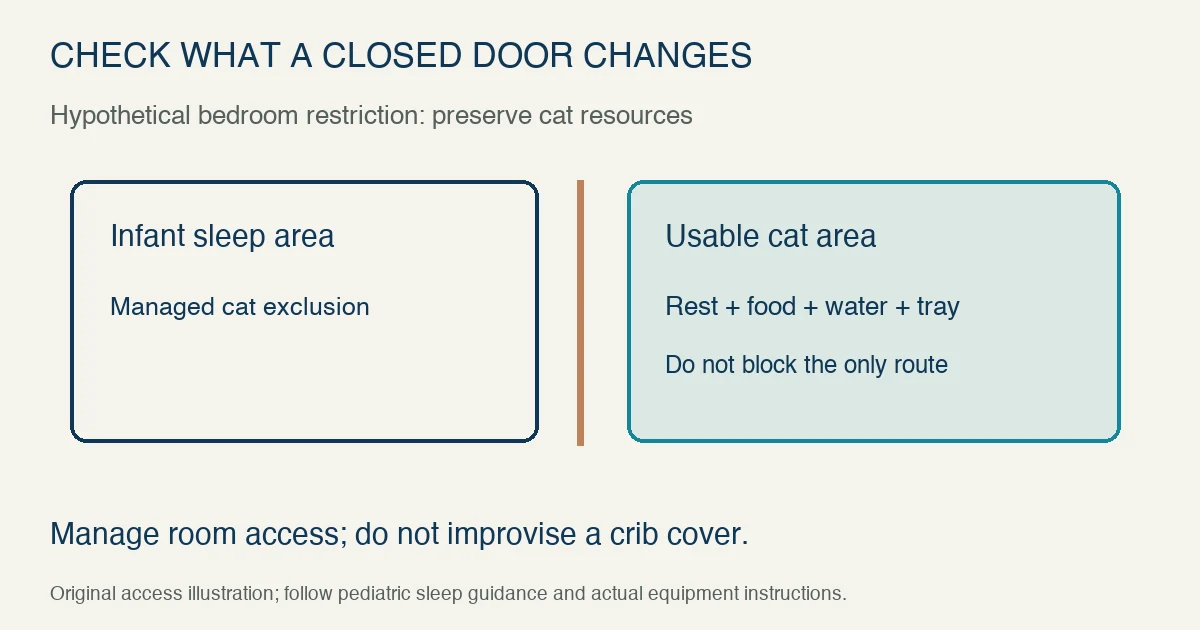
ASPCA advises keeping cats out of the crib and other infant sleeping locations [2]. Plan a reliable way to exclude the cat from the actual sleep area without changing the baby's sleep equipment. Check where the baby will sleep in practice, including a bassinet in an adult bedroom, rather than assume a nursery is the only relevant room.
The American Academy of Pediatrics recommends a firm, flat, appropriately compliant infant sleep surface, a fitted sheet and an otherwise clear sleep space. It also recommends room sharing while avoiding bed sharing [3]. Arrange cat access around that plan; do not interpret keeping a nursery closed as a reason to put a baby alone in another room contrary to the family's pediatric guidance.
Some pet articles suggest crib tents or nets over baby equipment. Those suggestions are not a product safety approval. This guide does not recommend adding a tent, net, tape-covered surface or improvised cover to a baby's sleep space. Follow current infant sleep guidance and the exact equipment instructions, and discuss uncertainty with the pediatric team [3].
Ask who checks the cat's location before the baby rests, who closes the relevant access and what happens when someone enters. A camera or a promise that the cat rarely jumps into the bassinet is not the same as preventing access. Resolve a room or doorway arrangement before relying on it.
Change the cat's resources without making them disappear
International Cat Care recommends gradual environmental changes and alternative comfortable resting places when access will change [1]. If the cat's bed or litter tray is in a room that will become restricted, establish a usable alternative before closing that route. Check its new journey to food, water, toileting and retreat.
Consider a hypothetical household preparing a bedroom for a bassinet. The cat currently sleeps there and its only tray is reached through that room. Closing the door changes both rest and toilet access. A plan that adds a comfortable sleeping choice but forgets the tray is incomplete. This example illustrates a resource check, not a tested nursery arrangement.
The home resource checklist helps review available resources. Maintain a quiet retreat away from visitors and baby-related activity; do not make the cat pass close to the baby to reach every essential. As the child becomes mobile, revisit that retreat and use the cats and children guide for the next stage.
Introduce new sounds and items at the cat's pace
Set up new furniture early enough for the cat to encounter changes gradually, while keeping infant sleep boundaries intact. International Cat Care also suggests introducing baby sounds at a barely audible level and increasing only when the cat is untroubled [1]. Do not play a loud recording repeatedly until the cat stops reacting; withdrawal or distress is a reason to reduce the challenge and seek advice if needed.
Allow the cat to investigate an appropriate baby-scented item separately, as described by International Cat Care and ASPCA [1][2]. Do not force it toward the item or use the baby as an exposure exercise. Scent preparation is not proof that the cat will be comfortable with the real sounds, movement and changed routine.
When the baby arrives, stay calm, provide distance and let the cat choose whether to approach or retreat under adult supervision [1]. A first encounter does not need touching or a photograph. Do not hold a reluctant cat beside the baby to complete an introduction.
Give the cat a named caregiver and a workable routine
Decide who feeds the cat, provides water, cleans trays, gives any prescribed care and spends time on play. If responsibilities will change, introduce the new caregiver before the birth where practical [1][2]. The important detail is who can do the task during a busy day, not a promise that everyone will help.
Include a backup for a hospital stay or an unexpected schedule. Use the sitter handover to record actual feeding, medication, access and veterinary instructions. A feeding device does not replace checking that the cat eats and can reach other resources.
Keep manageable opportunities for familiar interaction and play. The play and enrichment guide offers adaptable activities; choose a quiet location and a time someone can supervise. Do not force the cat to play beside the baby to prove acceptance.
Observe changes and ask for the right help
Record withdrawal, toileting changes, altered appetite or difficulty using familiar resources. A new baby changes several parts of the home, but that does not establish the cause of every new problem. Seek veterinary advice about new or concerning changes rather than assume jealousy or stress. Ask for qualified behavior support when introductions or household access remain difficult.
International Cat Care recommends handwashing after handling the cat or cleaning trays and maintaining preventive care [1]. Agree a practical hygiene routine with the household and relevant health professionals. Keep cat care supplies and litter handling separate from baby care; do not invent pregnancy risk estimates or a treatment protocol from this page.
Review the arrangements after changes in sleeping location, visitors or the baby's mobility. The useful outcome is continued safe separation where needed, supervised contact and an accessible, predictable life for the cat—not a guarantee that cat and baby will become friends on a fixed timetable.