
Start with the deadline, not a loading trick
If a veterinary visit is imminent and you cannot safely get your cat into the carrier, call the practice now. Explain the timing, the cat's condition and what has already happened. Do not postpone urgent care while waiting for a home training plan to work. The Feline Veterinary Medical Association warns that avoiding visits to prevent stress can harm a cat's health and recommends discussing persistent travel distress with the veterinarian [1].
If you have time before the next journey, work toward voluntary entry in small stages. Cats Protection recommends leaving the carrier available, allowing exploration and moving forward only when the cat is comfortable with the current stage [2]. A cat walking in to collect food has completed one part of the task; this is not proof that it is comfortable with a closed door or being carried.
Make the starting arrangement usable
Place the open carrier where the cat can approach it. Use familiar bedding rather than presenting an empty box only on appointment mornings. FelineVMA recommends keeping it in the cat's usual living area and adding familiar bedding [1]. Check the door, fastenings, base and the manufacturer's assembly instructions before training with it.
Write down your starting arrangement: location, bedding, whether the door is held open securely, and whether the cat can approach and leave without another cat blocking the route. Use a reward the cat can have; ask the veterinary team about food restrictions for the appointment or the cat's medical needs rather than assuming treats are always appropriate.
You do not need to persuade the cat into the deepest part immediately. For a cat reluctant to approach, Cats Protection describes beginning with bedding near the carrier and gradually bringing it closer before placing it inside [2]. Keep that early setup separate from transport: a partly dismantled carrier or open door used at home is not a safe carrying arrangement.
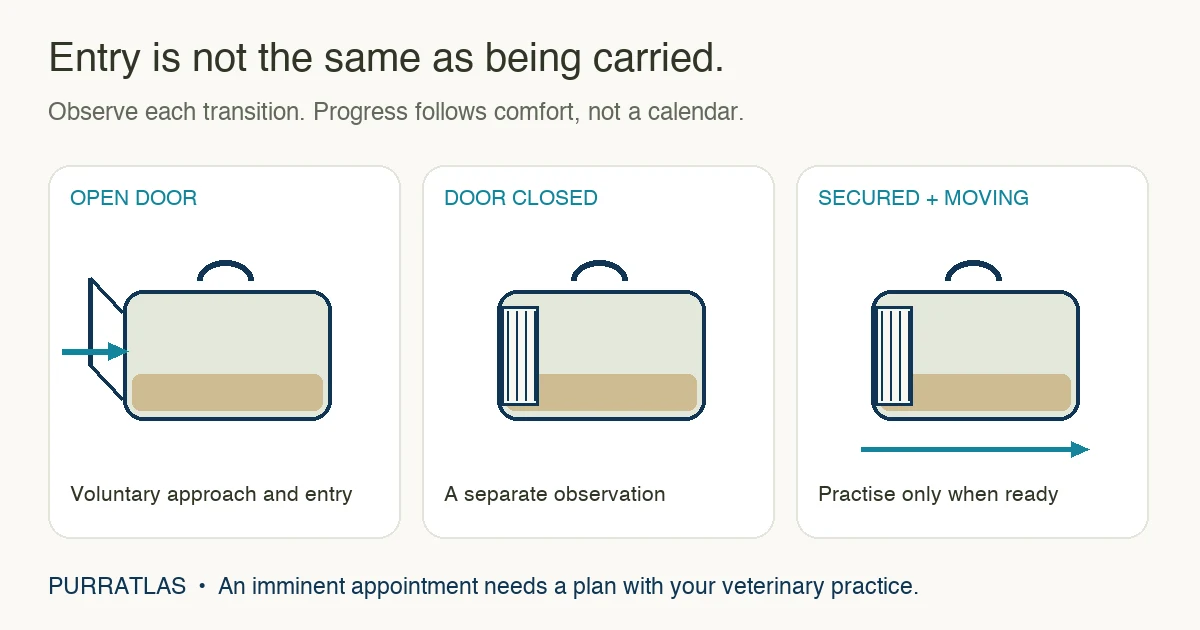
Separate entry, door closure and movement
Treat these as different observations, not a single “carrier trained” label:
- The cat approaches or rests near the carrier with the door open.
- It enters voluntarily and can leave.
- It remains comfortable while the door is briefly closed.
- It tolerates a longer closed-door interval.
- It remains comfortable when the fully secured carrier is lifted and carried.
This progression follows the training sequence described by FelineVMA [1]. It is not a five-day schedule. Do not move to the next stage simply because a calendar says to, and do not close the door as a surprise every time the cat follows a reward inside. Cats Protection advises returning to earlier practice if the cat is not happy at a stage [2].
Keep the observations precise. “Entered twice, immediately left when I touched the door” tells you more than “refuses the carrier.” Your next practice can stay at open-door entry instead of adding closure and carrying together.
When progress stops, identify the transition
Illustrative situation: a cat rests in an open carrier each evening but leaves when the owner reaches for the latch. The carrier itself is being used. Replacing it immediately would not establish whether the issue was the approaching hand, door movement or closure.
Record which action preceded leaving. During ordinary practice, return to the last comfortable arrangement. Change one part of the sequence at a time so the next observation is interpretable. This example describes a hypothetical decision process, not a tested training outcome or a guarantee that the existing carrier is suitable.
Another household might report that its cat stays inside with the door closed but becomes distressed when the carrier moves. Do not count resting inside as proof that carrying has been addressed. Ask the veterinary team for help with travel distress and explain the exact transition that caused difficulty. There is no success percentage or fixed training duration claimed here.
If the appointment is soon, arrange help instead of escalating
Tell the practice whether your cat will approach, enter, remain with the door closed or tolerate movement. Include recent failed attempts and any injury or bite risk. Ask what handling support is appropriate, whether the appointment timing should change, and what to do if safe loading is still not possible. The urgency of the cat's condition belongs in that conversation; a website cannot make that triage decision.
FelineVMA says that any necessary placement should be gentle and calm and that some cats need veterinarian-prescribed support despite preparation [1]. Do not chase repeatedly, improvise restraint from a search snippet, or use another animal's prescription. Medication, its timing and whether it is suitable for this cat require the veterinary team's instructions.
Cats Protection publishes a short-term towel-wrap method for nervous cats [2]. That is not the same task as voluntary familiarisation. This page does not teach physical restraint from text alone: if you cannot load the cat safely, ask the practice to demonstrate an appropriate method or arrange help. A quick loading video does not establish that you can safely repeat its handling with this cat.
Keep the carrier secure after entry
An open-door training setup ends before the journey begins. Check every closure and connection after reassembly. Support the carrier underneath and keep it level; FelineVMA advises against carrying by the handle alone [1]. Transport several cats in separate carriers, and do not let a cat travel loose in the car [2].
Tell the practice about any travel-related vomiting or distress rather than using a human motion-sickness product. Ask for feeding instructions that fit the planned visit; do not invent fasting times. This guide covers entry and familiarisation, not airline acceptance, crash certification or a full transport plan.
After returning home, record the part of the journey that needs work next time. If a cat is newly joining your household, use bringing a cat home for the separate settling-in task. Keep medical observations in your cat's profile, and keep training-stage notes in your own records: the profile currently does not provide a dedicated carrier-training tracker.