
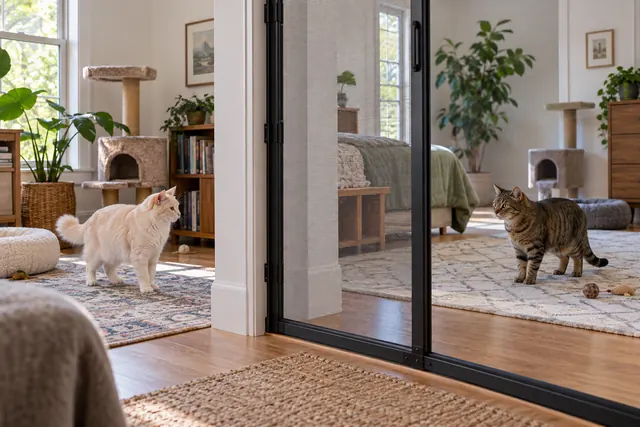
Decide whether you can provide separation first
Introducing cats is a process of managing access and responses, not a countdown to a fixed meeting date. Before arrival, arrange a room for the newcomer with their own food, water, litter, hiding place, scratcher and resting area. The resident cat should retain familiar resources without having to cross the new cat's room.
The FelineVMA introduction handout provides a staged approach [1]. The sequence below turns that principle into a home planning checklist. It is not a guarantee of friendship or a replacement for individual behavior support.
Stage 1: let the newcomer settle separately
Bring the carrier into the prepared room and allow the cat to emerge voluntarily. Keep visitors and forced handling to a minimum. Look for ordinary activities such as eating, using the litter box, resting and exploring before adding another challenge.
Write down what you actually saw. A silent cat hiding continuously is not necessarily relaxed. If food intake or health is concerning, contact your veterinary team rather than extending an introduction experiment.
Stage 2: introduce scent without a confrontation
Exchange suitable bedding or other familiar scent items between spaces, without forcing either cat to approach them. Give each cat a way to move away. Keep normal care and individual play available.
An example record might read: “Resident approached the blanket, sniffed and returned to the window; newcomer stayed behind the bed.” This describes behavior without declaring either cat dominant or ready. If an item produces persistent distress, increase distance or remove the challenge and consult the source handout about an easier step.
Stage 3: explore spaces without meeting
When manageable, arrange controlled access to each other's spaces while the cats remain separated. Secure doors and coordinate with another adult if needed. Do not improvise a swap that allows them to meet in a narrow hallway.
For a small apartment, plan where each cat will wait before moving the other. If separation cannot be maintained safely, pause and seek practical help rather than treating floor space as a reason to rush.
Stage 4: allow brief visual contact through a secure barrier
Use a barrier that actually prevents contact; a gate a cat can jump is not dependable separation. Begin at a distance where neither cat must approach. Keep an exit route and end the session while it remains manageable. Eating a treat once does not prove every later interaction will be comfortable.
Watch for sustained staring, blocking, retreat or other signs of tension described in the FelineVMA guidelines [2]. Return to a lower-intensity stage if either cat cannot disengage. Avoid punishment or holding cats face-to-face.
Stage 5: supervise shared access
Only progress when earlier contact is consistently manageable. Prepare multiple routes and separate resources before opening access. Keep the meeting brief and supervised; do not leave unfamiliar cats together simply because one session was quiet. Seek professional guidance if you cannot separate them safely.
If conflict occurs, do not put your hands between fighting cats. Prioritize safe separation and get veterinary advice about injury or sudden behavior change. Record the trigger, distance, duration and recovery, then discuss an appropriate reintroduction plan.
What progress can look like
The useful goal is that both cats can eat, rest and move through the home without being blocked. Sleeping together is not a required endpoint. One cat may prefer distance even when the household is functioning well.
Use multi-cat home planning to check resources and private observations to record changes. There is no universal number of days: repeat a manageable stage or return to an easier one according to the cats in front of you.