
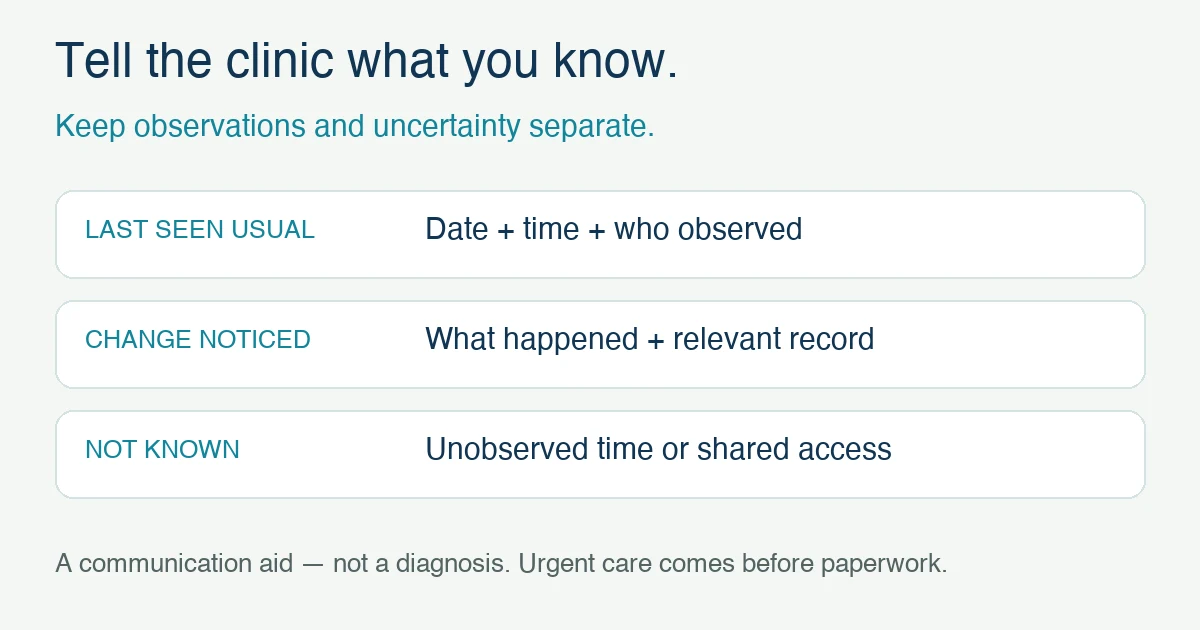
Start with the reason for the visit
Write the main concern in one factual sentence, then place the supporting details below it. “Milo left part of breakfast twice this week” gives the team something to ask about. “Milo definitely has a stomach condition” adds a diagnosis that the observation cannot establish. This guide helps organise what you know for a veterinary conversation, not decide what disease or treatment your cat has.
The Feline Veterinary Medical Association's checkup checklist asks caregivers to note changes in eating, weight and activity, write questions, and bring previous medical records when attending a new clinic [1]. You do not need a perfect spreadsheet to begin. A short note with honest gaps is more useful than a polished history filled from assumptions.
Do not delay contacting the clinic while completing a record. Cats Protection advises immediate veterinary contact for concerns such as difficulty breathing, pain, weakness, balance problems or difficulty passing urine or stools; suspected poisoning also needs prompt contact [3]. Explain what is happening now and follow the team's instructions. This page is not a triage checklist and does not rule out urgency when a sign is absent.
Build a timeline that admits what you did not see
Record the last time you actually saw the usual behaviour, the first time you noticed a change, and the subsequent observations. If you were away between those times, say so. “First noticed Tuesday evening; not observed during the day” differs from “started Tuesday evening.”
Use dates and approximate times rather than “recently.” Keep the cat's name next to each entry. In a shared household, identify the observer and distinguish their report from something you saw yourself. If several cats use the same bowl or tray, mark when you cannot attribute an observation to one cat.
| Less informative note | More useful factual version |
|---|---|
| “Not eating for days.” | “I saw her eat on Monday morning. Tuesday's shared bowl was empty, but I did not see who ate. Wednesday she approached her own meal and walked away.” |
| “Lost lots of weight.” | “Two recorded weights are available, with dates, units and the scales used. I do not have a measurement between them.” |
| “The medicine did not work.” | “Here is the prescribed label, the doses I know were given, the uncertain dose, and the observations since then.” |
These are invented wording examples, not real patient histories or normal-versus-abnormal thresholds. Do not copy their dates into your cat's record. Their purpose is to expose uncertainty instead of turning it into a medical conclusion.
Keep measurements with their units and method. If a scale, feeding arrangement or observer changed, record that too. Weight-record guidance explains the site's logging entry point; the numbers do not diagnose a condition or replace examination. You can bring a paper note or another record system instead.
Bring the product details behind a shorthand name
Zoetis's public appointment checklist identifies current medicines, medical history, important documents and signs of illness, including video, as useful material to prepare [2]. Organise those items around this cat rather than a household-wide list.
For a medicine, bring the actual label or an accurate photograph showing the product, strength and prescribed instructions. Add when it was last given and any known missed, partial or uncertain administration. Include supplements and other products you have used. Do not recreate a missing dose from memory or change a regimen to make the list look consistent; ask the prescribing team about uncertainty.
For food, identify the exact product and what you actually offered. Photograph the package if the name alone could refer to several formulas or sizes. Separate the amount offered from the amount you know the cat ate. If access to another cat's food, treats or outdoor feeding makes intake unclear, write that limitation down. Separate feeding spaces explains how shared access can obscure observations; it is not a reason to postpone assessment until intake is measured perfectly.
Mention relevant recent changes without claiming they caused the concern: a new food, medicine, home move, visitor, boarding stay or altered resource access, for example. A date beside the change lets the veterinary team evaluate it. A sequence of events is not proof of cause.
Use photos and videos to show an ordinary observation
A short recording may show something that does not happen during the appointment [2]. Keep the original file, note when it was taken and tell the team what you were trying to document. Ask how they want to receive it; do not assume a publicly posted link is their preferred clinical channel.
Capture an ordinary event only if it is safe to do so. Do not provoke movement, repeat a frightening event, open a hazardous access route or delay help to obtain a clearer clip. If the cat needs prompt care, making the call takes priority over improving the footage.
Choose the relevant segment instead of expecting the team to search through an entire evening's camera recording. Preserve the surrounding context when useful: what the cat was doing before and afterward, whether food or another animal was present, and whether you altered the playback speed. A video is supporting evidence, not a remote diagnosis or a replacement for the visit.
Check that previous records reach the right clinic
For a new clinic, ask how earlier records should be transferred and what identifying details they need. The FelineVMA checklist recommends bringing previous medical records [1]; asking about receipt avoids assuming that a request means the documents have arrived.
Keep supplied vaccination, procedure, laboratory and discharge documents identifiable by clinic and date. Label an owner's recollection as a recollection, not a confirmed veterinary record. If an adopted cat's history is unavailable, say which information is missing instead of inventing vaccinations, test results, age or past treatment.
Send personal and medical information through the clinic's agreed channel. This article is a public guide; do not post your cat's records, addresses or contact details in public comments to get help with organisation. It does not establish legal record-access rights or automatically transfer anything from PurrAtlas to a clinic.
Confirm the practical preparation with the team
Ask what you should bring, whether the clinic needs a sample, and how any requested sample should be obtained, stored and delivered. Do not assume a container at home or a sample collected days earlier is suitable. If a collection request is impractical, tell the team rather than forcing handling or improvising a method.
Confirm feeding and medicine instructions for this cat and this visit. The FelineVMA's general role-at-the-visit article includes travel preparation advice [4]; it cannot determine the appropriate fasting or medication plan for an individual patient. This page provides no fixed fasting period, sedative dose or substitute for the clinic's instructions.
If transport or handling is likely to be difficult, tell the practice beforehand [4]. Getting a cat into a carrier separates advance familiarisation from a visit that already needs loading help. Record what has been difficult and any previous instructions, rather than waiting until departure to discover the plan cannot be carried out.
Leave with a clear follow-up record
At the appointment, begin with the main concern and timeline, then let the team guide the discussion. Keep your unanswered questions visible. If new instructions are given, ask for clarification about what to do, what to observe, whom to contact and when to return; do not silently fill an unclear instruction yourself.
Afterward, keep the clinical instructions separate from your continuing observations. “Veterinarian advised…” and “I observed…” have different meanings. Confirm discrepancies with the clinic before treating an old label and a new note as interchangeable.
A useful handoff contains the main concern, dated observations, known products and administration, relevant records, and explicit gaps. Its value is that another person can understand what is known. It does not need to predict the diagnosis or promise that the appointment will find a particular answer.