
Plan the change around eating, not an empty bag
A food transition succeeds when your cat is eating the intended diet in a suitable amount, not simply when you stop putting out the old food. Before a routine switch, identify the exact replacement, retain enough of the accepted food to avoid an unplanned gap, and decide how you will observe intake.
If your cat has suddenly stopped eating or is eating markedly less, contact your veterinary team instead of starting a preference contest. Cats Protection advises veterinary contact for sudden eating or drinking changes [1]. A transition chart does not make it safe to wait while a cat refuses food.
For a therapeutic diet or a cat with a medical condition, ask the prescribing team for the transition instructions, allowable foods and what to do if intake falls. Do not keep offering the old diet against a specific clinical instruction, or substitute a retail product with a similar name. This page supports a conversation and a routine change; it does not prescribe a diet.
Confirm that the replacement is the intended food
Record the full product name, wet or dry form, pack size and regional label. A different flavour within a brand can still be a different formulation. “Senior,” “indoor” or an ingredient highlighted on the front does not by itself establish suitability for your cat.
For a routine main diet, check the nutritional adequacy statement and the life stage it identifies. AAFCO explains that complete and balanced foods and products intended for intermittent or supplementary feeding have different purposes [4]. A complementary topper should not quietly become the sole diet because it is the food your cat accepts during a trial.
AAHA's feeding-plan guidance says major diet adjustments are not necessarily needed for an apparently healthy patient maintaining an ideal weight unless a nutritional risk factor is identified [3]. Write down your reason for switching: availability, a veterinary recommendation, a life-stage change or another defined concern. Avoid treating a marketing claim as proof the current suitable diet must be replaced.
Use feeding basics for label and portion questions. This guide focuses on the process of changing food, including what was offered and what was actually eaten.
Offer a small separate portion, then respond to acceptance
Cats Protection's cat-specific method is to offer a little new food in a separate bowl alongside the familiar food, then gradually increase the new food and reduce the old if the cat eats it. The guide discourages mixing the foods because it can put cats off [1]. A separate bowl also lets you see which food was accepted.
Keep the feeding place and normal routine familiar where possible. You do not need to change the bowl, feeding location, schedule and food all at once. Record any necessary changes so a reduced intake is not automatically attributed to one ingredient.
Offer an appropriate small portion and follow the actual product's handling instructions. Repeatedly topping up a stale portion makes observations unclear. Before adding food, note what remains and replace or discard it as required by that product's directions. Do not leave unsuitable food out just to give the cat more time to accept it.
If the new food is not eaten, avoid automatically increasing its share. Cats Protection advises continuing the old food and consulting the vet if the cat rejects the new food or becomes unwell [1]; a therapeutic plan may need different instructions from the prescribing team. Never remove all accepted food to force hunger-driven acceptance.
Why seven days is not a universal deadline
AAHA's 2021 pet-parent handout shows seven-day bowl illustrations, but its text also says cats may need up to 40 days and that a different texture can require a longer transition [2]. The same handout stresses adequate daily calories. Its longer time estimates are about a transition in an eating cat, not permission for prolonged food refusal.
Cats Protection describes a week or more, while AAHA's general feeding-plan guideline describes adjustments over four to seven days [1][3]. These are general resources with different contexts. Do not combine them into an invented rule that every cat must finish on day seven, or that every cat should wait 40 days before veterinary advice.
Agree an individual plan when there is a medical diet, previous difficulty or uncertainty about intake. Ask what would justify slowing the change, changing the presentation or contacting the clinic. Progress should reflect actual intake and tolerance within that plan. There is no compulsory 25/50/75 percentage timetable on this page.
Keep portion units and intake separate
The same cup or pouch fraction may supply different calories in the new food. AAFCO describes calorie content in kcal per kilogram of food and per familiar unit such as a can or cup [4]. Keep the unit attached to the number. Do not use a kcal/kg value as though it were kcal per can.
For a weight-based record, kcal per gram equals the listed kcal/kg divided by 1,000. You can use the food calorie converter to check unit arithmetic; it does not determine the cat's individual daily requirement or medical feeding plan.
An invented arithmetic example: Food A is labelled 4,000 kcal/kg and Food B is labelled 3,500 kcal/kg. An observed 10 g of A supplies a calculated 40 kcal; an observed 10 g of B supplies 35 kcal. Those example values are not verified products or a recommended ration. They illustrate why replacing equal grams does not necessarily preserve calories.
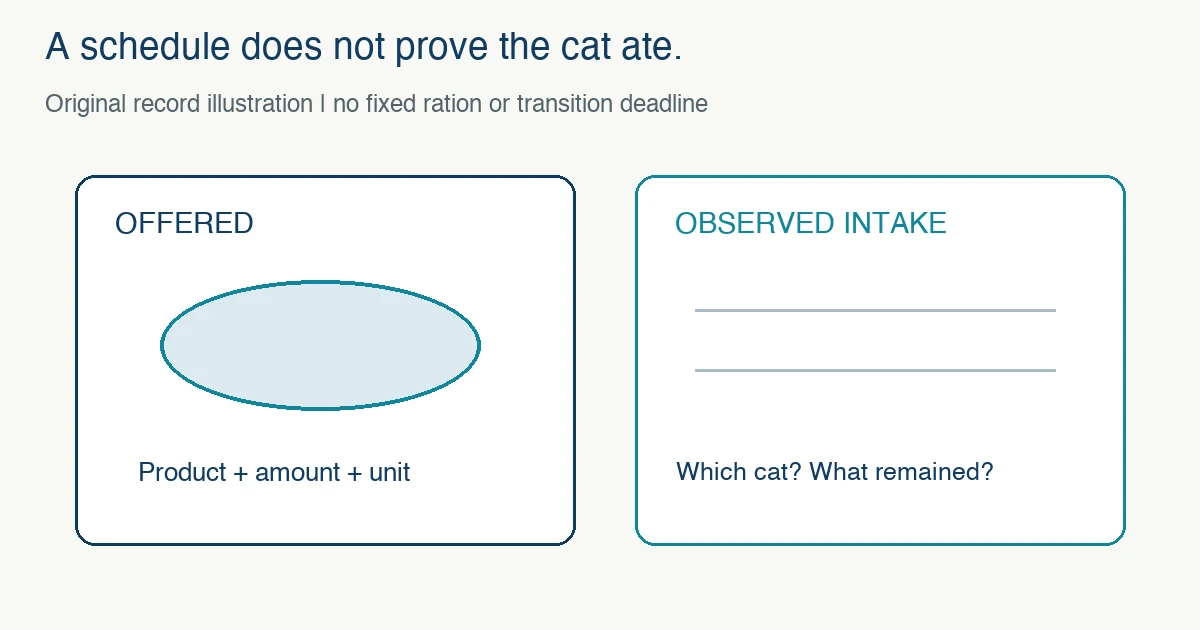
Write “offered” and “eaten” separately. Food disappearing from a shared bowl cannot reliably be assigned to one cat. Use separate feeding spaces when you need to observe individual intake. A dispensing device's scheduled amount is also not confirmation of consumption.
Here is a record format you can adapt; the headings do not set a feeding target:
| Meal record | What to enter | Keep this distinction |
|---|---|---|
| Food identity | Exact old/new product and form | Brand alone may be ambiguous |
| Amount offered | Weight or clearly labelled pack fraction | Offered is not eaten |
| Direct observation | Cat seen eating and food remaining | Unobserved intake stays unknown |
| Other changes | Vomiting, stool change, appetite or activity | Record facts; do not diagnose |
With wet food, a leftover weight after time exposed may not give an exact consumed amount because the food can change. Keep the method and limitations in the record rather than presenting an estimate as a clinical measurement.
Ask for help when intake or wellbeing changes
Contact your veterinary team about refusal, a sudden appetite change or illness during the transition [1]. Provide the actual products, dates, amounts you offered, what you directly observed and any vomiting or stool changes. Do not label every symptom “normal adjustment” because it followed a switch.
If your cat is unwell, ask before repeatedly offering a planned long-term new diet. AAHA's handout discusses learned food aversion associated with nausea [2]. This is a reason to get a clinical plan, not to diagnose nausea at home or use appetite stimulants, supplements or force-feeding without instructions.
For an unavailable or withdrawn product, a gradual change may not be possible. Do not use recalled, spoiled or otherwise unsuitable food merely to complete a timetable. Contact your veterinary team and the manufacturer as appropriate about a safe replacement; state that the familiar food is unavailable and what the cat is actually eating now.
Leave a clear plan for the next caregiver
Write down which food is currently accepted, the intended new product, current amounts and the next review or contact instruction. If someone else feeds the cat, give them the actual labels and a way to report reduced intake rather than telling them only “we are on day four.”
Completion means the intended suitable diet is being eaten in the agreed amount and can be maintained. Continue monitoring within the veterinary plan and retain the record for discussion. A cat finishing a new bowl once does not establish a nutritional assessment, treatment success or a guarantee that the transition is complete.