
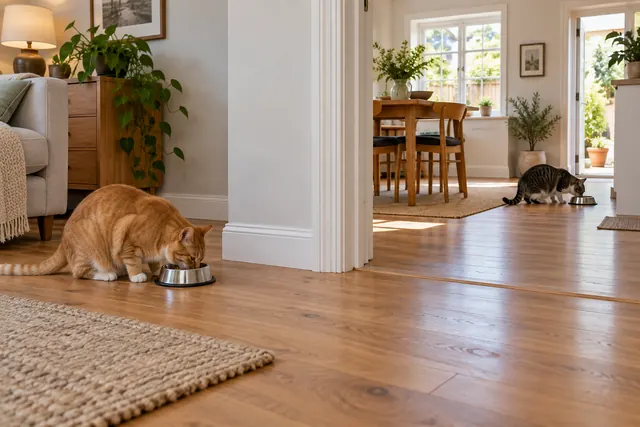
Establish what each cat should receive
When cats share meals, an empty bowl cannot tell you who ate the food. Begin with an individual feeding plan: product, agreed allowance, meal arrangement and any veterinary diet instruction for each cat. Do not divide one household total equally unless that is the appropriate individual plan.
Cornell's feeding guidance explains why product and nutritional suitability matter [1]. FelineVMA's multi-cat resources emphasize access to separated essential resources [2]. The steps here help you manage meals without guessing a nutritional prescription.
Choose locations with usable approaches
Look at the route to each bowl and whether one cat can stand between another cat and the meal. Two bowls inches apart may not provide meaningful separation. Where necessary, use different rooms or a safely separated area during feeding.
Plan what happens when a meal ends: who removes leftovers, when a door opens and whether a faster eater can enter the other space. A feeding station must be safe and practical for the caregiver too.
Run one observed meal
- Prepare the correct labeled portions separately, using the cat's name on each note or container.
- Put each cat in their familiar, suitable feeding location without forcing a confrontation.
- Observe who ate, the amount offered and any leftovers. Keep the units consistent.
- Remove or store remaining food according to the product's instructions.
- Record whether another cat approached or blocked access before changing the next meal.
If an unwell cat needs a different schedule or diet, confirm the arrangement with your veterinary team rather than relying on this general workflow.
A small-apartment example
One cat eats quickly in the kitchen while another abandons a bowl nearby. A trial could put the second cat in a familiar quiet room for the meal, with its own resources and a planned door-opening time. Keep its food and portion unchanged while testing location.
Record whether it approaches and eats in the new space. If the cat still refuses food, do not keep rearranging rooms while delaying veterinary contact. Cornell advises prompt attention to appetite loss [3]. This example does not establish whether another cat, illness or a food issue caused the change.
Consider equipment only after the workflow
A selective feeder may help some households, but check which cat can actually access it and whether another can take food beside them. Confirm training, identification method, cleaning and power behavior for the exact product. Do not buy an expensive feeder as proof that separate diet instructions will be followed.
For a cat that grazes, discuss how monitoring and separation can work with their plan. A solution that leaves one cat without access for long periods is not suitable simply because it prevents stealing.
Convert and divide correctly
Use the label calorie converter for each food separately. Use the portion planner only after a daily gram allowance is established. Different products and cats may need different entries; equal grams do not imply equal energy or equal needs.
What to record for a useful follow-up
Bring the food label, each cat's allowance, leftovers, timing and a sketch of feeding locations. Ask whether a diet change, different meal schedule or additional assessment is appropriate. Review multi-cat resource routes if the same access problem affects water, litter or rest too.