
Choose for the cat and the journey you actually need
Start with three questions: can this cat rest and reposition in the usable space, can you load and unload it safely, and can you clean and reassemble the carrier correctly? A weight label alone does not answer those questions. Cats Protection advises checking comfort, security, openings and ventilation, not simply choosing by appearance [1].
For ordinary veterinary visits, a removable top can allow the cat to remain in the lower section during examination; Cat Friendly Homes describes this advantage alongside entry, privacy and cleaning considerations [2]. For a planned flight or another transport service, check that operator's current requirements before purchasing. A manufacturer's general travel description is not acceptance for your particular booking.
Distinguish usable interior from the catalogue dimensions
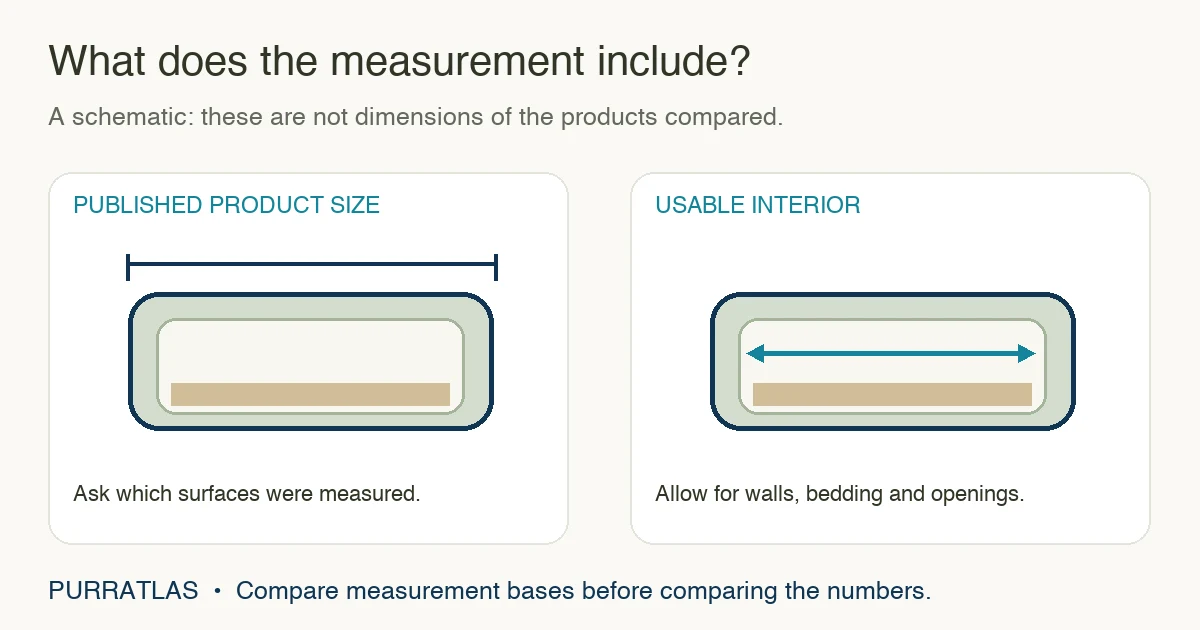
Record each measurement with its meaning and units. An exterior length includes the shell; an interior measurement may describe a different space. Bedding, curved walls and a projecting door can also affect the space available to the cat. Do not compare one product's internal dimensions with another product's unspecified “size” as though the figures were interchangeable.
When interior dimensions are not published, ask the manufacturer what was measured. Ask about usable floor space, height with bedding fitted, and the actual entrance opening. If a listing gives only a maximum pet weight, keep that as a manufacturer limit rather than converting it into a guarantee of fit for a long-bodied or tall cat.
Before purchase, write down what you need to check in person or through a returnable trial. Watching your cat's ordinary posture is more relevant than forcing it into a box to see whether a seller's weight claim works. A carrier that closes around a cat is not automatically a carrier in which that cat can reposition comfortably.
A specification-based comparison, not hands-on testing
The following are two examples of how to read manufacturer information, not a “best carrier” ranking. PurrAtlas has not physically tested either model. We checked the official pages on 9 October 2026. Prices, stock, customer ratings and veterinary approval claims are not included.
| Field to verify | Petmate E-Z Load Two Door, 24-inch option | Catit Cabrio, Blue-Gray #41372 |
|---|---|---|
| Published measurement and basis | Product note identifies 21 L × 14.5 W × 13.5 H inches as interior dimensions for the 24-inch option [3]. | Specification page lists 20 × 13 × 13.75 inches, also 51 L × 33 W × 35 H cm. It does not identify this as usable interior space [4]. |
| Material information actually checked | Manufacturer describes plastic and steel-wire construction [3]. | The reviewed specification page does not identify the exact body material. Ask the manufacturer rather than assuming a resin from the photograph [4]. |
| Entry information | Manufacturer describes two-door/top-loading access [3]. | Manufacturer describes a front door and a top that opens to either side [4]. |
| What still needs checking | Usable entrance dimensions, bedding clearance, assembly and the exact option being ordered. | Usable interior and entrance dimensions, material information, bedding clearance and the intended transport arrangement. |
The table deliberately leaves gaps visible. It does not show that one carrier is larger inside than the other. It also does not substitute the Petmate 19-inch option or another Catit product when comparing a seller's listing. Save the exact model, color/size option and source page with your notes.
Test the opening and the cleaning task before committing
Think about two separate operations: getting the cat in at home and allowing access at the practice. A top opening can help with placement, while a removable upper shell may help a veterinary examination. These are different features, and the product label “top loading” does not tell you whether the entire upper half detaches. Check the actual instructions and ask the practice what access would help for this cat [1,2].
For cleaning, consider the door, corners, bedding and any removable parts. Cat Friendly Homes recommends an easy-clean carrier with a leak-proof bottom [2]. Write down how you will remove, wash and dry the bedding and reach the surfaces beneath it. Use the manufacturer's cleaning instructions; “plastic” alone does not establish that a particular chemical or dishwasher cycle is suitable.
If you dismantle the carrier for cleaning or home familiarisation, practise reassembly before a journey is due. Check all fasteners and door closures after putting it back together. Missing clips, a damaged hinge or a door that does not close correctly are practical issues to resolve before transport, not details to overlook because the model has good reviews.
Keep car restraint and carrier fit as separate decisions
A handle, carrying strap or advertised seatbelt connection is not evidence of crash protection. Catit describes routing a seatbelt through its handle [4], while Cat Friendly Homes refers to Center for Pet Safety guidance that distinguishes crash-tested carriers from others when discussing backseat placement [2]. Do not turn those statements into a homemade mounting method.
If vehicle protection is part of your buying decision, inspect the current Center for Pet Safety certification information and the instructions for the exact model and setup [5]. This guide does not claim that either example above is certified. A certification for one product, size or arrangement must not be transferred to a similar-looking carrier.
Resolve unclear or conflicting installation instructions with the manufacturer before travel. Do not rely on an affiliate roundup, a customer photograph or a belt fitting through a gap to prove that an arrangement has been evaluated. Airline fit, cabin acceptance and vehicle crash protection are also different claims; none follows automatically from the other.
Write down why an option passes or fails for your household
Illustrative comparison: a household is considering a 24-inch Petmate option because the published interior dimensions are useful, but has not checked the entrance or usable height after adding bedding. Its decision remains provisional. Another household likes the Catit side-opening arrangement but needs confirmed interior measurements before judging fit. Neither needs to invent a winner from incomplete figures.
Keep a short decision note: exact model and option; which dimensions are internal; unresolved questions; how it opens; cleaning and reassembly steps; and the transport requirements it must meet. Do not record “vet approved” unless you have a real, relevant approval to explain. The examples are invented purchasing situations, not customer experiences.
Once a suitable carrier is available, work separately on voluntary entry, door closure and movement. Buying a different box does not by itself establish comfortable travel. If your next journey is for a newly adopted cat, bringing a cat home covers the separate arrival and settling-in plan.