
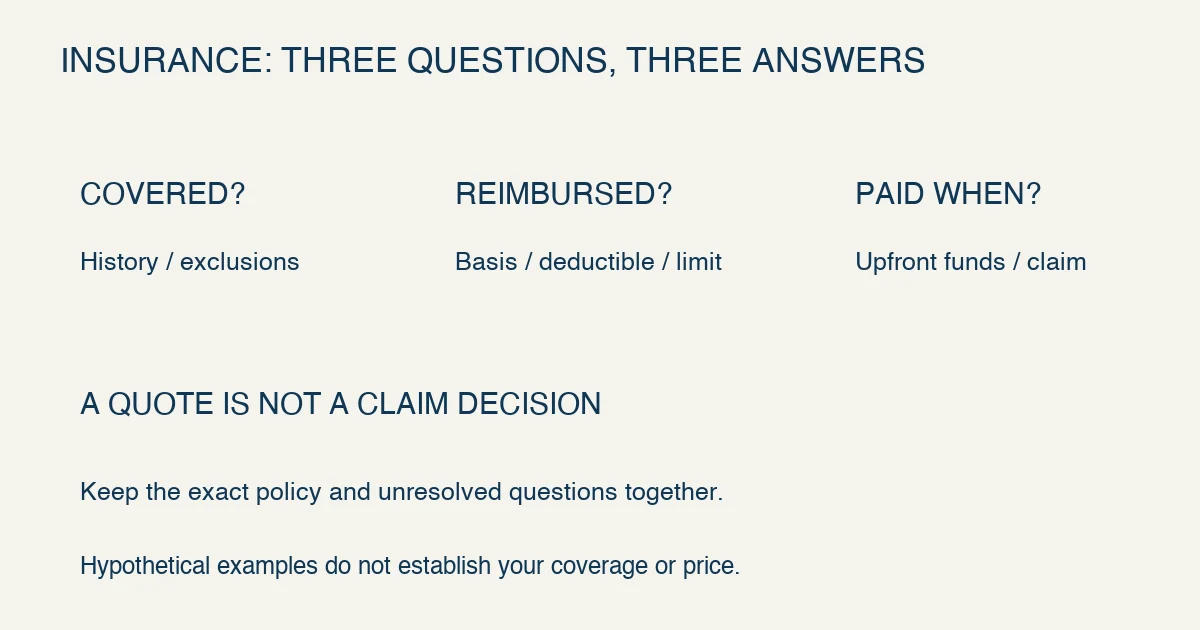
Compare cat insurance using the policy wording, your cat's medical history and the money you could actually access during a veterinary visit. A low monthly quote or a large reimbursement percentage does not answer all three questions. This US-focused guide helps you prepare a comparison; it does not select an insurer, guarantee a claim or give individualized financial advice.
Most policies reimburse specified expenses and have exclusions, deductibles and limits. Some use a benefit schedule rather than a percentage of your actual bill. NAIC describes these differences, so two products called “pet insurance” may produce quite different outcomes. [1]
Decide what problem you want the policy to cover
Separate unpredictable accident or illness costs from routine planned care. Write down the kinds of expenses you want help with: emergency assessment, hospitalization, ongoing prescribed medication, dental illness or specialist investigations. Then check whether each is included in the actual product. Do not assume that an accident-and-illness name includes every examination fee, dental procedure or preventive service.
NAIC identifies accident-only, accident-and-illness and wellness categories, but describes variations within them. Its consumer guidance also distinguishes insurance from veterinary wellness programs and discount arrangements. A discount at participating practices is not the same promise as reimbursing an eligible insured claim. [1][2]
Ask the seller for the sample policy, exclusions and applicable endorsements for your state, not only a marketing summary. Keep the quote date, legal insurer name, product version and cat details together. A comparison made for another age, address or coverage level cannot establish your own price.
Resolve the medical-history question before switching
Send accurate records and ask how the policy defines a pre-existing condition. Bring dates of symptoms, advice, investigations and treatment, including unresolved problems. Do not hide an earlier observation because there was no final diagnosis. Ask how the insurer assesses the history and whether it can provide a written coverage review before you rely on the policy.
Most insurers exclude pre-existing conditions according to NAIC; the exact definition and any exceptions must be checked in the contract. California's insurance department specifically tells consumers to ask about prior advice or treatment and waiting periods. Its guidance is a California consumer resource, not a statement that every state or every contract uses identical rules. [1][3]
Ask about hereditary and congenital conditions separately. “No previous illness” does not by itself answer either question. Record what the policy says about your concern, rather than inferring coverage from an advertisement showing a cat of the same breed.
Switching is not just replacing one premium with another. Ask what happens to a condition covered by the current policy if you move to a new insurer, how the new waiting period works, and whether any gap is created. Do not cancel existing coverage on the assumption that a quote already means accepted, effective and equivalent coverage. A renewal or transfer question deserves a written answer specific to the policy. [2][3]
Understand the bill before comparing percentages
For each candidate, identify the reimbursement basis, the deductible, when that deductible resets, the reimbursement percentage or benefit schedule, and any annual, lifetime or condition limit. Ask for a worked explanation of one bill containing both eligible and excluded items. The order of the calculation matters; this page cannot supply a universal formula for every insurer.
Here is a deliberately simplified hypothetical example, not an insurer quote or a prediction. Suppose the bill is $1,200, of which $1,000 is eligible. Assume this particular example subtracts a $250 remaining deductible from eligible expenses and then reimburses 80%, with no other limit applying. The result would be $600: ($1,000 − $250) × 0.80. The owner's final share would be $600, including the excluded $200. Applying 80% to the entire $1,200 bill would misrepresent this example.
Change the eligibility decision, calculation order or remaining limit and the answer changes. Ask whether the quoted deductible is annual, per condition or another arrangement, and whether a claim earlier in the period has already used some of the benefit. California's consumer questions expressly address deductibles, coinsurance, limits and reimbursement schedules that may differ from the billed charge. [3]
An “unlimited” headline still needs its surrounding terms read. It does not remove exclusions, eligibility decisions or your share of expenses. Keep a comparison note with the exact clause for each uncertain item, rather than assigning an overall score from the percentage alone.
Plan for the day of treatment, not only reimbursement
Confirm who pays the veterinary practice and when. NAIC explains that owners often pay the full bill first, while some arrangements pay the veterinarian. Ask both the insurer and the practice whether any direct-payment arrangement actually applies to the proposed visit. [2]
In the hypothetical example above, the eventual reimbursement of $600 would not necessarily reduce the amount required at reception that day. If upfront payment applies, the household still needs access to the $1,200 bill while the claim is assessed. A reimbursement promise and immediate available funds are different resources.
Ask how claims are submitted, what documents are required, how questions are handled and what the insurer says about processing time. Do not treat a marketing time estimate as a guaranteed settlement date. Identify who in the household keeps the itemized invoice, clinical record and claim correspondence.
Include the premium and predictable excluded costs when reviewing affordability. Do not postpone urgent veterinary contact while waiting for a coverage answer. Tell the practice about payment constraints so it can explain the actual available options; this page cannot promise credit, charity support or payment plans.
Keep the comparison usable when the policy changes
A useful comparison ends with unresolved questions, not only a winning price. For example: “Does the sample clause include examination fees for this service?” and “What is the written history assessment for the earlier vomiting?” are more actionable than “good coverage.” Mark unanswered questions before buying.
Review the renewal notice for the premium, deductible, limits and terms. Ask what changed and whether a previously covered ongoing condition remains covered. NAIC's consumer page specifically raises renewable-benefit questions; it is an older 2018 resource, so verify the present contract rather than treating that article as current provider-specific terms. [2]
For US licensing or a dispute, use your state's insurance department. NAIC directs consumers there; an online recommendation or a veterinary practice's willingness to treat the cat is not verification that a seller is licensed. [2]
Keep health information factual using the vet-visit record guide. If you are comparing care providers as well as payment arrangements, check services, communication and referral access directly rather than using insurance acceptance as the only measure of a practice. This page contains no affiliate ranking, verified premium quote or claim-success claim.