
Plan for adult supervision and a cat that can leave
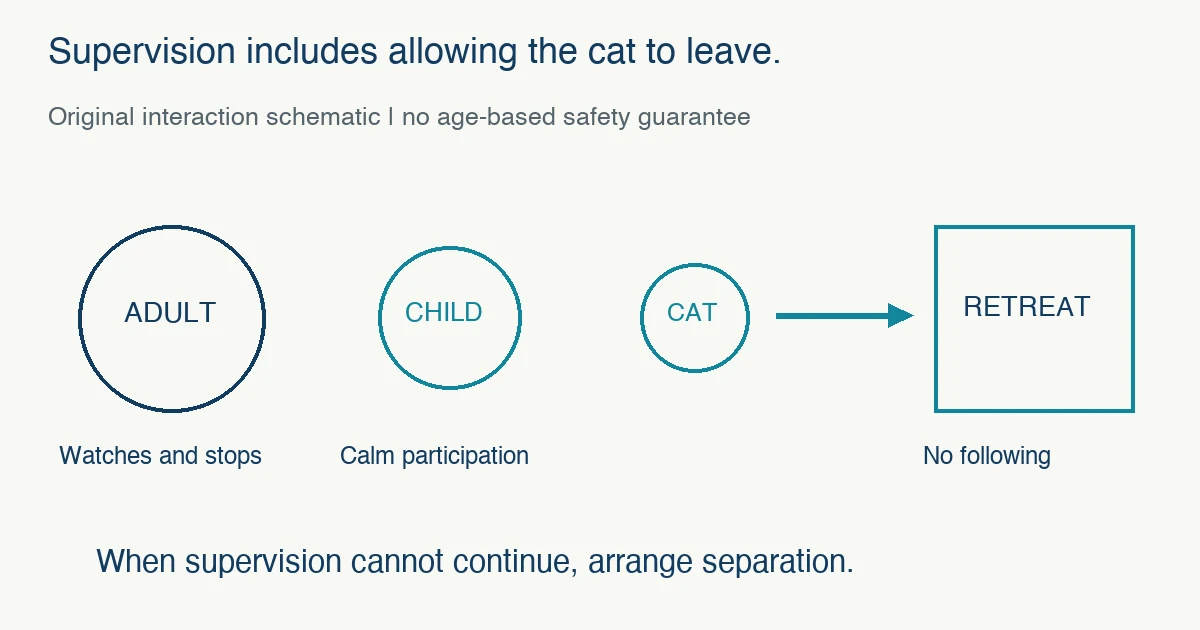
Begin with two practical conditions: an adult can supervise the interaction, and the cat can return to an undisturbed place. Cats Protection advises supervising cats with children and allowing the cat to retreat [1]. That matters for a familiar family cat as well as a newly adopted one. Previous gentle contact does not make chasing, grabbing or cornering acceptable today.
For a new cat, first let it settle into its starting room and become comfortable with the adults. Use the new-cat settling guide to prepare that space. Meeting a child is a later choice for the cat, not a welcome-home event that must happen on arrival. A calendar deadline is not evidence that the cat is ready.
The objective is a manageable shared home, not a cuddle or photograph. A child observing a cat calmly from a distance can be a successful interaction. If you cannot supervise because you are cooking, taking a call or leaving the room, arrange separation rather than rely on instructions the child may be unable to follow.
Give the retreat a rule the whole household can enforce
Choose a quiet place the cat can reach and leave without passing through a crowd. Keep the cat's resting and toileting areas protected from children. Cats Protection discusses quiet resource locations and child-free spaces [1]. An adult should check the actual setup: a gate may help manage the child's access, but this guide has not certified any gate as suitable for a particular child or cat.
Explain the rule in concrete terms: when the cat goes to that place, nobody reaches in, calls it out repeatedly or follows it. Maddie's Fund's San Francisco SPCA handout emphasises respecting hiding places and the adult's ultimate responsibility for both children and animals [2]. A refuge is not useful if adults retrieve the cat whenever a visitor wants to meet it.
A higher perch can offer distance, provided the cat can also get down and the furniture is stable. A cat with movement difficulties may need a ground-level refuge instead. Do not treat height as the only way to protect a cat; the indoor-life guide helps assess routes and accessible resources.
For a hypothetical visit, two children enter and the cat moves beneath its usual chair. The adult redirects the children to another activity and keeps that area undisturbed. Pulling the cat out to “show that it is friendly” removes the very option the setup was meant to provide.
Prepare the child before inviting an interaction
Agree on a few observable actions: sit quietly, let the cat approach, keep hands away from the tail and paws, and stop when the cat leaves. Explain that sleeping, eating, drinking and toileting are times to leave the cat alone, following Cats Protection's advice [1]. Adults should demonstrate the same rules rather than ask children to behave differently from everyone else.
Adjust the activity to what the individual child can manage. A child who currently grabs or lunges needs more distance and a different activity, not repeated chances to hold a cat. An older child's understanding also needs checking in practice. This page does not set an age that makes unsupervised contact safe.
Ask before involving an unfamiliar cat, including one belonging to a friend. Obtain the caregiver's instructions and respect a decision not to introduce it. A relaxed cat observed through a barrier or from across the room can still be worth learning about without touching it.
For the first meeting, keep the setting quiet and the retreat available. Let the cat choose whether to approach. Avoid bringing it to the child's lap or holding it in place while the child strokes it. Cats Protection recommends gradual meetings, voluntary approach and no forced proximity [1]. Repeating a meeting is useful only if the conditions remain comfortable; it is not a fixed exposure quota.
Choose participation that keeps hands out of the game
Observation, helping an adult prepare the correct meal and supervised toy play offer alternatives to picking up the cat. Adults remain responsible for the food amount, safe handling and whether the activity is suitable. A child participating in care does not become the person responsible for checking that the cat has eaten or received its prescribed treatment [2].
Cats Protection advises against using fingers or toes as play targets and recommends toys that keep the game away from the body [3]. Choose an activity the supervising adult can control. A wand toy requires supervision and appropriate storage; it is not something to leave with the cat and child after the adult walks away. Check toys for damage and remove those with parts that could be swallowed or cause entanglement [3]. The safe-toy guide covers those checks.
An adult can demonstrate a short toy movement and stop when the cat no longer wants to participate. If the child waves the toy into the cat's face, grabs at the cat or becomes too excited to follow the arrangement, end the game and change activity. Do not use the cat as a test of whether the child can calm down.
Touching is optional. If the cat approaches comfortably, the adult can model gentle contact and a pause, watching whether the cat stays or moves away. Carrying the cat is not a necessary next stage. Avoid turning a tolerated stroke into an expectation of handling, hugging or being held.
Stop early when either participant is uncomfortable
Watch the whole interaction rather than wait for a bite. Cats Protection describes warnings such as hissing, tail movement, ears turning sideways or back and attempts to avoid contact [1]. These are reasons to give space, not a test that requires the child to interpret every signal perfectly. The adult makes the decision to stop.
| What you observe | Adult action |
|---|---|
| The cat moves away or toward its refuge | Prevent following and leave the route clear. |
| The child reaches into a hiding place or grabs | End contact and redirect the child; protect the refuge. |
| Hissing, tense avoidance or repeated swiping | Separate calmly and review the situation before any new interaction. |
| The adult cannot keep watching | Arrange separation before becoming occupied elsewhere. |
The table is a supervision aid, not a diagnosis or a promise that every bite has an obvious warning. Quietness does not on its own show that a cat is comfortable being held. Do not punish the cat for leaving or warning; forcing the interaction to continue defeats the choice you are trying to preserve.
If avoidance, aggression, changed eating or toileting develops, contact your veterinarian. Cats Protection recommends veterinary assessment before a qualified cat behaviorist when difficulties occur around children [1]. Describe the setting and changes rather than conclude that the cat is jealous or dislikes a particular child. The vet-visit record guide can help organise those observations.
Keep hygiene and injury response under adult control
CDC advises washing hands after handling cats, their dishes or supplies and before eating, and supervising hand washing for children under five [4]. Keep litter boxes away from children and food-preparation areas. A child's care activity can be preparing supplies with an adult or observing a routine; it does not need to include contact with litter.
The 2019 Maddie's Fund handout broadly includes litter cleaning among possible child-care activities [2]. This page uses CDC's current hygiene guidance to keep young children away from litter access and leaves cleaning responsibility with an adult. Do not read a general “children can help” statement as permission for every child to carry out every task.
Teach children to tell an adult immediately about any bite or scratch. CDC states that even a wound that appears minor can transmit germs. It advises immediate washing with warm soapy water and medical attention for circumstances including serious wounds, signs such as redness, pain, warmth or swelling, a sick cat or uncertain rabies vaccination status [4]. Consult a healthcare professional about the child's injury and relevant vaccination questions; this article does not choose antibiotics or rule out infection. Serious injury needs urgent help.
After attending to the child, prevent further contact and review what happened before another meeting. Keep factual details: what the child and cat were doing, where the cat could retreat, whether handling was forced and any previous changes in the cat's health or behavior. Trimming claws or buying another toy does not replace supervision, medical advice or a veterinary assessment when those are needed.
The household plan is ready when adults know who supervises, the retreat is protected, the child has an appropriate activity and there is a clear way to stop. The cat does not have to become a child's playmate for those arrangements to be worthwhile.