
Plan for separation before planning a meeting
Start with the arrangement you can maintain when the animals are apart. A cat needs a dog-free area with usable essentials and a retreat; the dog also needs an appropriate separate space. Cats Protection recommends considering each animal's history, health and reactions, rather than letting them resolve the introduction themselves [1]. Previous peaceful contact with a different animal is useful history, not proof that this pairing is safe.
If the dog has chased, fixated on or injured cats, or you cannot reliably manage separation, seek qualified help before attempting direct contact. Do not use the new cat to test whether the dog has changed. Tell the adoption organisation and your veterinary team about the actual history. This guide cannot assess an individual dog's response or establish that two animals will eventually share a home safely.
Make a household plan for doors, feeding, toileting and supervision before arrival. Name who opens which door and where the other animal will be. An introduction that depends on everyone remembering not to open a single unmarked door needs a more dependable arrangement. If you cannot provide the separate care both animals need, discuss that constraint before proceeding.
Keep the cat's everyday needs inside its protected area
For a newly arrived cat, prepare its quiet room before bringing it inside; do not let the dog wait at the entry to greet the carrier. Battersea recommends separating the animals while the new cat settles [3]. The bringing-home guide covers arrival and first-night arrangements in more detail.
If the cat already lives with you and the dog is arriving, protect familiar resting and resource access rather than remove every existing cat option. Blue Cross recommends a safe area and high places that the cat can use, with essentials unavailable to the dog [2]. Check the route as well as the destination: a shelf reached only by crossing the dog's space is not the same as a reachable retreat.
Keep food, water and litter arranged for the cat, with distinct usable locations. Do not require it to walk beside the dog to eat or use its tray. If the cat has movement limitations, inspect the entry height and route; a high platform alone may not provide an accessible escape. The senior home-products guide explains how to check actual access rather than assume a marketed feature suits every cat.
Plan how you will clean and replenish the cat's area while preserving separation. Place needed supplies where the responsible adult can use them. A hypothetical household stores litter in the dog's room and repeatedly opens both rooms to retrieve it. Moving the supplies is a practical way to reduce those accidental-contact opportunities; it does not establish that the animals are ready to meet.
Check the barrier against these two animals
A product described as a baby gate is not automatically an animal-separation system. Blue Cross points out that small dogs may fit through cat openings and kittens may pass through gate bars [2]. Look at the actual animals, openings and installation instead of relying on the category name.
| Setup detail | Question to resolve before using it |
|---|---|
| Bars, gaps or a built-in cat opening | Can the dog or kitten pass through, or reach the other animal through it? |
| Gate height and mounting | Is the installed barrier suitable for the animals and the doorway, following its instructions? |
| Cat retreat beyond the barrier | Can the cat leave the viewing area without entering the dog's reach? |
| Door used for daily care | Who controls the other animal while an adult passes through? |
These are setup checks, not a certification or a complete installation specification. If a barrier cannot provide the needed separation, maintain closed-room separation and obtain advice before a viewing session. Do not turn an unresolved gap into a supervised experiment to see whether the kitten slips through.
Sources offer different details for confined introductions. Blue Cross describes a large prepared crate for kittens, while Cats Protection warns against placing a cat in a carrier to meet a dog because the cat loses its ability to retreat [1,2]. A transport carrier and a prepared kitten enclosure are not interchangeable. This guide does not instruct owners to confine a cat opposite a dog to resolve a barrier problem. Ask the veterinary or adoption team for a plan suited to the kitten and the actual space.
Separate familiarity from permission for direct contact
Cats Protection describes scent familiarity and viewing through a barrier before direct meetings, with progression based on both animals remaining relaxed [1]. Smelling bedding without a visible reaction is one observation; it is not proof that the dog will respond safely to a cat running across the room.
Introduce unfamiliar scent without taking away the animal's choice to move away from it. Record what happens and preserve the separate areas. Do not push a scented item into a refuge or force handling to collect scent from an unwilling animal. If handling or the item causes distress, stop and ask for guidance rather than insist that the step be completed that day.
For any viewing session, decide the adult roles, distance, separation and ending arrangement in advance. One person cannot closely observe both animals while also changing a barrier or opening a door. Keep essential resources available outside the viewing task so that participation is not required to obtain food or reach litter.
Look beyond an absence of barking. Can the dog redirect its attention, and can the cat leave and return to ordinary activity? Cats Protection identifies fixation, pulling and strong responses to cat movement as concerns, and recommends help rather than advancing after a significant reaction [1]. Record the actual behavior; do not translate a still animal into “calm” without considering the situation.
A direct meeting needs control and a cat exit
Only consider direct contact when the earlier arrangement is working and the animals' responses support progressing, ideally with professional guidance where there is uncertainty. Cats Protection recommends two people, a controlled dog on a lead, a cat that can leave and secure exterior openings [1]. Check the layout before bringing both animals into it.
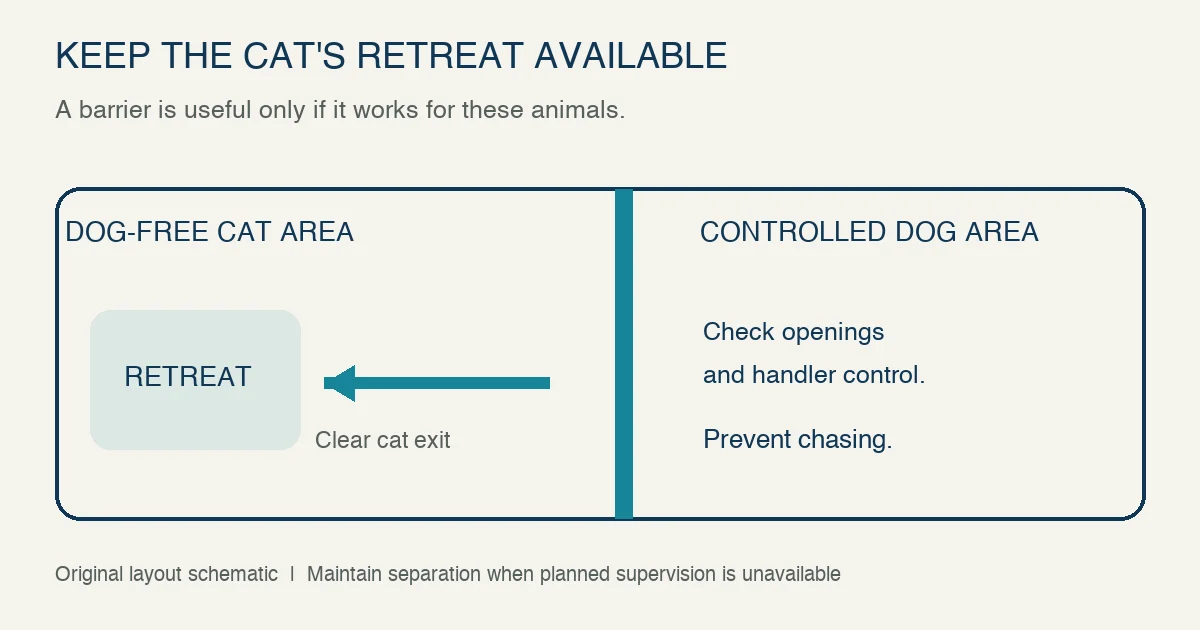
Work out the dog's reachable area using the actual lead and handler position, without putting the cat inside that area to test the distance. Keep the cat's route to its refuge available. Do not hold the cat for the dog to sniff or bring the carrier closer because the cat will not approach. Blue Cross stresses preventing chasing and allowing the cat to choose whether to approach [2].
Battersea advises separating animals that are not getting on and seeking further advice [3]. End the contact before losing your planned control; a session does not need to last until the animals interact. If fixation, pursuit or fear appears, restore safe separation and review the setup with the relevant professional. Do not continue to obtain a photograph of them together or to meet a timetable.
This page gives no physical fight-breaking technique or emergency restraint procedure. If an animal is injured or acutely distressed, contact the veterinarian about that situation. Repeatedly reattempting contact is not a substitute for assessing what went wrong.
Preserve separate options as the household changes
A few quiet meetings do not remove the need for dog-free cat resources and a supervision plan. Keep the cat's food and litter out of the dog's reach, as Blue Cross recommends [2]. Check whether routes remain usable when furniture moves, visitors arrive or the person normally handling the dog is absent.
Record what arrangement was in place when things went well: the room, distance, barrier or lead, handlers and each animal's response. “They were fine yesterday” leaves out the conditions that made yesterday different. Share those notes with everyone providing care and specify separation when the planned supervision cannot happen.
If progress stalls, return to an arrangement the household can safely maintain and seek help. A gradual introduction aims to improve the chance of comfortable coexistence, not guarantee friendship. The decision to continue must reflect these animals and your ability to care for them apart as well as together.