
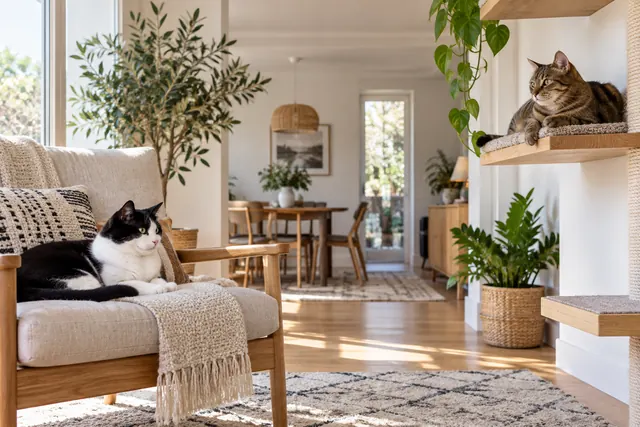
Check each cat's experience separately
A home can have enough bowls and still make one cat wait for another to leave. Begin with each cat's routes rather than a household total. FelineVMA notes that tension can be subtle and may occur even in two-cat households [1]. Absence of a fight is not sufficient evidence that access is comfortable.
On a sketch of your rooms, mark food, water, litter, scratchers, resting places, hiding places and entrances. Use a different mark for each cat's observed routes. Add any location where a cat waits, turns back or is repeatedly watched by another.
Separate capacity from choice
Two bowls side by side provide two servings but one feeding location. A row of litter boxes can share one approach. Cats Protection recommends distributing litter trays in different locations [2]. Consider whether a cat can use a resource without passing another cat's bed or entering a dead end.
Choose the next change according to the map. This might be a second feeding room, a different route to a tray, or a resting place that does not require crossing a shared doorway. Keep a familiar option while testing a new one.
Look for patterns rather than personality labels
Record what happened before deciding why. “Milo sat in the doorway; June waited outside and ate after Milo left” is more useful than “Milo is the boss.” Note staring, chasing, avoidance, hidden resting and changed resource use as observations to investigate, not a diagnosis.
Check the context too: a moved sofa, closed office door or returning cat can change routes. New or persistent changes warrant veterinary discussion; pain and illness should not be ruled out by an environmental checklist.
Work through a two-cat layout example
Suppose both cats are fed in a narrow kitchen and one often leaves its meal. First document the meal and access pattern. Offer that cat a separate quiet eating location with an unobstructed approach. Keep the amount and food unchanged while you observe the location change.
Check that the other cat cannot simply follow and take the meal. If separation is needed, use a safe room during the meal and coordinate opening the door afterwards. See feeding cats separately for a more detailed workflow.
The example is a planning exercise. It does not establish the cause of poor appetite, which may need veterinary attention.
Make a manageable weekly review
- List which resources each cat actually used, not just those purchased.
- Check shared doorways and access after furniture changes.
- Identify one recurring difficulty and make one practical adjustment.
- Record whether both cats can disengage and reach their own options.
- Escalate persistent conflict or health changes to your veterinary team and a qualified behavior professional as appropriate.
Use the home resource checklist for an inventory. Its counts cannot grade relationships or declare a home stress-free.
If you are adding another cat
Do not assume an existing pair will welcome a newcomer or that a companion will fix loneliness. Plan separate starting accommodation and follow the introduction stages. Consider the resident cats' history, the available routes and who will supervise before committing.
Can cats share everything? Some do use shared resources, but provide alternatives and observe access. Must they become friends? No. A workable arrangement respects individual space; a household needing sustained separation deserves an individualized plan rather than more generic tips.