
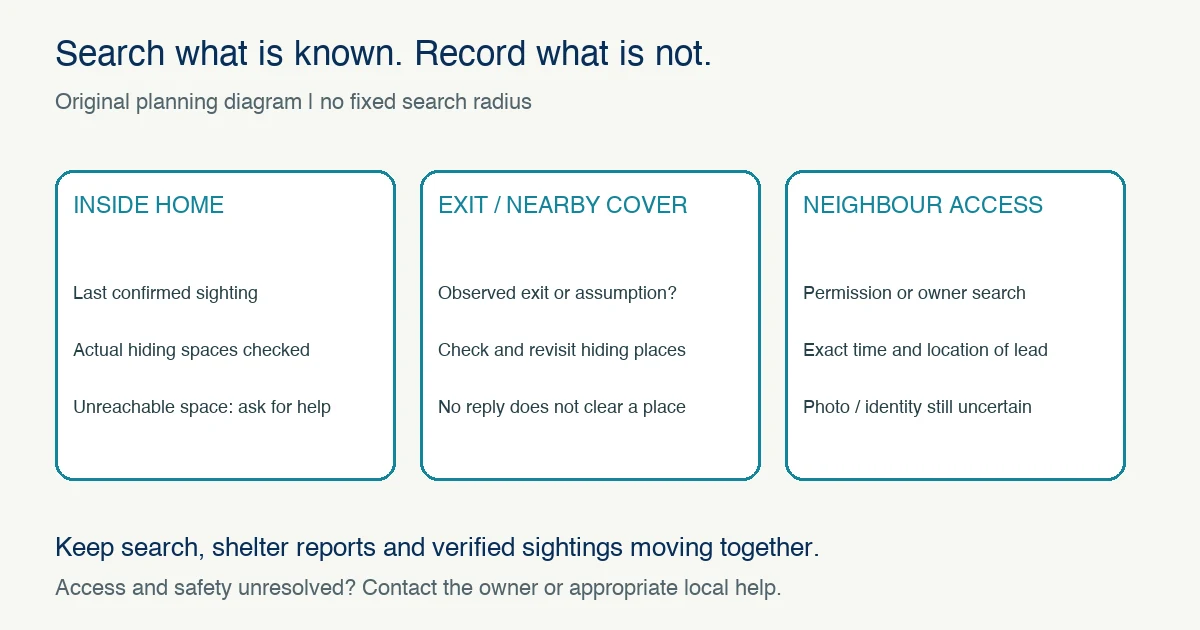
Start searching, even if nobody saw an escape
Search inside the home and the nearby hiding places now. Ask neighbours to help with access, notify local shelters and your cat's microchip registry, and keep a record of sightings. Calling from the doorstep or publishing a poster alone leaves places unchecked. There is no dependable waiting period or distance beyond which this guide can say your cat must be safe.
If the cat is seen injured, trapped in a dangerous place or missing essential medication, contact your veterinary clinic and local animal rescue or animal-control service promptly. Tell them the actual circumstances. Do not enter drains, climb unsafe structures or start a hazardous rescue yourself.
This guide concerns an indoor cat missing from home. A cat missing during a move or journey has a different last-known location; start from the actual incident, not automatically from the home address. The sources below were read on 9 October 2026. PurrAtlas has not conducted recovery trials and cannot promise reunion.
Establish what is known before expanding the search
Write down the last confirmed sighting: time, room or outdoor location, and who actually saw the cat. Separate that from a possible exit. “Door open at 10:00” does not establish that the cat went through it. Ask household members and visitors about doors, windows, deliveries and recent work without spending the search period assigning blame.
Cats Protection advises checking concealed indoor and garden spaces, including cupboards, bedding, appliances and building-work openings [1]. Check appliances before anyone switches them on. A room described as “searched” needs a person to explain what was checked; looking through its doorway is different from checking an accessible hiding space.
SPCA of Northern Virginia recommends starting around the escape point, looking into nearby cover with a flashlight and repeating searches. It notes that frightened indoor cats may stay quiet and that previous outdoor experience and escape circumstances affect the search [2]. No response to a familiar voice is therefore not a completed search.
Use a simple search note rather than relying on memory: “Utility room: cupboard and behind accessible appliances checked by Sam at 10:25; closed wall cavity not accessible; maintenance contact requested.” This is an invented example. It keeps an unresolved place visible instead of silently marking the whole room clear.
Ask neighbours for specific help
Show a clear photograph and ask for permission to check suitable hiding places, or ask the property owner to check them. Cats Protection includes neighbours' sheds, outbuildings and vehicles in its search advice [1]. SPCA NOVA likewise recommends an active search with neighbours, rather than only asking whether they have noticed a cat [2]. Respect property access and personal safety.
Give a request someone can act on: “Could you check inside the shed before locking it, and look at camera footage around the time the door was open?” Record permission still needed separately from places already checked. Avoid assuming that a locked garage was searched because a neighbour said they had not seen anything.
Arrange who receives calls and who continues searching. Use the same photo and contact details across notices so helpers do not have to reconcile conflicting information. The Missing Animal Response Network explains that a displaced cat can conceal itself silently and recommends physical searching alongside publicity [3]. A growing number of shares is not evidence that the nearby spaces have been checked.
Turn a sighting into a usable lead
Ask witnesses to contact you promptly without pursuing or approaching the cat; SPCA NOVA cautions that approaching can frighten it away [2]. Request the exact location and observation time, which direction the cat moved, and a photo or footage if already available. Do not ask someone to chase it to get a better picture.
| Report received | Detail to establish | Search note to retain |
|---|---|---|
| “A tabby was in my yard” | When, where and which visible markings? | Possible match; identity not confirmed |
| A camera clip shows a similar cat | Original time, camera location and direction of travel | Save the clip and compare markings; distinguish recording time from message time |
| Someone reports a cat inside a shed | Is it still there, can the owner provide safe access, and is it injured? | Contact the owner and appropriate help; do not assume access or attempt a hazardous entry |
This is a reporting aid, not a probability score. Keep uncertain leads rather than upgrading them into confirmed sightings. If several people send the same forwarded image, retain the original witness and timestamp; three messages may describe one event.
Notify organisations and verify reports
Cats Protection recommends notifying the microchip company and local vets and rescue organisations, and including a photograph, identifying features, missing date and reachable contact on notices [1]. A microchip is an identification record; contacting the registry does not show where the cat is now. Check that the contact information they hold is current.
For a US search, SPCA NOVA recommends filing a lost report with the local shelter and checking found-cat reports, including neighbouring jurisdictions when relevant [2]. Ask each shelter how reports are matched, whether an in-person check is useful and what their current intake procedure is. This page does not establish a nationwide holding period or promise that every found cat reaches a shelter.
Record the organisation, date, report reference if issued, and next requested contact. Keep the underlying search going while waiting for replies. If a shelter says it has a possible match, use its independently verified official contact details to arrange identification and recovery.
MARN documents scams involving fake recovery organisations, supposed reclaim fees and requests for account-verification codes [5]. Do not share login codes with someone claiming to have your cat. Verify a claimed organisation through its own official contact channel before paying or following a message link. A copied logo or urgent demand is not proof that the cat has been found.
Do not rely on a litter-box lure
Published advice differs. Cats Protection lists used litter among possible familiar scent items [1]. SPCA NOVA advises against putting out a used litter box [2]. MARN also opposes it, while explicitly stating that its proposed territorial-cat mechanism has not been proved in a scientific study [4]. That distinction matters: disagreement is not evidence for a guaranteed lure or a scientifically established outcome in every yard.
PurrAtlas does not make used litter the recovery plan. Prioritise checking hiding places, gaining access and following verified sightings. Do not replace those actions with a claim that the cat will smell its tray from a fixed distance.
If using food, SPCA NOVA says to do so only when it can be monitored; for trapping it recommends guidance from an experienced cat trapper and active monitoring [2]. Contact a local shelter or rescue about suitable help. This page deliberately does not supply a universal trap setup, unattended overnight plan or waiting period before seeking assistance. Other animals, weather, location and the cat's condition need an actual assessment.
Keep the search record current
Review which places remain inaccessible, which were checked earlier and which sightings have useful evidence. MARN describes changes in hiding behaviour and cautions against abandoning an active search for passive methods [3]. A previous negative search is a record of that visit, not proof the location can never matter again.
If your cat is recovered, update notices and organisations so volunteers can stop acting on an obsolete report. Contact the veterinary team about injuries, illness or other concerns and describe what is known about the time missing; do not invent food or medication intake. The veterinary visit record helps separate observations from unknowns.
After the immediate situation, review the actual escape route with the door and window safety guide. Recovery and prevention are separate jobs: identifying an unsecured door helps the next household routine, but it does not replace today's search.