
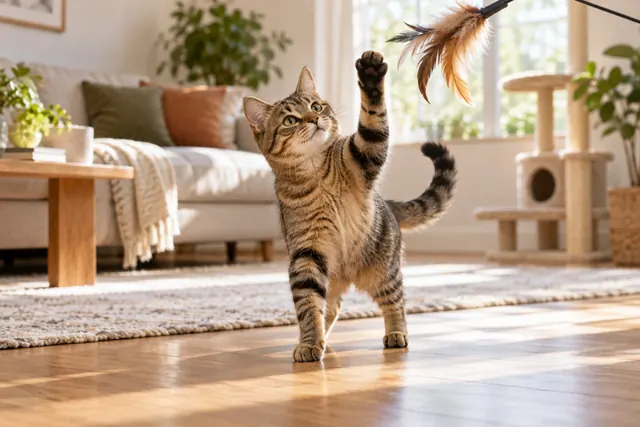
Choose the activity your cat is missing
Enrichment is more than buying another toy. Look at the day: does your cat have chances to watch, investigate, scratch, hide, climb, play and rest without interruption? Cats Protection explains that play can provide opportunities for stalking, chasing and catching [1]. Your starting task is to offer an activity the cat can choose, then observe the response.
Pick one opportunity rather than replacing the whole home. A cat that watches a wand from a distance might prefer slower movement behind a box. A cat that leaves a busy room may need a quieter location before a different toy.
Try three low-cost activities
- A supervised wand game: move the toy away from the cat in short, variable movements. Let the cat watch and approach. Allow a catch rather than keeping the toy permanently out of reach [1]. Keep fingers out of the game and put string toys away afterwards.
- A hiding-and-exploring station: offer a stable cardboard box with a usable entrance. Remove staples, loose tape and handles that could trap the cat. Place it away from essential access routes, then see whether the cat chooses to investigate.
- An easy food puzzle: use a suitable commercial feeder or a safe design from the ASPCA's DIY enrichment guidance [2]. Start so food is readily accessible. Use part of the established allowance and supervise the first attempts; success should not require skipping a meal.
These are options, not a daily quota. Check toys for damage and avoid loose parts that might be swallowed.
Make the first session easy to evaluate
Choose a quiet space and a time when the cat is awake. Offer a brief activity with room to leave. Note the toy, movement, location and response. Stop when the cat disengages; do not chase them with the toy or wake them repeatedly to meet a target.
A useful example record is: “Watched slow wand movement from behind the chair, approached once, then returned to resting.” On the next attempt, keep the movement and try a quieter location. Changing one factor makes the observation useful.
If your cat ignores it
Check the difficulty, timing and surroundings before adding intensity. Make the puzzle easier, move the toy along the ground or offer another texture. Give the cat a choice between familiar and new objects. Some cats will prefer watching before acting.
If a cat suddenly stops engaging in activities they normally choose, record the change and contact your veterinary team. Lack of interest should not automatically be labeled laziness or a need for more exercise.
Keep play separate in a multi-cat home
One energetic cat can interrupt another's session. Try individual sessions with each cat able to access their own resting area afterwards. Do not infer that a chase is friendly simply because neither cat makes noise; look at whether both can disengage and return voluntarily.
For household layout, use indoor home planning. For resource access and repeated pursuit, review multi-cat homes.
Build a routine you can sustain
Keep a small rotation of safe activities and repeat what your cat uses. A successful week might mean finding one enjoyable game and one resting place, not accumulating products. The daily checklist can remind you to observe; it does not certify that an enrichment plan meets every individual need.