
Decide whether a trim is needed
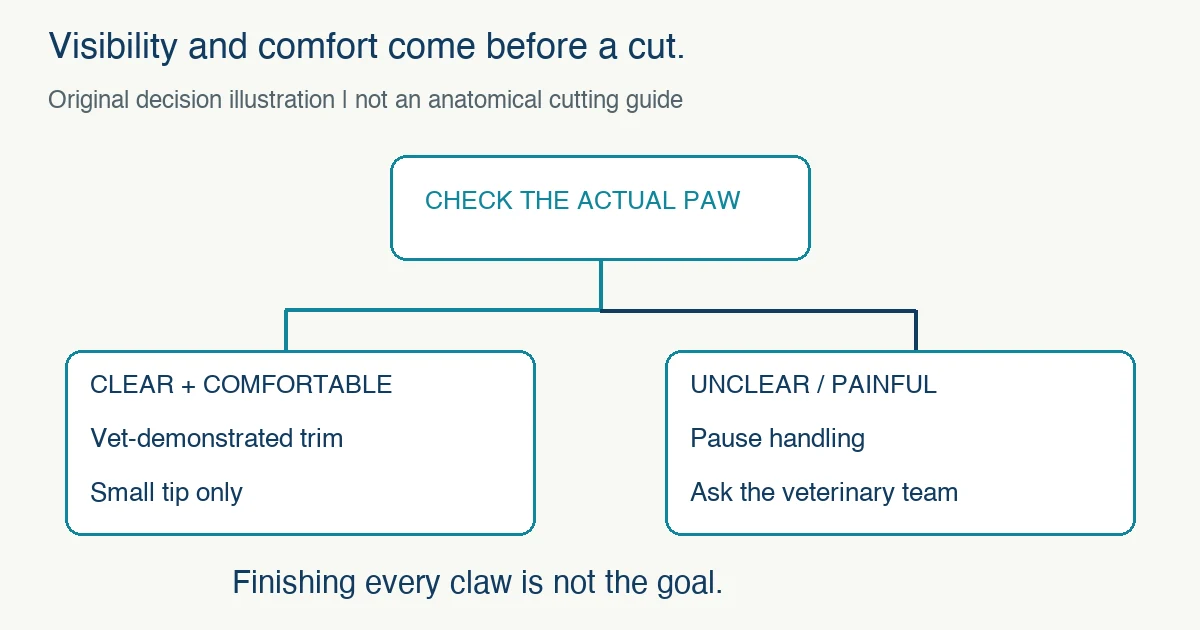
Cat claws are maintained partly through scratching; a sharp tip alone is not a reason to cut every claw on a calendar. Cats Protection notes that young, active cats with suitable scratching opportunities may not need trimming, while older cats or cats with reduced mobility can need help [1]. Check the actual paws and ask your veterinary team what maintenance is appropriate.
Notice repeated snagging, claws that are unusually visible while resting, difficulty retracting them or a new change in movement. These observations can justify a check, but they do not diagnose arthritis or prove that trimming is the only answer. Cats Protection advises a veterinary appointment for changes in the claws or suspected growth into a paw pad [1].
A claw pressing into a pad, an injured claw, swelling, bleeding or a painful paw belongs with the veterinary team. Do not attempt to pull out an embedded claw or treat a wound while following a routine trimming article. If you cannot examine a paw comfortably, tell the clinic that; a struggle is not a necessary first step.
This page is for a small maintenance trim after you have established that it is appropriate. Ask a vet or veterinary nurse to demonstrate the technique on your cat before attempting it yourself, especially if you cannot identify the part to avoid [1][2].
Prepare for visibility and a calm stop
Use clippers designed for cat claws. Cats Protection and PDSA advise against scissors or human nail clippers because they can damage or split the claw [1][2]. We have not tested brands or established that a particular handle suits every person. Ask the demonstrator to check your actual tool, its condition and how you hold it.
Choose a well-lit place where the cat is supported comfortably and you can see the claw without twisting the paw. Have the clippers and any planned reward ready before handling begins. Keep doors and windows secure, as Cats Protection recommends, but do not corner the cat into a struggle [1]. A second calm person can help with reassurance or an agreed reward; their role is not to overpower the cat.
Separate three abilities: accepting a paw touch, allowing a claw to be exposed and remaining comfortable while you position the clippers. A cat accepting the first has not automatically accepted the others. Practise the handling your veterinary team demonstrates without making a cut, and stop when the cat withdraws or becomes distressed.
If safe handling is not possible, arrange professional help. PDSA explicitly advises against forcing nail cutting [2]. There is no benefit in completing the last few claws at the cost of an injury or a much harder next session.
Identify the quick before bringing in the clippers
Gently support the paw and apply very light pressure to reveal one claw, following the demonstration. Do not squeeze the paw or force a toe into an awkward position. Look for the quick, the tissue inside the claw containing blood vessels and nerves. PDSA describes it as red or pink and warns that cutting it causes pain and bleeding [2].
The maintenance cut is confined to the very end of the claw, away from the quick. Cats Protection advises staying with the white part at the tip; PDSA describes leaving a margin from the quick [1][2]. These descriptions are not permission to make a guessed cut when colour, lighting or the claw's condition makes the boundary unclear.
If you cannot identify the quick confidently, do not use a fixed millimetre instruction as a substitute. Ask your veterinary team to show it on that claw and confirm whether it should be trimmed at all. We do not provide a universal cutting line or an anatomical drawing to be used as a measurement guide.
Position the tool only when both you and the cat are steady and the intended small tip is clearly visible. If the paw moves, remove the clippers and reset rather than following the moving toe. You can end the session without making any cut.
Trim a small tip and leave the rest for another session
Following the veterinary demonstration, remove only the small tip that is clearly clear of the quick. Check the claw and the cat's response before considering another. Do not repeatedly shorten it to make the end look perfectly blunt. Trimming is limited maintenance, not removal of the cat's normal ability to scratch.
Cats Protection suggests spacing the task out and working on one paw at a time to avoid distress [1]. Treat that as permission to divide the task, not a requirement to finish an entire paw when the cat is no longer comfortable. One safely completed claw can be the end of today's session.
Check all the claws that your veterinary team has shown you, including the front dewclaws that PDSA specifically notes [2]. Do not assume that counting a typical number tells you which claws this individual cat has or which need attention. Keep a simple record of what was inspected or trimmed so another caregiver does not repeat the same work blindly.
A hypothetical note might read: “Left front paw inspected; small tip removed from one claw; remaining claws not trimmed because cat moved away.” This tells the next person what happened. “All nails done” is inaccurate if you stopped early, and the record should not hide that useful information.
If there is bleeding or a possible injury
Stop trimming. PDSA describes holding cotton wool around a bleeding nail until bleeding stops [2]. Ask the veterinary team for the first-aid method they want you to use and how to reach them before beginning home trimming. Do not continue cutting other claws while an injury needs attention.
Contact the clinic for bleeding that continues, a damaged or split claw, significant pain or a claw involving the pad. If you cannot safely handle the paw, say so when asking for advice; do not force examination or delay care while trying to obtain a photograph. This guide does not set a universal waiting time, remove damaged tissue or prescribe a wound treatment.
Report the paw involved, what happened, whether bleeding has stopped and how the cat is behaving. Record an observation such as limping rather than a diagnosis of its cause. The vet-visit record guide helps organise those facts for the clinic.
Keep scratching available after trimming
Finding a shed outer claw sheath near a scratching place can be normal; Cats Protection distinguishes this from losing the entire claw [1]. Do not pull attached material off a paw or use that explanation to dismiss an injury. If you are unsure what you found or see a change in the paw, ask for advice.
Keep suitable scratching surfaces accessible. A trim does not resolve why a cat chooses a sofa, whether a post is unstable or whether another cat blocks the route. Use the furniture-scratching guide to investigate those choices and the scratcher selection guide for support, material and placement considerations.
Ask the veterinary team how often this particular cat's paws should be checked, especially when mobility or grooming habits change. Base further trimming on the claw condition and the agreed care plan rather than making “every few weeks” a rule for all cats. The useful outcome is comfortable maintenance with clear stopping points, not a full set cut on schedule.