
Plan for leaving with the cat, not only buying a kit
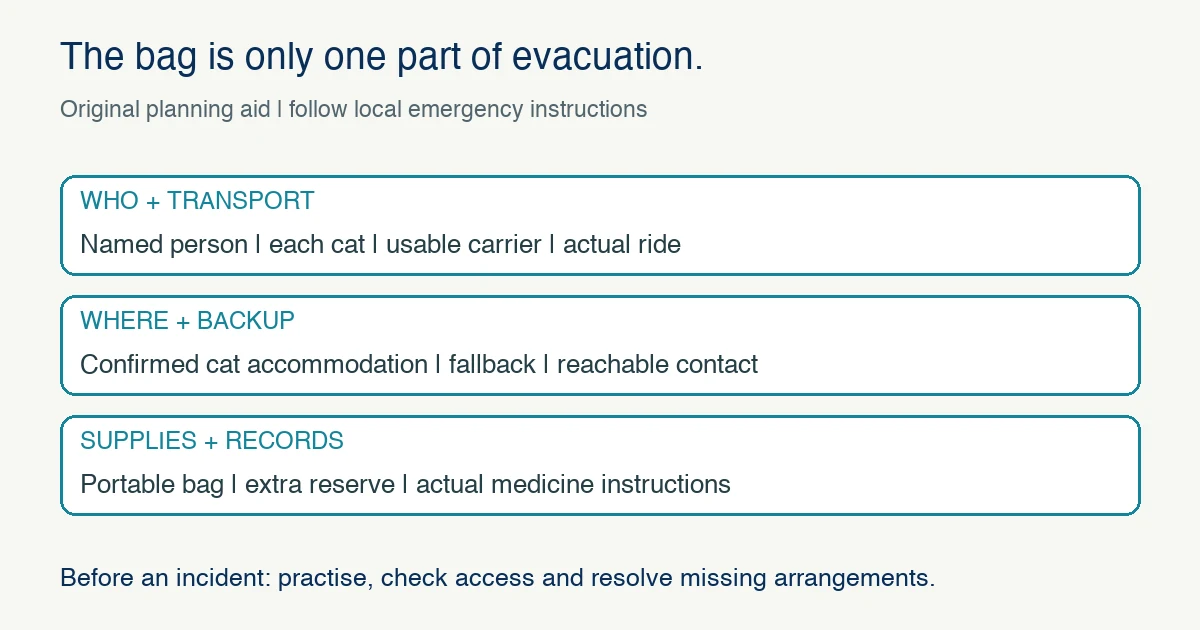
A workable cat evacuation plan identifies who collects each cat, how they travel, where they can stay and which supplies and records go with them. Keep it ready before an incident. Follow local emergency officials' instructions; this article cannot decide whether a building, route or return home is safe.
Ready.gov advises taking pets when evacuating, planning a destination and arranging a trusted backup person [1]. AVMA warns that an apparently short evacuation can prevent access to home for days or weeks [4]. Do not assume leaving extra food means you can return soon enough to care for the cat.
If danger is immediate, contact emergency services and follow their directions. Do not delay a required exit to finish this checklist, and do not enter an unsafe building to retrieve a bag. Tell responders where an animal was last seen if it could not be brought out. The planning questions below belong before the emergency, not in place of emergency instructions.
Confirm a destination and a way to reach it
“Pet friendly” in a search result is not a confirmed place for your cats. Ready.gov notes that many shelters and hotels do not accept pets [1]. Call prospective accommodation, boarding facilities or relatives in advance, and recheck availability when the plan is needed. Ask specifically about cats, the number you have, medical needs, required records and whether animals stay with their owners or in separate care.
Keep the address and contact number available offline. Name a fallback destination and the person who will call it if the first option is unavailable. Follow current official road and evacuation information rather than treating a saved route as open.
CDC recommends arranging transportation help if you do not have a car, practising with the household and locating veterinary care near the temporary destination [2]. A carrier alone does not solve the transport problem. Before an incident, establish who can actually drive, how all carriers fit and whether that person can be reached when you are away.
An invented planning note: “Two cats; two carriers. Lee brings both carriers and the small supply bag. Jo checks the primary destination and carries the records. If Lee is away, the agreed neighbour has access details privately. Destination availability still needs confirmation.” The unresolved last sentence is essential: writing a name is not proof of a reservation.
Prepare for finding and containing each cat
Keep a suitable carrier available for each cat. AVMA's small-animal checklist calls for individually labelled carriers, with contact information [4]. Count the animals actually inside before departure rather than only counting closed carriers.
Ready.gov recommends leaving carriers accessible and familiar and noting hiding places [1]. Work on comfortable carrier entry during ordinary days. Emergency departure is not the time to begin a lengthy training exercise or experiment with a sedative. Ask the veterinary team in advance about any individual medical or handling needs.
For a multi-cat home, write which cat commonly uses which hiding place, who checks that place and where the carriers are. AVMA advises a willing neighbour who knows the animals, access arrangements, procedures and supply locations when you are not home [4]. Discuss the limits honestly: a neighbour is not being asked to disregard evacuation orders or enter a dangerous property.
Practise the actual carrying route while conditions are safe. Can the responsible person carry the cats and bag through the building's relevant exit? For apartments, AVMA includes planning for evacuation via stairs [4]. If the arrangement depends on assistance, resolve who supplies it before describing the plan as ready.
Separate a portable bag from the larger reserve
Ready.gov distinguishes a larger shelter-in-place kit from a lightweight evacuation version [1]. Its webpage says several days of food and water; Los Angeles County lists 7–10 days; CDC's disaster-kit checklist lists two weeks [1, 5, 3]. These are different preparedness lists, not proof that one small bag fits every household or that a particular duration will be sufficient in every incident.
Decide what can be carried with the cats, what additional reserve can travel if transport permits, and how replenishment will be arranged. Follow local preparedness guidance and discuss special diets and medications with the clinic. Do not calculate a universal feline water allowance from a generic shopping result.
| Part of the plan | What to prepare | What remains to check |
|---|---|---|
| Portable essentials | Actual food and feeding instructions; water and usable bowls; litter and tray; waste-cleanup supplies | Can the assigned person carry these with the cats? Can containers be opened without unavailable tools? |
| Identification and records | Recent cat photo, microchip information, contacts and current veterinary documents in protected form | Does the receiving facility require anything else, and are contact details current? |
| Extra reserve | Additional supplies for a longer disruption, with storage and transport locations recorded | Who retrieves them safely and how will they be replenished if access is lost? |
The table is a planning aid, not a purchased-kit evaluation. CDC's list supports food, water, feeding instructions, litter, a carrier, current photos, veterinary records and protected documents [3]. Check actual contents: an unopened commercial kit may not contain your cat's prescription food, current paperwork or correctly sized carrier. PurrAtlas has not tested a commercial evacuation kit.
Keep medication instructions attached to the actual cat
CDC includes prescribed medication supplies and instructions in its kit checklist [3]. AVMA says to identify each animal's drugs, doses and frequency, include refill contacts, maintain freshness and record the location of medication stored elsewhere because of temperature requirements [4]. Copy the current prescription instructions; do not create a dose from this article.
Ask the clinic or dispensing pharmacy how to transport a temperature-sensitive medicine and what to do if storage conditions or supply are disrupted. A note saying “in refrigerator” identifies a retrieval task; it does not establish a safe transport temperature or make a bag appropriate for that product. Record doses actually given during the disruption so the next caregiver does not assume or repeat them.
First-aid lists also need interpretation. AVMA's first-aid page explicitly describes examples to discuss with a veterinarian, not a treatment protocol [4]. Los Angeles County's generic list includes hydrogen peroxide [5]; that entry is not permission to administer it to a cat or improvise poisoning treatment. Ask for an appropriate individual first-aid plan and contact a veterinarian when medical help is needed.
At temporary accommodation, establish the daily care arrangement
Ask the receiving staff where carriers can be opened safely, who feeds the cats, where litter is placed and how health concerns are reported. If the cats are housed separately from you, get the intake reference and the procedure for checking on and reclaiming them. Do not assume a human shelter automatically provides cat care.
CDC's evacuation-centre guidance advises maintaining containment, separating pets from food preparation areas, washing hands after handling pets or waste, and cleaning cat litter boxes at least daily [6]. Use the site's current instructions and veterinary advice for your cats' care. If a cat appears ill, tell staff and contact a veterinarian; do not use stressful circumstances to dismiss a health concern.
Keep the practical care handover with any person temporarily responsible. The important record is what was actually fed, administered and observed, not an assumption that every usual routine continued.
Recheck the home before resuming normal access
Return only as directed by the relevant authorities. CDC advises checking for sharp debris, chemicals and exposed wiring, and notes that changed scents and landmarks can leave pets disoriented after disasters [2]. Permission to return does not remove every indoor hazard or establish that a damaged room is suitable for a loose cat.
Review the evacuation note afterwards: a missing key, inaccessible carrier or unconfirmed destination is a specific repair to make. Update used or expired supplies, changed prescriptions and contact details. The plan becomes useful through those actual corrections, rather than through declaring the bag “complete” once.