
A handover should survive a missed call
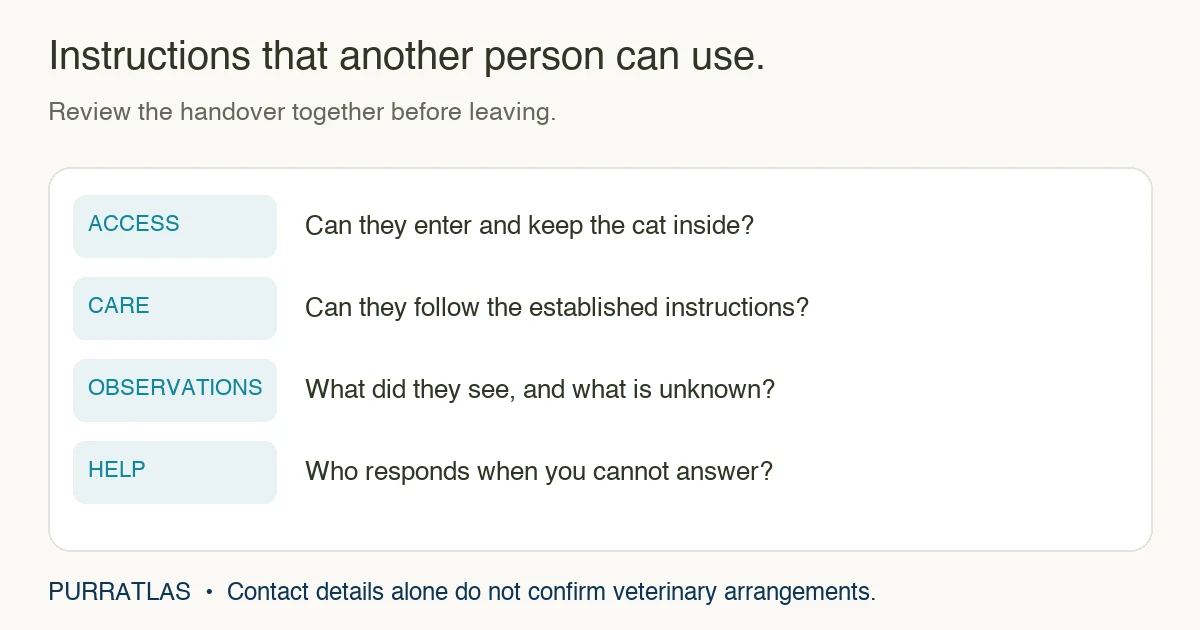
Written instructions are useful only if the sitter can find the cat, enter the home, perform the agreed care and get help when something changes. Put the urgent contact and access arrangements ahead of a long description of your cat's personality. Work through the instructions together before leaving.
Cats Protection recommends an advance meeting, checking the sitter's experience for special care, and arranging a backup for cancellations. Its holiday guidance also calls for daily care instructions, supplies and veterinary contact details [1]. Use that meeting to confirm the actual tasks, rather than assuming a profile mentioning cats covers every need in your household.
This is a guide to preparing and checking a handover. It is not a booking service, a medical protocol or a veterinary consent form. No sitter, availability, insurance or qualification is verified by appearing in an example here.
Demonstrate the visit from the outside door onward
Ask the sitter to try the actual key or agreed entry method while you are present. Explain which doors and windows must stay closed, how to avoid letting the cat out during entry, and what to do if a key fails. Cats Protection specifically advises testing access with the sitter and arranging a backup key [1].
Agree who can supply replacement access and how they can be reached. A spare key inside a locked home is not an entry backup. Share access details privately with the people who need them; do not put keys, entry codes or your travel itinerary in a public cat profile or online checklist.
Walk through the locations of food, bowls, litter trays, waste disposal, cleaning supplies and the carrier. Let the sitter locate the items instead of simply saying they are “in the usual cupboard.” If access depends on an alarm, appliance or electronic lock, confirm the agreed operation and failure arrangement. Avoid relying on a video call from a different time zone to solve a predictable problem.
Identify the cat before assigning observations
For each cat, provide a recent identifying photo, name and distinguishing features. Describe familiar hiding places and normal ways the cat approaches visitors, but do not turn “usually shy” into a reason to ignore a change. Agree how the sitter will report a cat they have not seen and whom they should contact.
In a multi-cat home, a shared empty bowl or a clump in a shared tray does not identify which cat ate or toileted. Ask for what was actually observed, with uncertainty visible. “Milo ate from the blue bowl during this visit” and “the blue bowl was empty on arrival” mean different things.
Do not request that a sitter drag a hiding cat out for a photograph just to complete a report. Discuss any essential identification or monitoring need with your veterinary team beforehand and confirm that the sitter can meet it safely. Use separate feeding arrangements where appropriate, rather than treating an unidentified shared meal as an individual appetite record.
Turn feeding instructions into an executable task
Specify the exact food, where it is stored, the amount and unit, the relevant bowl and the time or agreed visit. Demonstrate the measure you use. “One scoop” needs a named scoop and a demonstration; it is not interchangeable with grams or another scoop. Keep prescribed diets and household food allocations clear.
Write what the sitter should do about leftovers, storage and cleaning based on the actual food and your established instructions. If supplies run low, identify the exact replacement and contact arrangement. Do not ask the sitter to guess a substitute for a prescription diet or change portions because the cat looks hungry.
The following is an illustrative comparison of instruction quality. The amounts are deliberately not filled in: they must come from your cat's real feeding plan, not this article.
| Ambiguous instruction | What to specify in your own handover |
|---|---|
| “Feed as normal.” | Exact product, amount with unit, times or visits, bowl identity and where it is kept. |
| “Check that everyone ate.” | Which cat was observed eating, what remained, and what cannot be assigned to an individual. |
| “Give the usual medicine.” | Current written veterinary instructions, labelled medicine, demonstrated method and a contact for a missed or uncertain dose. |
| “Call me if anything happens.” | Owner contact, backup contact, veterinary and after-hours numbers, and what happens when the owner cannot answer. |
For understanding labels and household measuring, feeding basics is a separate guide. Neither that guide nor a calorie tool supplies a replacement medical feeding plan.
Confirm medication care before agreeing to it
If medication is needed, let the sitter review the current written veterinary instructions and see the method while you are present. Ask them to demonstrate their understanding. Confirm whether they can reliably perform the task and meet its timing; an enthusiastic agreement is not the same as demonstrated ability.
Keep the medicine labelled and the instructions current. Agree how administration is recorded and what to do if the cat refuses, a dose may have been missed, or nobody is sure whether it was given. Those situations need veterinary instructions rather than improvised extra dosing. Do not leave dose calculations or a guessed substitution to the sitter.
If the sitter cannot provide the required care, arrange a suitable alternative with your veterinary team before departure. Do not use a generic visit schedule to cover a cat whose needs require more frequent or specialised care. Cats Protection notes that visit needs can differ for young, older or medically affected cats [1].
Agree emergency authority with the practice, not just the sitter
Pet Sitters International recommends preparing emergency veterinary permission and discussing arrangements when owners may be unreachable. It also notes that a signed form may not resolve every practice's requirements [2]. Ask your practice what it needs from you, and confirm the arrangement before you go.
Record the usual practice, a verified after-hours option, current telephone numbers, carrier location and who can transport the cat. Confirm any payment or authorisation arrangement directly with the practice. Do not write down an invented spending limit from a template, or assume every emergency service accepts the same paperwork. This article does not establish a legally valid consent document.
Agree how the sitter contacts veterinary help when there is a concern and how the owner and backup are notified. The plan should not require an unanswered holiday call to be the sitter's only next step. Ask the practice for advice relevant to this cat's conditions and care plan; a sitter's daily message is not a substitute for professional assessment.
Request a factual report and close the final handoff
An informative visit report records date and time, cats seen, food offered and what was observed eaten, water and tray tasks completed, medication recorded under the established plan, and concerns or uncertainties. Ask for concise facts rather than a reassuring “all good” that leaves the essential observations unspecified.
Illustrative report: “7:20 p.m.: Juniper seen eating from her labelled bowl; Rowan not seen. Shared tray scooped, individual use unknown. Called the agreed backup about Rowan according to our handover plan.” This is an invented writing example, not a real visit, proof of health, or a universal escalation threshold.
Confirm what happens if the sitter is unavailable, a visit cannot be completed or your return is delayed. Record the final visit and how you will tell the sitter you are home; do not let care end solely because a flight was scheduled to land. Arrange return of keys or revocation of temporary access through your agreed private process.
Your handover is ready when the responsible people can carry it out and explain the unresolved points. If entry, medical care or emergency contact remains uncertain, fix that arrangement before treating the checklist as complete.