
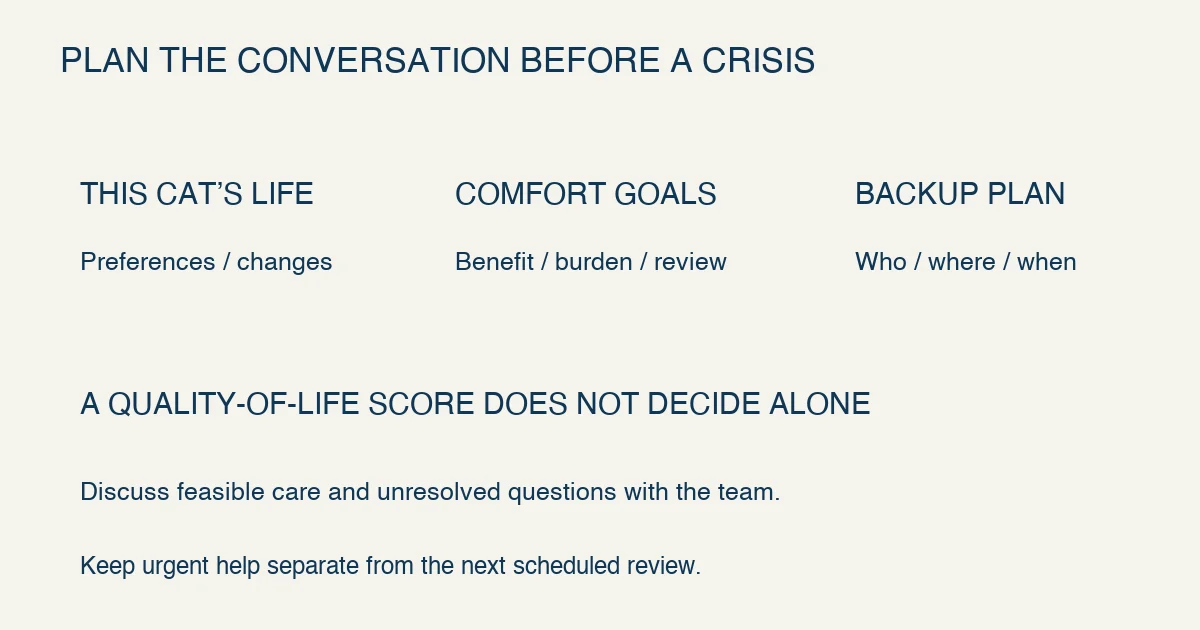
An end-of-life discussion is a conversation about your cat's comfort, what care can realistically achieve, and what to do when the situation changes. You do not need to wait for a crisis to ask for that conversation. Nor do you have to arrive already knowing the answer.
Bring concrete observations and ask the veterinary team to explain the condition, options and likely burdens. A quality-of-life sheet can organize questions, but it cannot make an individual euthanasia decision from a score. FelineVMA recommends discussing quality of life and planning with the veterinarian; AVMA describes the decision as personal and supported by clinical advice and people you trust. [1][3]
Begin with the cat's own ordinary life
Describe what normally matters to this cat: resting in a chosen spot, grooming, using the litter box comfortably, watching a window, eating willingly or seeking company. These need not be energetic activities. An older cat's quieter preferences are still useful reference points.
Record what changed and when. Instead of writing only “bad day,” note the difficulty: could not settle comfortably, stopped a favored interaction, needed help reaching water, or left meals untouched. Distinguish an observation from your interpretation. Hiding may have several causes; a note about its timing and context is more helpful than deciding it certainly means one thing.
FelineVMA suggests tracking normal behavior and changes across time and discussing pain, hunger, hydration, hygiene, enjoyment and mobility. [1] You do not need to reconstruct a perfect lifelong journal if none exists. Start with what you genuinely know and mark uncertain details.
Ask how the team wants you to use any scale or calendar. A total can obscure one severe problem, and a single enjoyable moment does not erase prolonged distress. Keep the underlying observations available rather than relying only on an average or number of good days.
Ask what each care option is trying to achieve
Have the veterinarian explain whether an option is intended to treat the illness, relieve a symptom, support daily function or provide comfort while the illness progresses. FelineVMA distinguishes palliative symptom relief from hospice care focused on comfort during advanced or life-limiting illness. [2] Neither term means abandoning the cat or ignoring a new problem.
For each proposed option, ask what improvement would look like, how soon it should be reviewed and what difficulties to report. Ask which parts can be done at home, what demonstrations you need and what the cat may find burdensome. “More treatment” and “more comfortable time” are not automatically equivalent.
In a hypothetical discussion, the aim may be comfortable eating and resting rather than restoring jumping to a high shelf. Make that aim explicit so you and the team can judge whether the plan helps. If the cat remains uncomfortable despite the agreed measures, contact the team; do not keep extending a trial merely because the calendar has more empty boxes.
Tell the team about physical, emotional, time and financial limits. FelineVMA's hospice guidance specifically asks caregivers to discuss those constraints so the plan is realistic. [2] Saying that you cannot safely give a medicine or provide overnight observation is information the plan needs, not evidence that you care less.
Make comfort care possible in the actual home
Ask whether resources should be moved closer, whether entry heights are manageable and how hygiene or grooming can be supported without distress. Keep familiar resting places accessible and provide choice about company. FelineVMA describes access to food, water, litter, safe resting areas and appropriate scratching opportunities as part of comfort care. [2]
Describe a route rather than simply buying a “senior” product. If the cat rests in one room but the litter box requires stairs and a high step, identify those obstacles. The arthritis home-care guide can help prepare an access discussion; it does not establish the cat's diagnosis or supply pain treatment.
Ask for a demonstration before attempting unfamiliar care. If appetite falls, discuss nausea, pain, nutrition and the care goal rather than repeatedly forcing meals or hiding medicines in every favored food. FelineVMA warns that medication hidden in regular food can lead to food avoidance and advises involving the team when nutrition is inadequate. [2]
Keep the plan proportionate to the cat's response. If an adjustment intended to help creates more distress, report that specifically. There is no universal shopping list, compulsory exercise target or home treatment that makes every cat comfortable.
Agree on a review date and a crisis route
Write down whom to call for worsening comfort, what changes require immediate help and where to go outside normal hours. Confirm the backup provider before a holiday or closure. FelineVMA explicitly recommends an out-of-hours plan and emergency protocols. [1]
Ask the veterinarian which problems need urgent assessment for this cat. Severe breathing difficulty, collapse or a sudden crisis should not be left until a scheduled quality-of-life review. A hospice plan should say how urgent distress will be managed; “allow a natural death” is not an adequate substitute for that discussion.
Keep the current medicines, last confirmed administrations, recent changes and the agreed goals together for the emergency team. If a different caregiver will be present, make sure that person knows the contact route and who can discuss decisions. Do not assume every provider has access to the same records or authority arrangements.
The review should answer whether the goals are being met, whether symptoms can be relieved, and whether the plan remains feasible. Set it with the clinical team; this page cannot provide a number of days it is safe to wait.
Ask about euthanasia before you have to decide in a rush
It is reasonable to ask what the actual appointment involves, where it can take place, whether a preliminary sedative is proposed, who can be present and what you may see. Ask the attending veterinarian to explain their particular process and answer questions. AVMA explains that movement or deep breaths after the euthanasia medicine may be reflexes; knowing what to expect can reduce fear and misunderstanding. [3]
Home and clinic arrangements depend on the provider's availability, the cat's situation and practical constraints. Do not assume a home appointment is always available or that waiting for one is appropriate during severe distress. Confirm a backup route if your preferred arrangement cannot be provided promptly.
Discuss family preferences without pressure. Some people want to remain throughout; others say goodbye beforehand. AVMA recognizes both choices. It also recommends truthful, simple discussions with children and consideration of their feelings. [3] Ask for help explaining what will happen rather than using confusing promises about sleep or a return home.
Ask about aftercare options, costs and what decisions or consent are required in advance. If considering burial, check local requirements rather than assuming a general website makes it permissible. There is no universal price or provider promise on this page.
Allow support for the person making the decision
You can ask the team to restate the options or schedule a further conversation when circumstances permit. Ask which uncertainties remain and what they mean for comfort. A supported decision does not require pretending the situation is certain or emotionally easy.
Anticipatory grief may begin while the cat is still alive; FelineVMA acknowledges this and encourages support. AVMA describes varied grief responses and suggests trusted people, pet-loss support or professional help when needed. [2][3] There is no required timetable for feeling better or deciding whether to adopt another cat.
Use the vet-visit record for a short factual note, then bring the questions that matter most to you. The purpose is a compassionate, practical conversation about this cat—not a score that tells you what you must do.