
Report the changed activity before calling it old age
If your cat has stopped making a familiar jump, struggles at a tray entrance or tolerates handling less, arrange a veterinary assessment. Osteoarthritis is painful, and cats may hide signs; home changes support care but do not diagnose or cure the condition [1][2].
Describe the activity the cat previously managed and what happens now. International Cat Care recommends home movement videos because a cat may move differently in the clinic [3]. Film ordinary, voluntary movement if practical. Do not make the cat repeat a difficult jump or manipulate a joint for the camera.
A useful note identifies the route, attempt and result. It does not have to declare a pain score or name the affected joint. These are hypothetical examples of clear observations:
| Vague description | More useful detail to take to the clinic |
|---|---|
| Getting old | Now pauses below the usual sofa and leaves; previously jumped onto it. |
| Being difficult | Pulls away when the usual brushing reaches the back; handling tolerance has changed. |
| Missing the tray | Approaches the upstairs tray, hesitates at the high entrance and toilets beside it. |
The examples do not establish arthritis. Other health or mobility problems can affect the same activities [3]. Take observations and the current care plan with the vet visit record.
Keep treatment decisions with the veterinary team
Ask what the individual cat's plan includes, how to give prescribed treatment, what changes or side effects to report, and when to review it. PDSA warns against giving human medication without veterinary advice because some drugs are highly toxic to cats [1]. Do not use a human painkiller, leftover prescription or online dose calculation as a bridge while choosing furniture.
Joint supplements are not a replacement for prescribed pain management. PDSA and Cats Protection describe limited evidence for their effectiveness in cats and recommend veterinary guidance [1][2]. A supplement label, customer review or before-and-after video does not establish that the cat's pain is controlled.
Discuss weight and diet with the vet too. The cat's weight, muscle condition, appetite and other illnesses matter; do not automatically restrict food because arthritis appears in a senior cat. Home adjustments can begin alongside the agreed plan, with essential resources kept accessible throughout.
Check the route as well as the resource
Review a complete everyday journey: resting place to food, water and tray, then back. A suitable tray in a room reached only by a difficult staircase is not an accessible toileting arrangement. International Cat Care recommends distributing trays on the home's levels and providing a low entry and enough usable space [3].
Check whether the cat can approach, enter, turn and leave without a struggle. Retain a familiar usable option while adding an alternative. If considering a different litter, use the litter transition guide rather than changing location, tray and substrate together and losing track of what the cat accepts.
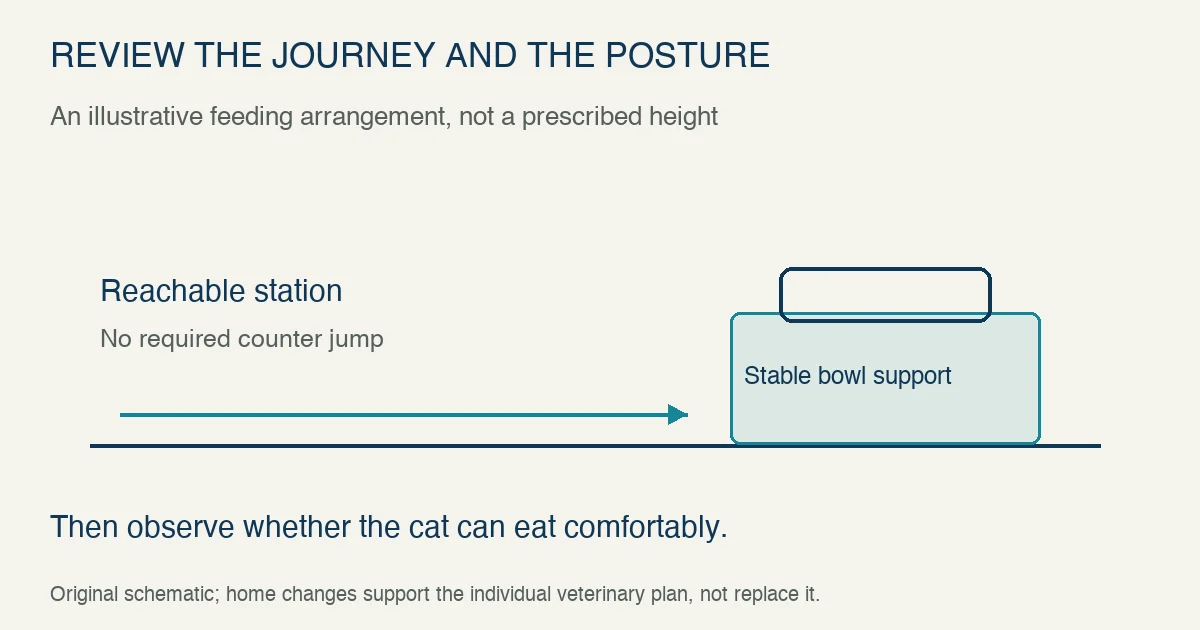
Access and posture are separate questions at feeding time. Cats Protection recommends reachable resources at floor level; International Cat Care also discusses raising a bowl for cats uncomfortable lowering their head [2][3]. These points are compatible: keep the feeding station on a reachable level, then assess the bowl's actual height and stability. Raising food onto an inaccessible counter defeats the purpose.
Watch the cat's approach and eating position. Do not prescribe a universal bowl height from body size or assume the highest stand is best. Discuss persistent difficulty with the vet, and keep a workable option available while assessing a change.
Preserve valued resting places without demanding a jump
A favorite sofa or window resting spot may remain valuable even when the route becomes difficult. Review a stable step or ramp, suitable traction and a comfortable lower alternative rather than simply carrying the cat up to its old perch [1][3]. The cat also needs a workable way down.
Consider a hypothetical sofa setup where a ramp reaches the seat but slides when touched and ends on a slippery floor. Its presence alone does not make access usable. Resolve stability and footing before use, and observe the cat's voluntary approach; do not push it up a route it avoids. This is a planning example, not an inspected product or a tested home modification.
Use the senior home product guide to examine access, surfaces and product instructions. Soft, easily reached resting places and protection from direct heat contact are relevant [3]. A heated product needs its own instructions and an individual suitability check; a warmth claim is not permission to improvise a heating arrangement.
Adapt coat care, scratching and activity to comfort
Changes in grooming and claws can accompany reduced mobility [1][3]. Inspect the coat and claw condition gently. Do not pull at mats or heavily restrain a sore cat for grooming. Seek help where grooming is painful or knots need removal; the long-haired grooming guide explains those limits. Ask for a demonstration before attempting claw care and use the claw trimming guide.
International Cat Care suggests considering a horizontal scratching option if a vertical stretch is uncomfortable, and adapting play to short, gentle, low-impact activity with suitable footing [3]. Consult the vet about appropriate activity for this cat. Keep choice available: refusal is information to review, not a reason to force movement to complete a daily exercise target.
Review practical changes alongside the clinical plan
Record the adjustment and whether the cat uses it: the new tray entrance, feeding position or resting route. If several things change at once, note them all rather than attribute improvement to one product. Take follow-up videos when useful, without making the cat perform.
Report loss of resource access, worsening movement, apparent pain or other new changes to the veterinary team. Arrange the agreed review even if a ramp appears helpful. A cat reaching the sofa more easily shows something about that route; it does not prove arthritis has resolved or that treatment can stop.