
Choose for the feeding task, not the biggest hopper
An automatic feeder can deliver a scheduled amount of compatible food. Before buying, establish which cat must receive it, the actual food and meal plan, who checks that eating occurred, and who can respond when the equipment or connection fails. A full hopper and a successful app message do not establish that a particular cat ate.
This is a specification-based comparison of two named models, not a hands-on test, reliability ranking or recommendation to leave cats without a caregiver. We have not measured dispensing accuracy, tested battery endurance or inspected these products. Use feeding basics to separate a feeding plan from a manufacturer's preset.
Write the job in one sentence. For example, an invented household might need a daytime dry-food meal while its owner is at work; another needs to prevent a second cat from taking a prescribed diet. Those are different tasks. A shared open bowl does not solve individual access merely because it fills automatically. Review separate feeding spaces before selecting a dispenser for several cats.
Match the exact food and model before ordering
Find the model number, regional manual and supplied power equipment. Similar names, a camera edition and a newer generation can have different instructions. Save the manual for the unit you will actually receive, not a search result about the brand.
PETLIBRO's official PLAF103 support page specifies dry food and kibble diameter of 2–15 mm [1]. Its linked V3.0 manual identifies the same model [2]. Compatibility is a starting condition, not proof that every pellet shape dispenses accurately. Ask about your actual food if its size, shape or texture does not clearly fit the documented requirement.
PetSafe's PFD00-14574 manual contains a conflict: its safety instructions say dry food only, while its specifications mention dry or semi-moist food [3]. Do not silently treat those as equivalent. If you need semi-moist food, ask PetSafe for current instructions for the precise unit before buying or using it. This guide does not resolve the manufacturer's inconsistent wording. Neither of these documents supports putting canned or wet food in these hoppers.
For a cat whose prescribed food is unsuitable, changing the diet to fit a gadget is a separate clinical decision. Discuss that with the veterinary team. A different feeding arrangement may be more appropriate than adapting an unsupported food or modifying the machine.
Compare the constraints that change the decision
These are selected documented differences, not an exhaustive feature score. Confirm current package contents with the seller; the manuals do not establish today's price, stock, service coverage or return terms.
| Decision | PETLIBRO Granary WiFi PLAF103 | PetSafe Healthy Pet Simply Feed PFD00-14574 |
|---|---|---|
| Backup arrangement | Three alkaline D batteries; manual says emergency use | Four alkaline D batteries; optional adapter with batteries as backup |
| During battery operation | WiFi, play and reset functions disabled; stored meal schedule continues per manual | Adapter/battery arrangement documented; no app capability claimed here |
| Dispensing unit | Manual lists one portion as 1/12 cup (20 ml) | Manual lists increments of 1/8 cup (30 ml) |
| Cleaning distinction | Stainless bowl dishwasher-safe; other feeder parts are not | Conveyor hand-wash only; specified removable bowl, holder, lid and hopper dishwasher-safe |
Sources: PLAF103 manual printed pages 8, 15–16 [2]; PFD00-14574 manual pages 9–10 and 18 [3]. Cups, millilitres and “portions” describe machine settings; they are not universal gram weights or calorie amounts.
A smaller increment may matter if your established feeding plan cannot be represented by a coarser setting. That does not establish that one device is more accurate. Likewise, WiFi may let you change a schedule, but a lost connection can remove that convenience without being the same event as a stopped motor. Choose based on the task and the documented fallback, rather than counting app features.
Translate the plan into observed output
Start from the amount and timing appropriate for the actual cat and food. Do not use a label such as “cat mode” or a manufacturer's example intake table as an individual nutrition assessment. The machine cannot infer your cat's needs from its preset.
During an attended trial, record the exact food, selected setting, scheduled time and amount actually dispensed into a clean collection bowl. If your plan uses grams, weigh the output with a suitable scale rather than assuming one portion always equals a particular mass. Repeat observations across the settings you intend to use; a single successful manual dispense does not verify a day's scheduled feeding.
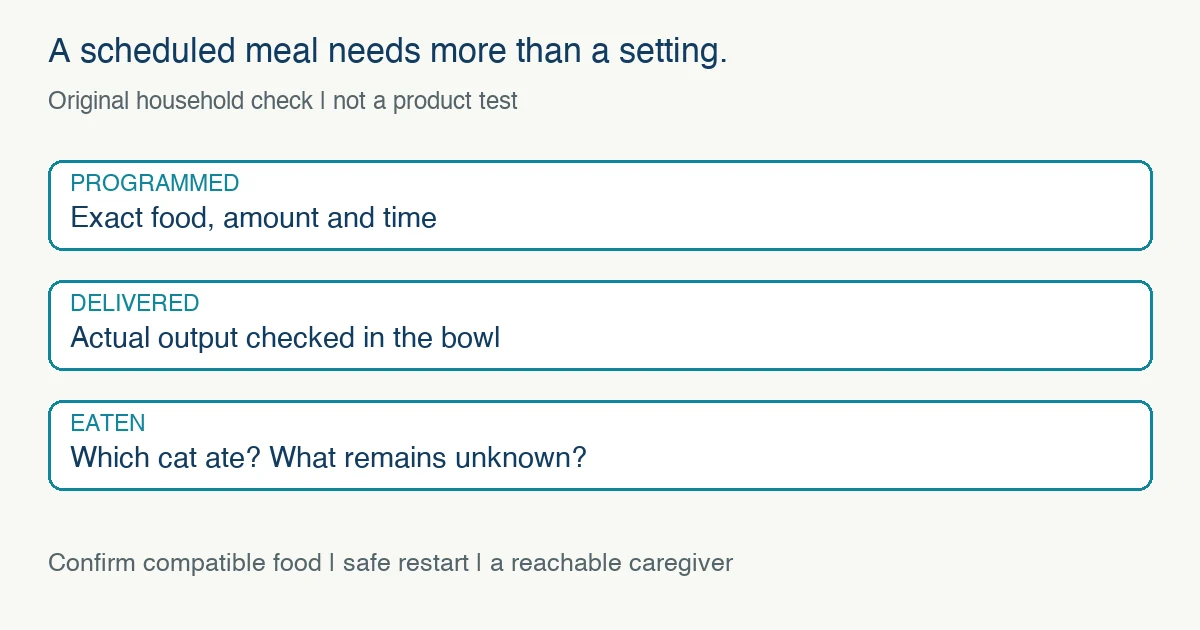
Distinguish four records: the amount programmed, the amount delivered, the cat observed eating, and food remaining. Do not subtract leftovers from a shared bowl and call that one cat's intake when you did not observe who ate. A camera may help you see an event, but its viewpoint or missing footage can leave uncertainty.
If output is inconsistent, follow the exact manual and contact support before relying on it. Do not increase the ration blindly to compensate for an unexplained shortfall. Keep the cat's established feeding arrangement available while investigating. This page offers no invented acceptable-error percentage or accuracy certification.
Test fallback while someone can still intervene
PLAF103's manual distinguishes continuing stored meals from unavailable WiFi during battery-only operation [2]. That is a useful example of why “battery backup” should not be interpreted as every feature remaining available. Check the actual unit's instructions for batteries, power supply and warnings; a backup that has never been installed is not a household contingency.
Before depending on a new device, confirm its schedule after setup and after any supported interruption test. Conduct checks while a person can provide the planned meal. Do not improvise electrical disassembly or use an incompatible adapter to simulate a fault. Observe both the machine and the actual cat: reachable food, willingness to approach and another cat's interference can determine whether an apparently working setup meets the need.
Write down the response to an alert or missing meal. Who receives it? Can they enter? Where is compatible food? How will they verify the cat's condition? What happens if the phone, router or notification service is unavailable? “We will check the app” leaves an unresolved gap if the app cannot connect.
For absence from home, arrange a caregiver with actual visit and access commitments. Use choosing a cat sitter to agree that service. Water, litter care, medication and observation remain separate tasks; a feeder does not complete them.
Include cleaning and restart in the purchase decision
Read the disassembly instructions before deciding that maintenance is manageable. Compare which food-contact parts detach, how they are washed, what must remain dry and whether replacement parts can actually be obtained for your model. A stainless bowl says little about access to the dispensing mechanism.
The manuals distinguish washable components from an electronic base that must not be immersed [2][3]. Their dishwasher rules differ, as shown above. Do not transfer one brand's method to another or wash the complete assembled device because the bowl is labelled washable.
After cleaning, follow that model's drying, assembly and restart instructions. Check the clock, active schedule and next meal, then observe output before returning to normal reliance. Consider this an ongoing household task, not a one-time installation. Leave a clear manual and a working alternative feeding arrangement for whoever takes over care.
Make the purchase only when compatible food, usable settings, individual access, maintenance and a real responder are resolved. If an essential point is unknown, ask the manufacturer or change the arrangement. A specification-based comparison can expose these questions; it cannot replace a trial with your actual cat or justify a claim that any feeder is failure-proof.