
Decide whether the home can support the cat during the work
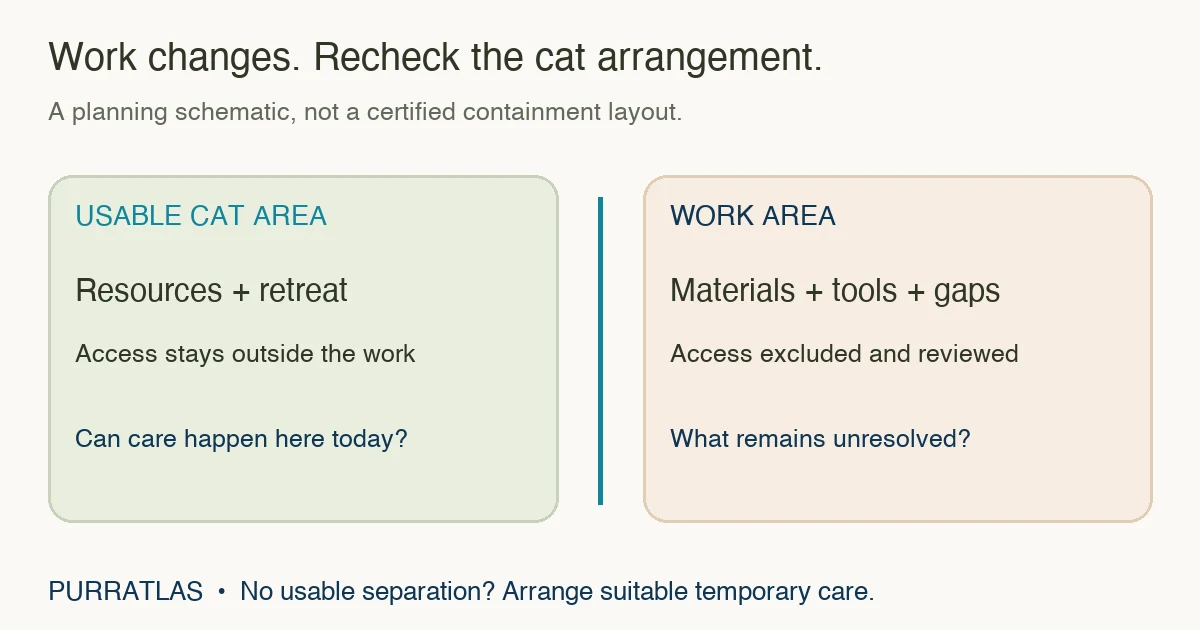
A renovation plan needs more than a quiet corner. Check where people will walk, which doors will stay open, what materials are being used and whether the cat's essential resources remain accessible outside the work area. A room called “safe” on a drawing may be unsuitable once workers, deliveries and tools arrive.
Cats Protection advises considering temporary care elsewhere for major noise, dust and disruption, while recognising that leaving home can itself be stressful [1]. Discuss the actual project with your veterinary team when the cat has health or behavioural needs. If you cannot keep construction activity separate from usable cat space, arrange suitable temporary care before work begins.
This guide helps organise a household project. It does not certify construction containment, assess chemical exposure, or give a universal number of hours after painting when a cat can return. Those questions depend on the work and products, and may need the contractor, manufacturer or veterinary team.
Review tomorrow's work, not only the overall schedule
Ask the person doing the work which rooms and access routes they will need each day. Establish whether they will remove floorboards, use chemicals, cut or sand materials, open windows, or leave equipment on site. Keep a brief note of changes so the cat's arrangement does not silently fall behind the project.
Cats Protection identifies open floorboard gaps, tools, chemicals and dust among building hazards, and recommends keeping cats away from the work area [1]. A cat must not be allowed to investigate unfinished work because the tools are momentarily quiet. Nor is a movable dust sheet a dependable access boundary.
Before each shift, agree who checks the cat's location and who tells workers that access restrictions are in place. Describe the permitted route for bringing materials in. A contractor should know whom to ask if the route changes, rather than discovering the cat-room door is the most convenient shortcut.
Illustrative planning problem: the hallway is scheduled for floor work, but the cat's bowl and tray are reached through that hallway. Keeping the cat away from the work is not enough unless another usable route or care arrangement exists. This is an invented layout example, not a real project or proof that a barrier is safe.
Provide usable territory beyond the construction boundary
Cats Protection recommends gradual resource changes where needed, familiar routines, hiding places and comfortable resting opportunities. Its advice also cautions that confinement can make a cat feel trapped [1]. Consider the whole usable area, not just the size of a room.
A quiet retreat and a construction exclusion boundary serve different purposes. The cat should be able to move between its usable resources and retreat within the protected arrangement, without entering the work area or reaching an open exterior door. Do not interpret free access to a retreat as permission to roam through the building site.
Check that food, water, litter and rest are actually reachable when the work boundary is closed. If two cats cannot use the same reduced space comfortably, plan separate access and resources or another care arrangement. Multi-cat home planning can help review routes; it cannot certify a construction zone.
If temporary care is needed, confirm the caregiver's actual ability to house the cat securely and meet its care needs. Use cat-sitter handover to check instructions and contacts. Do not wait until demolition has started to discover that the backup cannot take the cat.
Keep material labels available and access prevented
ASPCA Animal Poison Control describes risks from repair materials including paint products, glues, insulation and debris. Paint flakes or dust can also reach the coat and be swallowed during grooming [2]. Prevent access to products, residues and tools; do not rely on a cat being unlikely to taste them.
Keep the exact product name and label available. “Paint” or “glue” is not enough information to assess an exposure. Ask the contractor where products and contaminated equipment will be stored between shifts, who removes waste, and how accidental spills are handled. Keep the cat's bowls, bedding and toys out of the work and storage areas.
Follow the exact manufacturer's use, drying, ventilation and access instructions, and ask for clarification when they do not address your situation. This article does not treat “water based,” “low odor” or “natural” as proof of safety for cats. A surface feeling dry or a room no longer smelling strong does not resolve every product-specific question.
Do not attempt to assess suspected old-paint hazards from its colour or a photograph. Raise the issue with a qualified professional responsible for the work; this page does not provide a DIY lead-removal procedure or establish legal requirements for your property.
Know what to do if contact with a material occurs
If you suspect contact with or ingestion of a hazardous product, contact your veterinarian or a veterinary poison service promptly rather than waiting for the project to finish. ASPCA directs owners to seek help for exposure to hazardous repair items [2]. Have the package or product details ready, along with what you observed and when.
Paint thinners and strippers can themselves cause skin irritation or burns [2]. Do not improvise paint removal with those products. ASPCA's decontamination guidance says different substances need different recommendations and urges professional assistance for toxicity or ingestion concerns [3]. Ask for instructions for the actual exposure rather than improvising cleaning, inducing vomiting or giving a household treatment.
In the United States, the ASPCA Animal Poison Control number is (888) 426-4435; its current page says help is available 24/7 and a consultation fee may apply [4]. Elsewhere, use your local veterinary or poison-service contact. A call to an information line is not a replacement for emergency veterinary treatment when needed.
Inspect the site before restoring access
The end of the contractor's shift and the end of the hazard are separate events. Ask for a handoff that covers unfinished surfaces, products still drying or curing, loose debris, exposed openings, equipment and tomorrow's work. Check the actual area before changing the cat's access.
ASPCA warns about nails, screws, wires, power tools and repair by-products [2]. Look for those hazards without assuming that one quick sweep has made every part of the site suitable. Where the material, cleanup or product instructions remain uncertain, keep access restricted and ask the responsible professional what is needed.
An illustrative end-of-day note could say: “Bedroom remains excluded; adhesive instructions still being checked; tools and waste removed from the agreed cat-access route; next shift needs hallway access.” This records unresolved work rather than claiming the room is safe. It is an invented communication example.
Track the cat's response separately from project progress
Record observable changes in eating, drinking, litter use, resting and interaction. Avoid labelling every change “renovation stress.” Concerns belong in a conversation with your veterinary team; a project schedule cannot diagnose the cat.
Keep ordinary care practical and consistent while reviewing whether the reduced space remains workable. If the cat cannot settle in the current arrangement, seek advice and reconsider temporary care. Do not force the cat to approach noisy tools as a quick familiarisation exercise.
A useful daily plan ends with three answers: where the cat can actually go, who controls access while people work, and what must be confirmed before access changes. Recheck those answers whenever the work changes rooms or methods.