
If your cat has been prescribed inhaled treatment, ask the veterinary team to demonstrate the exact inhaler, chamber and mask before you begin. Build comfort with the equipment while keeping the prescribed treatment plan active. Training is not a reason to leave respiratory disease untreated.
If the cat is struggling to breathe, breathing with an open mouth, or you doubt its ability to breathe comfortably, seek veterinary help immediately. Do not keep rehearsing mask placement or try to diagnose the cause at home. Cornell explains that respiratory distress has many possible causes and requires prompt assessment. [1]
Get a treatment plan that the household can follow
Ask the team to write the medicine name, formulation, number of prescribed actuations, timing, device instructions and what to do if administration is uncertain. If there is more than one inhaler, have each one's purpose and sequence explained. Do not substitute a family member's human prescription or assume inhalers with similar packaging are interchangeable.
Cornell distinguishes anti-inflammatory treatment from medicines that dilate airways, and notes that bronchodilators do not treat the underlying inflammation by themselves. Its asthma article is dated July 2014; it supplies background, not a current prescription for your cat. [2] Your team's plan must answer the practical treatment questions.
Ask separately about routine treatment and the response to worsening signs. Keep the emergency number with those instructions. A plan that says only “use inhaler as needed” is too ambiguous if you have not been told what changes, medicine and limits that phrase refers to. Resolve uncertainty with the prescriber rather than adding extra puffs on your own.
If the cat is not yet able to accept the device, tell the team now. International Cat Care specifically advises maintaining necessary treatment throughout training and seeking help when a stage is difficult. [3] Ask what the interim plan is; this page cannot choose another route or medication.
Separate comfort training into skills the cat can manage
Choose a calm setting and a reward the cat actually likes, compatible with any dietary instructions. Let the cat investigate equipment voluntarily. Begin with an achievable interaction rather than immediately holding the mask tightly against its face.
International Cat Care's training series separates equipment introduction, voluntary nose placement, holding that position and putting the sequence together. Trudell's written training article describes rewarding gradual approximations and teaching separate components before combining them. [3][4] The goal is participation with calm breathing, not simply preventing escape.
For example, reward approaching the equipment before asking for nose placement. Once the cat willingly interacts with the mask, work on briefly maintaining that position. Practice the handling and sound components at a level the cat tolerates, with guidance if you are unsure how to arrange them. Do not spray medication merely to create training noises or put cleaning fragrances on the device.
Trudell's article suggests brief positive sessions and describes signs such as avoidance, disengagement or worry as reasons to stop. [4] Treat its examples as a training framework for its own chamber, not a guaranteed schedule for all cats. Progress according to the cat's response; no promised number of days appears here.
If the cat withdraws its face, allow it to disengage. Reduce the difficulty on a later attempt and ask the team for help if treatment cannot be delivered. Stronger restraint may turn a manageable step into something the cat avoids. A successful brief practice is useful information even if the whole treatment sequence is not yet comfortable.
Check the actual device technique with a demonstration
Bring the real chamber, mask and prescribed inhaler to the appointment. Ask the team to check mask fit and show assembly, the seal, any breathing indicator and the sequence specified for that device. Ask what signs show that the intended steps occurred and what would make the administration uncertain.
Do not infer a universal breath count, hold time or priming procedure from another product's video. Different medicines and equipment have instructions that need to be read together. A practice session using an empty mask is not a demonstration that medication was administered, and an actuated inhaler is not proof that the cat received the intended treatment.
Have the team watch you perform the technique when appropriate. “I understood the demonstration” and “I can reproduce it with my cat” are different checkpoints. Ask how to handle a poor seal, a cat moving away, an uncertain actuation or a missed treatment. Do not automatically repeat a full treatment because you are unsure what happened.
For maintenance, use the exact device's current cleaning, drying and reassembly instructions. Ask when parts need checking or replacement and how to confirm the inhaler remains usable. Do not apply boiling, dishwasher, disinfectant or sterilization instructions from an unrelated chamber. This guide has not tested devices or established a brand comparison.
Record administration separately from symptoms and practice
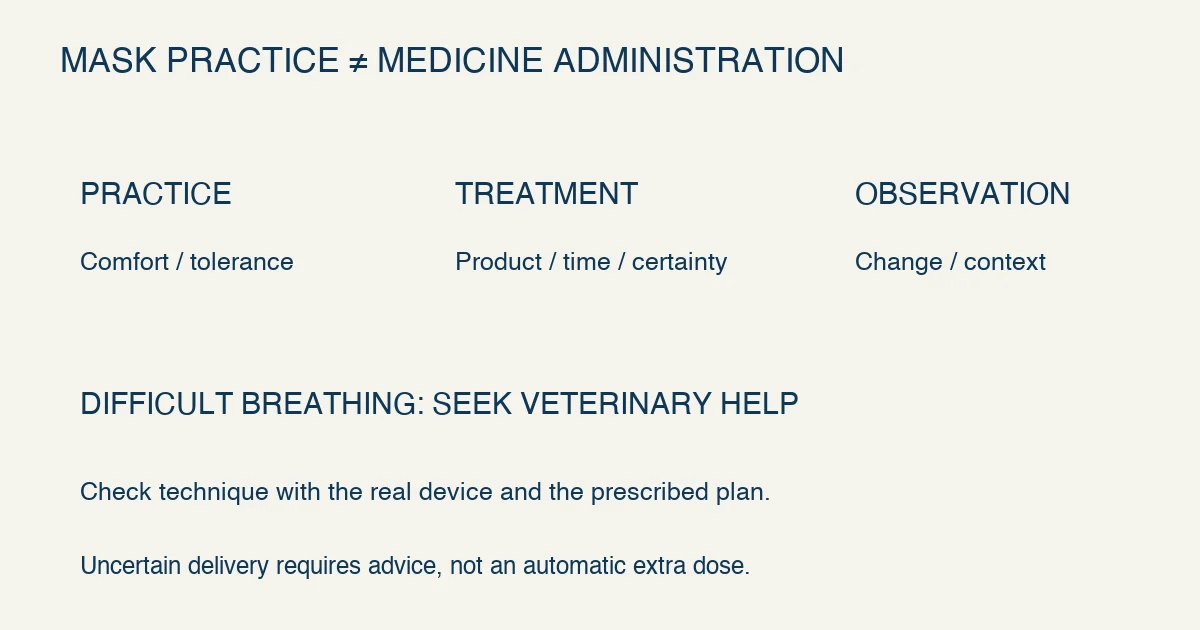
Use one shared record so two caregivers do not both treat the cat because they assume the other forgot. Distinguish three types of entry:
- Training: what the cat tolerated, with no medicine claimed to have been given.
- Treatment: the prescribed product, time, responsible person and whether administration was completed or uncertain.
- Observation: coughing or a breathing change, when it happened and the context.
In a hypothetical household, the morning caregiver records “mask practice only.” The evening caregiver must not interpret that as the morning medicine. Likewise, “inhaler pressed; cat moved away before seal” is an uncertainty to discuss, not a completed treatment to conceal or an instruction to double the next one.
Ask your team what observations it wants and how frequently to collect them. If recording a video is safe and does not delay care, it may help describe an event. Never provoke coughing, press the throat or hold a struggling cat still to produce evidence. Cornell's discussion of diagnostic findings is not a home test. [2]
Review difficulties before changing the prescription
Report problems precisely: the cat accepts the mask but startles at the sound; the seal slips; one caregiver cannot carry out the technique; or doses have become uncertain. These problems call for different adjustments. Do not label all of them “the inhaler does not work.”
Bring the device and log to the review. Ask the team whether technique, training, the prescription or the reassessment plan needs changing. A few quiet days do not authorize stopping a prescribed course, and an air purifier or fragrance-free room is not a proven substitute for treatment. Cornell notes that some environmental approaches borrowed from human asthma have not been rigorously established in cats. [2]
Use the vet-visit record to prepare a concise handover and the vet-selection guide if you need a practice that can help with demonstration and follow-up. The useful outcome is a workable prescribed routine with clear uncertainty and emergency routes, not a self-designed asthma regimen.