
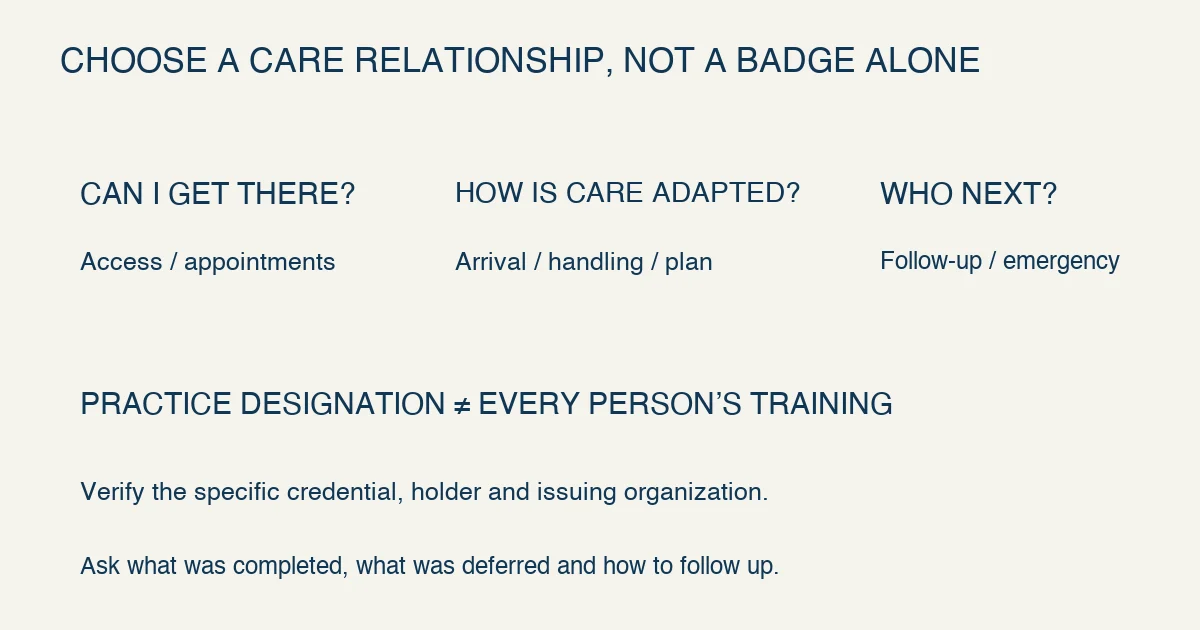
Choose a veterinary practice before you need one urgently. Start with the care your cat needs, ask how the team works with cats, and confirm what happens when that practice is closed. A nearby address or the words “cat friendly” in a listing are useful starting points, not a complete assessment.
This guide helps you make a shortlist and a practical first-visit plan. It does not rank local clinics, verify a named practice's credentials or replace urgent veterinary contact with a shopping exercise.
Start with a realistic access and care shortlist
Write down your actual constraints: transport, opening times, how you can communicate, and any known ongoing care needs. A practice you cannot reliably reach may be difficult to use even if its facilities look excellent. Ask whether it is accepting new cats, how registration works, and what information it needs before the first appointment.
For a cat with an existing diagnosis, describe the condition and current treatment accurately. Ask whether the practice can provide the required monitoring and how specialist referral would work if needed. Availability of a machine does not establish that every investigation is appropriate, and a referral relationship is not a promise of immediate specialist access.
International Cat Care recommends investigating and registering before a specific need arises, including arranging a look around without the cat when possible. FelineVMA's caregiver guidance recommends calling practices and then meeting the veterinarian or team. [1][2] Use those conversations to resolve constraints rather than choosing from a photograph alone.
If the cat is ill now, seek timely care. Do not wait for a perfect shortlist, an accreditation check or a practice tour before calling about a potentially urgent problem.
Ask what happens from arrival to examination
Describe the cat's previous difficulty, if any: barking dogs, a crowded waiting room, opening the carrier, being handled or the journey itself. Ask what the team can arrange for this specific visit. A vague promise of “low stress” is less informative than an explanation of how arrival and examination work.
Useful questions include:
- Is there a separate cat waiting area, a cat-only appointment period, or another way to reduce exposure to dogs?
- Can the carrier be placed securely above floor level, and how will visual contact with other cats be managed?
- What should I do if the waiting room is crowded when I arrive?
- Can an appropriate removable-top carrier remain part of the examination setup?
- How does the team adapt if the cat becomes frightened, and when would it pause or change the plan?
International Cat Care describes raised carrier positions, reduced dog exposure, allowing a cat to leave the carrier voluntarily where possible, gentle handling, non-slip surfaces and breaks. It notes that parts of an examination may be possible in a suitable carrier. [2] These are examples to discuss, not a demand that every cat and every procedure follow one sequence.
Do not open the carrier in a waiting room to test the team's approach. Ask about the plan first and follow the staff's safe arrival instructions. If medicines before a visit might be helpful, that is a veterinary decision for this cat, not a dose supplied by this page.
Read credentials as different claims
A Cat Friendly Practice® designation from FelineVMA describes a practice program. An individual Cat Friendly Certificate describes training completed by a person, who may be a veterinarian, technician or another team member. FelineVMA membership is another category. The caregiver guide discusses all three; do not treat the names as interchangeable. [1]
International Cat Care describes its Cat Friendly Clinic program, clinic membership, further feline qualifications and nursing qualifications separately. Accredited clinics in its program have designated cat advocates. [2] The program names and structures differ, so confirm the actual claim and issuing organization rather than combining them into one badge.
Ask who holds the qualification, what the designation applies to, and where current status can be checked. If a claim cannot be verified, mark it unverified. Conversely, absence of a particular badge alone does not establish that a veterinarian cannot provide good care for your cat.
A feline-only practice and a multi-species practice with a considered cat pathway can both be candidates. Assess what the team actually offers. A sign, a certificate or membership does not guarantee a clinical outcome or mean every staff member holds the same training.
Find out what happens outside the appointment
Ask how results are communicated, who answers follow-up questions and how a written home-care plan is supplied. If a cat requires medication, can the team demonstrate the technique and check that you can carry it out? If instructions become unclear at home, which contact should you use and what is the expected response route?
Ask directly about overnight supervision if hospitalization may be needed. “Open during the day,” “keeps patients overnight” and “staff continuously present” describe different arrangements. Confirm the actual staffing and transfer process; this page does not assume one from an opening-hours listing.
For out-of-hours problems, obtain the named emergency provider, telephone number, location and instructions for accessing it. Keep those details separately from the routine practice's number. Ask whether records can be sent to the emergency or referral team and how follow-up returns to the usual practice.
Discuss estimates and consent as part of communication. Ask how options, expected costs and a change in the proposed plan are explained. An estimate is not a guaranteed final bill, and insurance reimbursement is a separate issue from the practice's payment arrangements. Use the cat insurance guide to keep those questions distinct.
Use the first visit to test whether communication works
Bring previous records and a short account of your cat's normal routine and any current changes. FelineVMA recommends a veterinarian who answers questions and discusses matters such as nutrition and behavior, not only vaccinations. [1] Decide what you most need to understand before leaving and ask for clarification of unfamiliar terms.
In a hypothetical first visit, a frightened cat may need an altered examination plan. A useful follow-up is “What was completed, what was deferred, and how will we arrange the remaining assessment?” Counting the number of procedures performed would not by itself measure the quality of that encounter. Nor does a quiet cat necessarily show that the whole experience was comfortable.
Afterward, review whether you received a clear plan, understood the next contact and could carry out the home instructions. If something was difficult, describe it specifically before concluding the relationship cannot work. A practice may be able to change arrival arrangements or explain a different approach.
Prepare the journey with getting a cat into a carrier, and use the vet-visit record for observations and questions. The decision this page supports is a usable care relationship with an explicit backup route, not a “best clinic” label based on reviews or an unverified listing.