
If you find a possible tick on your cat, remove it promptly and carefully, or ask your veterinary team to do so. Do not keep pulling at an unidentified skin lump. If the cat is distressed, the attachment is hard to reach, or you are unsure how to use the tool, getting help is the next step. [1][2]
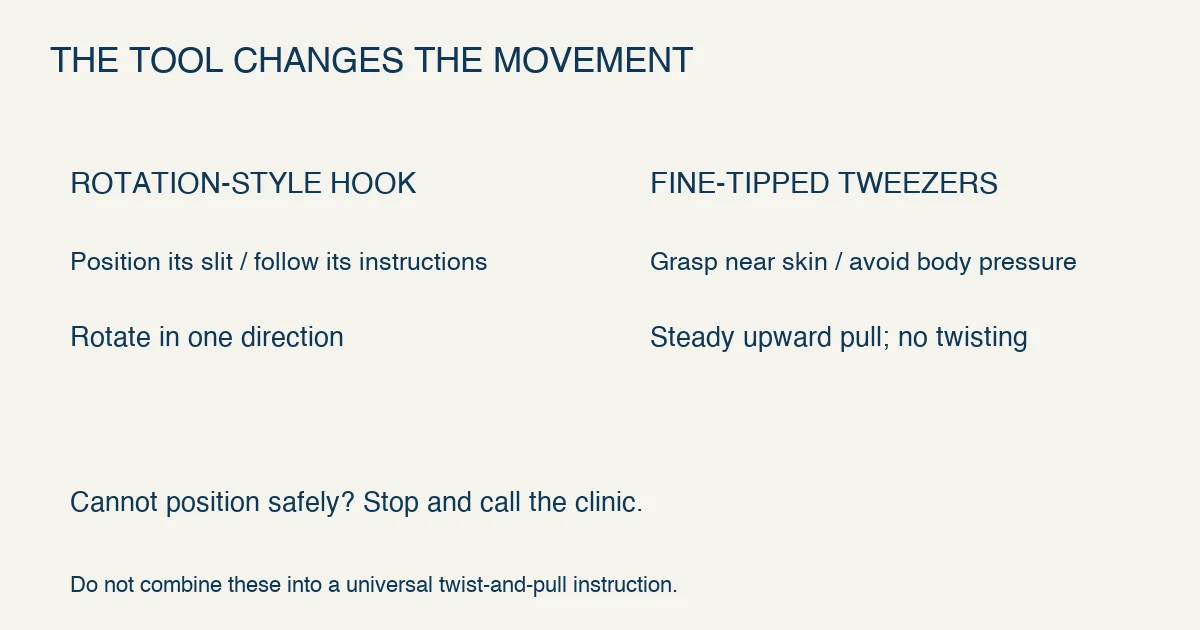
The important distinction is the device: a rotation-style tick hook and fine-tipped tweezers do not use the same movement. This guide helps you prepare, choose the correct approach and record what happened without treating removal as proof that illness cannot follow.
Confirm the object and prepare before touching it
Part the fur gently and look where the object meets the skin. Cats Protection describes visible legs at the attachment site as a clue; a lump alone is not sufficient identification. If you cannot see clearly, ask the clinic rather than grasping and pulling. [2]
Wear gloves and have the tool ready before approaching the cat. Prepare a stable surface, good light and a safe way to contain the removed tick. International Cat Care recommends calm handling with the cat's paws supported and stopping for veterinary advice if distress, biting or scratching develops. [1]
Do not repeatedly rehearse grabbing the tick while the cat waits. Check the tool instructions first. Ask a helper to support the cat gently if that makes the task safer; an assistant is not a reason to use stronger restraint. A tick near an eye, inside a difficult area or hidden in a painful patch may need professional removal.
Record the date found, body location and recent outdoor areas or travel. Finding time is not attachment time. An engorged appearance does not let this page calculate when exposure began or whether infection has occurred.
Match the movement to the tool
For a purpose-made rotation-style hook, follow that device's instructions. International Cat Care describes placing the slit around the tick near its head, with the tool cupping the body, then rotating in one direction. Cats Protection also describes a tick-tool twisting method. Do not substitute that action for every implement called a remover. [1][2]
For fine-tipped tweezers, International Cat Care describes holding them parallel to the skin, grasping close to the skin near the tick's head, avoiding pressure on the body, and pulling upward with steady pressure. It specifically says not to twist with tweezers because the mouthparts may break off. [1]
If you cannot position the implement without squeezing the body or pinching skin, stop and contact the team. The aim is careful removal, not a speed challenge. Do not apply a flame, petroleum jelly or alcohol to the attached tick in an attempt to make it release. Those are not the removal methods described here.
If removal is incomplete or uncertain
Tell the clinic what tool was used, what movement was attempted and what remains visible. Do not dig into skin with a needle or keep squeezing the area to prove it is clear. The team can assess the site and decide whether anything further is needed.
Keep a photograph of the removed object if practical, and ask whether the team wants it retained and how. Avoid contact with its fluids and dispose of it safely as instructed. International Cat Care stresses safe handling and monitoring for irritation or illness after removal. [1] Do not leave a loose tick on a tissue where the cat, another animal or a child can reach it.
Ask what cleaning is suitable for the bite site, especially if skin is damaged or the site is near an eye. The word “antiseptic” does not make every household product safe for cats. This page does not supply a homemade disinfectant concentration or recommend coating the wound with a flea product.
Monitor the site and the cat separately
A small mark at the site and the cat's overall condition are different observations. Check for developing redness or swelling and record changes in appetite, activity or other signs of illness. International Cat Care recommends veterinary contact if there is concern after removal. [1]
For a hypothetical record, “tick found on neck Tuesday; removed with hook; Wednesday eating normally; Thursday unusually quiet” is more useful than “tick removed successfully.” It gives the team a timeline without claiming the tick caused the later change. Report illness promptly instead of waiting for a named disease's characteristic mark.
Do not start leftover antibiotics or order a test solely from an online disease list. Geographic exposure, clinical signs and the veterinarian's assessment determine what investigation is appropriate. Cats Protection's discussion of Lyme disease is UK-focused; it cannot establish the disease risks for a cat in every US state or travel destination. [2]
Review prevention without borrowing a dog's product
Ask the team for prevention based on where the cat lives and travels, other animals, age, weight and existing conditions. Continue regular checks even when prevention is used; International Cat Care notes that products do not remove the need to look for ticks. [1]
Bring the actual name and date of the last product used. Do not add a new product immediately because one tick was found, and never use a dog tick product on the cat. Cats Protection warns that dog treatments can contain chemicals harmful to cats. [2]
After a new exposure area or repeated findings, discuss whether the prevention plan needs to change. A vet-visit record can preserve the travel and product history. The household flea guide addresses a different environmental problem; do not assume a flea-cleaning routine identifies or treats a tick-borne illness.