
Choose for the way the toy will be used
Start with the intended activity: an interactive game with a person present, an object for batting or kicking, a food puzzle, or a powered toy. Then check the actual item and the cat's behaviour. A “cat toy” label, natural material or popularity does not establish that every part can be left within reach indefinitely.
Cornell advises avoiding small or strand-like components that can separate and be swallowed, and considering electrical cords and hazards in the play environment [1]. Cats Protection advises regular wear checks and not leaving cats alone with toys they could shred, eat or become tangled in [2]. These are useful selection limits, not a guarantee that a toy passing a quick inspection is safe for every cat.
This guide helps you make a shortlist, test its use while present and decide how to store or retire it. It is not a tested brand ranking. We have not measured durability, swallowed-object risk or product materials for specific toys.
Inspect the parts, not just the overall size
Look at the toy as separate components. A large plush body may have small attached eyes, a bell, loose stitching or filling that becomes accessible when a seam opens. A broad base may still have a narrow strand the cat can chew free. Check connectors and attachments as well as the main body.
Ask the seller or manufacturer about the exact construction, intended use, replaceable parts, cleaning directions and damage that requires withdrawal. “Durable” is not a disclosed test method. “Non-toxic” does not establish that an object is safe to swallow. If material or component information is missing, record it as unknown rather than borrowing specifications from a similar photograph.
Observe how your cat interacts with the item. Carrying or batting it is different from repeatedly chewing at a seam or pulling out a strand. Do not wait for complete destruction to decide that the current design is unsuitable. Cornell's warning concerns parts that may detach during chewing, not only items already broken [1].
There is no universal small-part size cutoff established here. A measurement should describe the actual component, but it cannot certify that the cat will not ingest it. If you have concerns about a toy or a cat's pattern of chewing non-food objects, ask your veterinary team for advice before continuing use.
Keep wand games under direct supervision
Cats Protection describes fishing-rod toys as a way to play at a distance from hands and feet, while also warning against unsupervised toys that can be shredded, swallowed or cause entanglement [2]. Those points belong together: a wand can be an interactive tool, not an item left dangling from furniture when nobody is watching.
Inspect the line, handle, connector and lure before use. Look for fraying, insecure joins, sharp exposed parts or a lure coming apart. An intact connector does not make a swallowable or easily shredded attachment suitable. If your cat repeatedly chews the line or tries to consume the lure, choose another activity rather than treating supervision as a guarantee against ingestion.
Move the toy in a clear, accessible area, keeping it away from the cat's face and from routes towards open windows or unstable furniture. Allow an appropriate catch during play rather than making the object permanently unreachable. Keep hands and toes out of the prey role, as Cats Protection recommends [2].
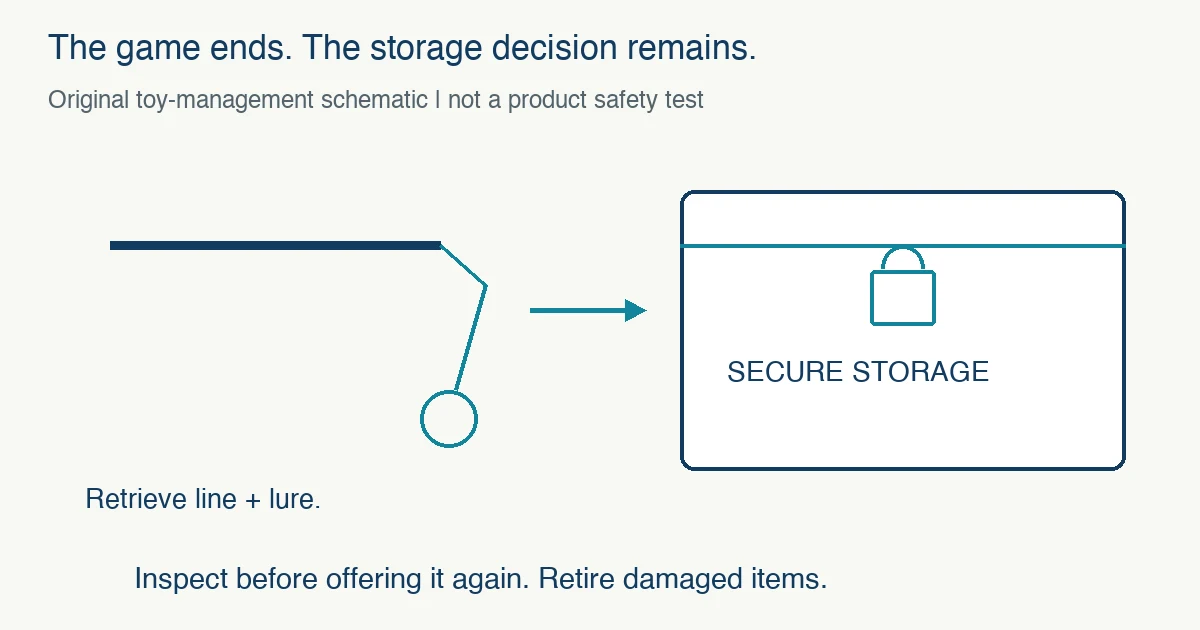
At the end, retrieve all components and put the wand in secure storage that the cat cannot access. Check the lure again; do not just place a damaged toy back in the active collection. A hook behind a door is not secure storage if the line still hangs within reach.
Do not turn household hazards into a toy collection
Hair ties, rubber bands, loose ribbon and similar objects may attract a cat, but Cats Protection identifies swallowing risks from these items and string [3]. Keep them out of reach, including after gift wrapping or tidying. Interest is evidence that the cat noticed an object, not that the object is appropriate for play.
A cardboard box or paper bag can be a low-cost activity option, as Cornell notes [1]. Inspect the actual object first: remove accessible handles, staples, tape, loose packaging and other parts that could catch or be chewed off. Leave an easy route out and check whether the cat is shredding and eating the material. Do not treat all packaging as equivalent because one plain box worked well.
Consider the room too. Cornell advises guarding against heavy objects falling and against falls while a cat is distracted by play [1]. Move fragile or unstable items, and avoid setting up a chase beside an unprotected drop. A toy's packaging will not account for your room layout.
For climbing rather than chasing, use the cat-tree selection guide to check the actual support and access. For a broader routine with multiple activities, see play and enrichment. This page focuses on selecting and managing objects, not prescribing one play schedule for every cat.
Treat powered toys as equipment
For an electronic toy, read its own instructions before use. Establish whether it is intended for attended use, how it shuts off, where it may be placed, how the battery compartment closes and what happens when a moving part jams. An automatic timer is a feature, not evidence that the toy is suitable for every unattended situation.
Check for an accessible charging cord, a loose compartment cover, damaged casing or exposed components. Cornell warns about chewable electrical cords; Cats Protection notes that small batteries can be swallowed [1][3]. Follow the actual charging and storage directions rather than inventing a safe charging location from a product photo.
Run the first session while present. Observe whether the cat follows comfortably, backs away, chews the casing or becomes caught on a moving element. Stop if the device is damaged, behaves unpredictably or cannot be used as intended. We have not verified a specific powered model or its battery, waterproofing or unattended-use performance here.
If the intended activity involves food, investigate the different fit and cleaning questions in choosing a food puzzle. An electronic toy, a puzzle and an automatic feeder solve different tasks; none establishes that a particular cat has obtained and eaten its meal.
Make a keep, store or retire decision after play
For each item, record its permitted use in plain language: “interactive wand, retrieve and lock away after play,” for example. Keep a separate place for retired or damaged objects so another caregiver does not offer them again. If you need a replacement component, use the correct model instructions and inspect the rebuilt toy rather than improvising a repair with glue or string.
A hypothetical note might read: “Cat batted the fabric toy, then pulled at the seam; filling exposed; toy removed.” That is a useful reason to withdraw the item. It is not a tested durability rating or a claim that every toy from that brand fails.
Cats Protection recommends replacing worn toys as needed, and both it and Cornell suggest rotation to retain interest [1][2]. Rotation means returning an intact, appropriate object after inspection. It does not restore a damaged seam or make a risky attachment safe.
If a part is missing, distinguish what you know from what you suspect: seen detached, found nearby, not located, or seen swallowed. Remove further access and contact your veterinary team promptly if ingestion may have occurred, giving the toy details and observations. Do not wait for a home checklist to establish a diagnosis.
VCA warns against pulling ribbon or tinsel protruding from a cat's anus and directs owners to veterinary intervention [4]. Do not attempt to retrieve an ingested object at home. If the cat is injured or unwell, contact the clinic promptly. Use the vet-visit record guide to organise facts without delaying care.