
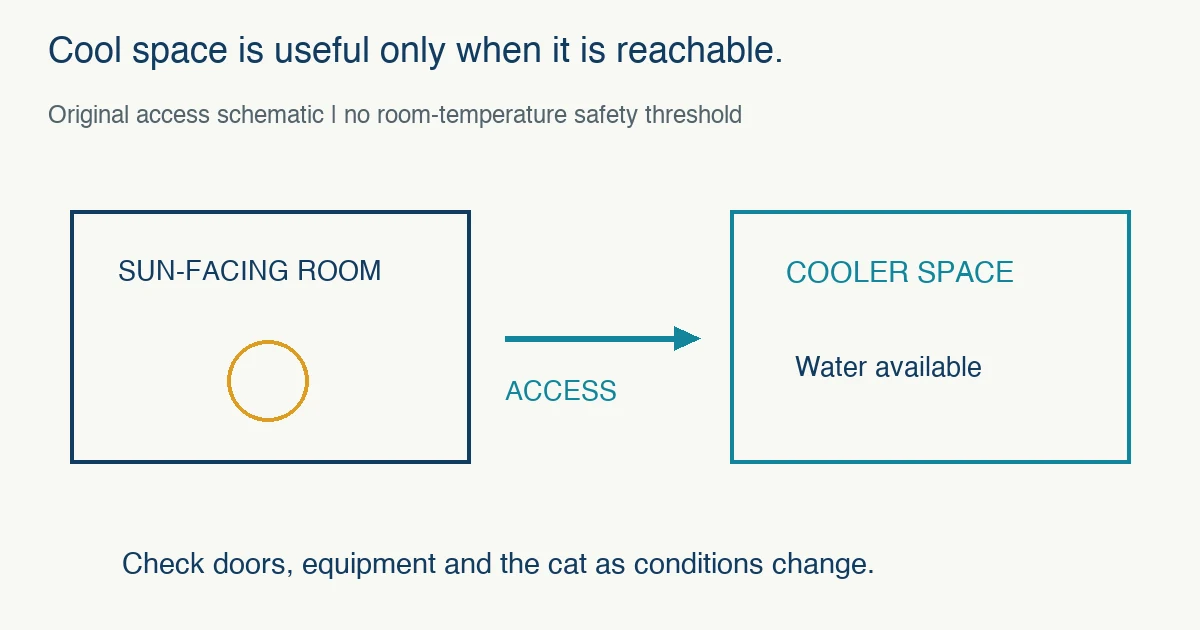
Make a cooler place available before the cat is trapped in heat
Give your cat access to shade, fresh water and a cooler, well-ventilated indoor area. Check its actual location before shutting sheds, garages, conservatories or cars. PDSA identifies being accidentally trapped in a hot, poorly ventilated space as a major cause of heatstroke in cats [2]. A cat choosing a sunny spot does not prove that being left there behind a closed door is safe.
This guide is for daily hot-weather preparation. If a cat exposed to heat develops fast breathing or panting, confusion, vomiting or collapse, contact your veterinarian immediately. Cats Protection describes heatstroke as an emergency and advises removing the cat from the hot environment at once [3]. Move it to a cooler, safe place and obtain urgent advice on cooling and transport; do not wait for a room-temperature reading or a home observation log to decide whether to call.
Do not mistake drinking water or appearing quieter for confirmation that a cat affected by heat has recovered. Suspected heatstroke requires veterinary care. The sources differ on details of emergency cooling, so this page does not combine them into a home treatment protocol or give a target body temperature for owners to chase.
Walk through the home as the temperature changes
Identify which spaces heat up, which remain cooler and whether the cat can move between suitable resting places. Cats Protection recommends cool indoor space and shade rather than encouraging exercise during the hottest conditions [3]. The useful question is not just “do we have air conditioning?” but “can this cat reach a suitable place throughout the day?”
A cool hallway behind a closed door is not available to a cat in a sun-facing room. In a multi-cat household, check whether another cat blocks the route or occupies the only comfortable resting space. Provide alternatives the cats can use separately, as discussed in indoor resources.
Keep fans and cooling equipment stable, with cords and moving parts inaccessible where necessary. Cats Protection suggests a fan to circulate indoor air [1]. Do not treat airflow alone as evidence that an overheated room is now safe. If equipment stops or electricity fails, reassess the room and the cat rather than continuing the same plan by habit.
Ventilation must also preserve containment. An open window can introduce an escape or fall risk; use the door and window safety guide when assessing openings. A basic insect screen has not been verified here as a load-bearing cat barrier. Avoid solving a heat problem by creating an unexamined escape route.
Keep water accessible and food handling consistent
Maintain clean, topped-up water at locations the cat can reach without confrontation or an uncomfortable trip through the home. Cats Protection recommends extra water stations and separating water from food and toilet areas [1]. Replacing one inconvenient bowl with a fountain does not resolve access for every cat.
Check bowls during the day rather than assuming morning filling lasts until evening. Note spills, a device that stopped working or a bowl another pet can empty. Use the fountain cleaning guide if you have a fountain; filters and a running pump do not remove the need for cleaning and inspection.
Wet food contributes water, but a hot day is not a reason to abruptly replace a prescribed diet or decide an individual fluid target yourself. Discuss feeding or drinking concerns with the veterinary team. Do not force water into a cat's mouth as a substitute for assessment.
Follow the food's actual storage instructions and remove leftovers appropriately. The cat-food storage guide explains packaging, refrigeration and handling without assigning one safe countertop period to all products. Changes in food type, spoilage and reduced intake should not be hidden inside the vague note “summer appetite.”
Offer a cooling option the cat can leave
For ordinary comfort, a resting option should be a choice rather than a restraint. Cats Protection describes putting a towel-wrapped frozen water bottle near a sleeping place, while warning against direct contact or forcing the cat to stay beside it [1]. Check that the bottle remains intact and the cat can move away.
A cooling mat, pad or new bed is not a guarantee of a safe room temperature. Read the exact product instructions, consider chewing or damage, and stop using an item that becomes unsuitable. This page has not tested a cooling product, verified its materials or established a duration of protection.
Keep familiar comfortable surfaces available. Do not repeatedly carry a settled cat to a new mat to make it use your purchase. If it persistently avoids the only cooler space, review that space's noise, access, other animals and equipment rather than assuming the cat prefers dangerous heat.
Do not shave a coat, bathe a cat or introduce a skin product as an improvised heat solution. Ask your veterinarian or qualified groomer about the actual cat's coat and handling needs. For tangles, use long-haired coat care rather than trying to cut close to the skin at home.
Distinguish sun protection from cooling
Shade and indoor choices matter even if a cat does not look overheated. Cats Protection notes greater sunburn vulnerability in pale cats, cats with unpigmented noses or ears, and cats with sparse hair in those areas [1]. Sunburn and heatstroke are different problems; avoiding one does not establish that the other risk is controlled.
Ask your veterinary team about appropriate sun protection for this cat rather than choosing a human product by its SPF label. This page has not verified a sunscreen formulation or given an application prescription. If skin becomes red, sore, blistered or peeling after sun exposure, Cats Protection advises contacting a veterinarian [1].
Consider the actual shade over time. A resting place shaded in the morning may be exposed later. UK source examples of peak sun hours are not a universal schedule for every location, season or window orientation. Keep the cat's available environment under review instead of relying on a fixed clock rule.
Plan journeys and checks for the individual cat
Never leave a cat in a vehicle on a warm day, including for a short stop or with windows open [2]. If a journey is essential, arrange ventilation, a suitable vehicle environment and secure containment. Contact the clinic about a non-urgent appointment during extreme heat; do not cancel needed care without discussing it.
PDSA identifies higher-risk groups including very young or old cats, flat-faced cats, cats with long coats, obese cats and those with heart or lung disease [2]. This does not mean other cats are safe. Ask the veterinary team about the cat's particular needs and maintain the agreed treatment plan.
If someone else is checking the cat while you are away, give a practical handover: where it is expected to be, which doors must not be closed, water locations, cooling equipment and the veterinary contact route. A hypothetical note might say: “Afternoon room became warmer; door to cooler hallway kept accessible; both water bowls checked; cat resting normally in hallway.” That records actions and observations without certifying a safe temperature.
If you cannot maintain a suitable environment, make another arrangement before leaving the cat. If you are worried about its health, call the veterinarian rather than completing a checklist first. A successful hot-weather plan keeps options genuinely available and allows changes when the home, equipment or cat changes.