
Decide whether this is routine care or a coat problem
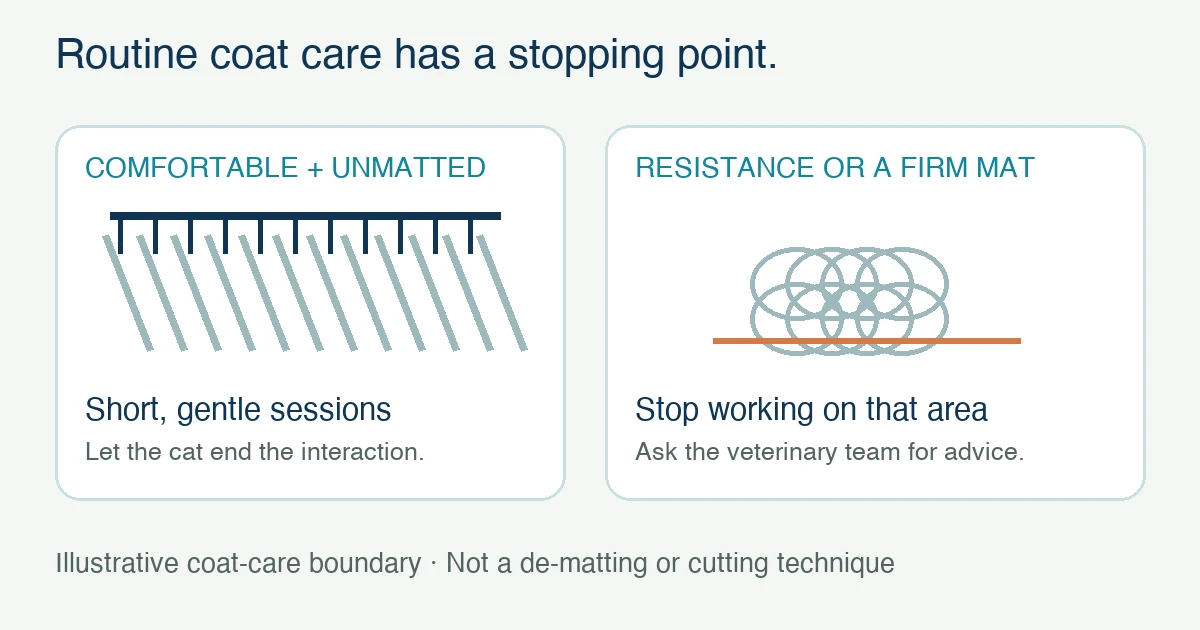
A long coat needs attention beyond making the surface look smooth. Check what you can comfortably see and feel, how your cat responds, and whether its own grooming has changed. If you find a firm mat, cannot assess the skin beneath it, or the cat seems uncomfortable, stop working on that area and ask your veterinary team for advice.
Cats Protection warns against brushing out established mats or cutting them with scissors, particularly when they are close to the skin: pulling can tear skin, and cutting is dangerous [1]. This page does not provide a home de-matting, clipping or sedation procedure. Contact the clinic about the coat's condition and the cat's response so they can decide what care is appropriate.
Routine brushing of a comfortable, unmatted coat and removal of a tight mat are different tasks. A tool advertised for tangles does not make every knot suitable for home treatment. Nor does a cat staying still prove it is comfortable.
Start with access the cat can tolerate
Choose a calm time and let the cat investigate the brush or comb. Battersea advises allowing the cat choice, beginning with a few gentle strokes in comfortable areas and brushing in the direction of fur growth [2]. Start small rather than aiming to finish the entire body in one sitting.
Watch the response as you change area or tool. Blue Cross identifies tail movement, ears moving back, enlarged pupils and attempts to leave among signs that grooming is becoming uncomfortable [3]. Stop or take a break before escalating handling. Do not wait for biting to become the only way the cat can end the session.
If your cat leaves, let it leave. Record where the session became difficult and avoid repeating the same long attempt next time. Cats Protection recommends minimal restraint and gradual introduction; a qualified behaviourist may help with an established fear of grooming [4]. If a grooming change is new or suggests pain, veterinary assessment comes first.
For an invented planning example, a cat accepts brushing along its back but moves away when the comb approaches the abdomen. The next action is to record the sensitive area and seek advice if it is tangled, not hold the cat down to complete a checklist. This is not a real cat's outcome or a diagnosis.
Choose a routine tool for the coat you actually have
Blue Cross lists a wide-toothed comb for long-haired cats [3]. Cats Protection also identifies combs as an option for long fur and notes that the cat's preference matters [4]. Ask a veterinary nurse or appropriate cat-care professional to demonstrate a suitable tool on your cat's actual coat if you are unsure.
Look beyond the product name. Check whether the tool has ordinary teeth or cutting blades, how it is intended to be used, and whether you understand its limits. This guide has not physically tested grooming products and does not rank de-matting blades as a safe solution for a tight coat.
During comfortable routine grooming, notice areas you cannot inspect without distress. Do not assume that a smooth topcoat establishes the condition underneath. If the comb meets resistance, stop rather than pulling through it. Describe the location and firmness to the veterinary team; do not treat resistance as a challenge to overcome with a sharper tool.
Clean the routine tool and remove collected loose hair according to its instructions. Cats Protection notes that loose hair from grooming can become caught again in the coat [1]. Keep discarded hair and tools out of the cat's reach, and reset the space before the next session.
Use the coat's condition to review the schedule
The sources give different general frequencies. Cats Protection's long-hair advice recommends daily brushing [1], while Battersea suggests roughly two or three sessions a week for medium-to-long coats, adjusted to the cat's needs [2]. Those are broad recommendations, not a guarantee that a particular schedule will prevent mats in every cat.
Make checking the coat a regular habit and ask for an individual routine when there are repeated tangles or limited access. Note how quickly a comfortable coat becomes tangled, whether certain areas remain unchecked, and how much interaction the cat tolerates. Short manageable sessions may be more workable than one long attempt, but an intolerable area still needs help rather than an indefinite delay.
A useful note says which areas were comfortably checked and which were not. “Brushed today” can hide the fact that only the back was reached. Do not call the whole coat mat-free unless you actually know its condition; uncertainty is information to share with the clinic.
Explain mats and grooming changes when you ask for help
Tell the veterinary team where the mats are, when you first noticed them, whether they are new or recurring, and how the cat responds to ordinary contact. Mention changes in self-grooming, movement or the ability to reach areas. Do not label a new coat problem “just age” or assume it is behavioural.
Battersea recommends a veterinary check for changes such as new mat locations, reduced or increased self-grooming, discomfort, fur loss or sore areas [2]. Cats Protection likewise advises veterinary assessment when grooming suddenly changes [4]. The pattern can help the conversation, but this page cannot identify the cause.
For abdominal matting that the cat will not comfortably allow you to brush, Battersea specifically directs caregivers to their vet [2]. Ask what the clinic needs to assess, how removal will be arranged, and what prevention plan is appropriate afterward. Do not assume every cat needs sedation or that a particular professional will perform every procedure; the clinical team decides what is needed.
Blue Cross describes gently teasing knots with fingers [3], whereas Cats Protection's mat-specific warning is more cautious [1]. This article does not turn the former into a technique for tight, skin-adjacent or painful mats. When you cannot tell what you are dealing with, seek help rather than experimenting.
Keep grooming separate from contamination care
Something stuck to the coat may need a different response from loose hair or a tangle. If you suspect a toxic substance, contact your veterinary team promptly for instructions; Cats Protection advises asking the vet about contaminated fur [4]. Do not add a cleaning chemical, essential oil or human grooming product because it seems likely to soften the material.
Home renovation guidance covers material labels and exposure contacts. A factual vet-visit record helps organise changes and photographs for the team. These are supporting tasks, not substitutes for assessment or treatment.
A workable grooming plan specifies comfortable routine care, areas you cannot safely manage, and whom you will contact when the coat changes. The goal is a coat your cat can comfortably maintain with appropriate help, not completing a forced session or giving every long-haired cat the same haircut.