
Clean the system, not just the visible bowl
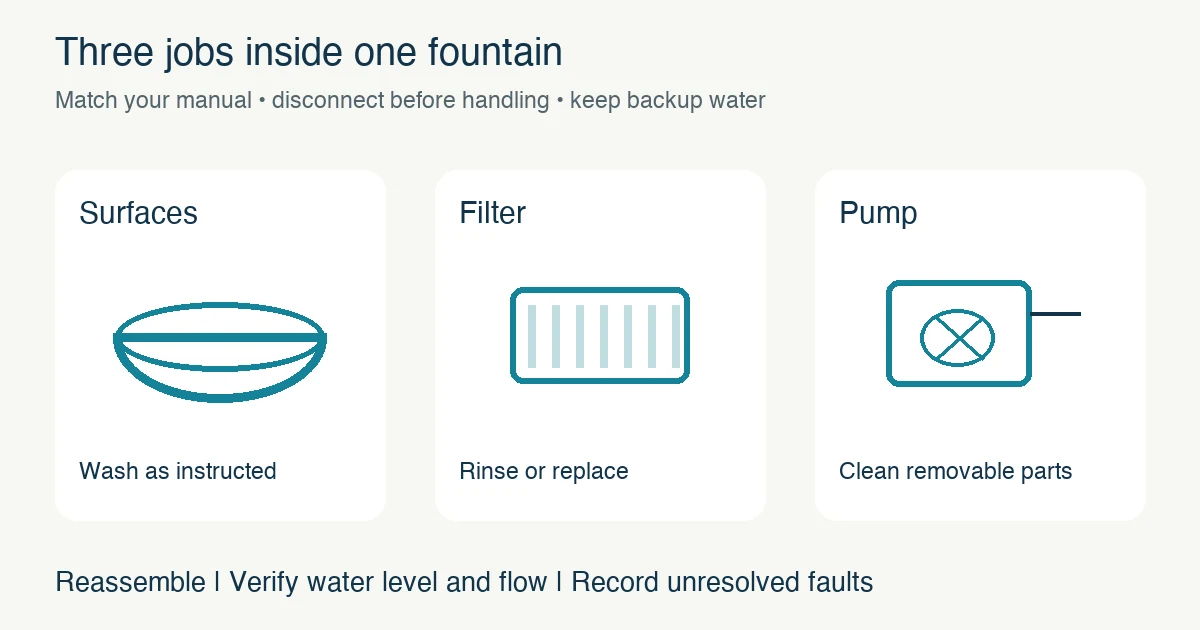
A useful fountain-cleaning routine covers the water-contact surfaces, the filter and the removable pump components. Refilling the reservoir or replacing a filter leaves other parts of that job unfinished. Start with the exact appliance manual and give the cat a separate clean, fresh water option while the fountain is unavailable.
Cats Protection recommends continuous access to clean water and veterinary assessment if drinking suddenly changes [1]. A maintenance problem and a change in the cat's drinking can occur together; fixing the appliance does not establish that the cat is well. This page explains maintenance planning, not a hydration diagnosis or a claim that fountains prevent disease.
The manufacturer examples were read on 9 October 2026. PurrAtlas has not tested the appliances, measured microbial removal or verified that a particular cleaning routine disinfects them.
Identify the model before taking it apart
Find the model number on the appliance, packaging or retained paperwork. Keep a copy of its manual and confirm the pump shown in the diagrams matches what is fitted. Similar brand names, flower tops and reservoir shapes do not establish that electrical or cleaning instructions are interchangeable.
Catit's manual selector separates the original, LED and stainless-steel Flower Fountains and provides region-specific downloads for some versions [2]. For the example here, the North America stainless-steel manual has #43725 on its cover [3]. Do not apply it to a PIXI fountain or another pump because the products share a brand.
Before starting, set out the manual, the approved cleaning tools and somewhere to retain the small removable parts. PetSafe specifically warns about losing pump parts down the drain [5]. If the diagram and your pump disagree, photograph the model and ask support; forcing a cover off is not a way to establish compatibility.
Separate washing, rinsing and replacement
Use three headings in your maintenance note: surfaces to wash, parts to rinse and parts to replace. This prevents “I cleaned the fountain” from hiding an untouched pump or a filter washed with a method the manufacturer does not permit.
In the #43725 manual, Catit specifies a soft sponge and non-abrasive cleaner for the fountain, thorough rinsing, and no soap on the filter [3]. Its July 2022 cleaning webpage says warm water and dishwashing soap for components [4], but the manual's filter exception matters. Do not interpret the webpage's broad wording as permission to soap the filter.
Use the actual instructions for scale removal and dishwasher suitability. A stainless-steel top does not make an electrical pump dishwasher-safe. Do not transfer a vinegar dilution, soak time or household disinfectant from another product's tutorial. If the permitted method does not resolve deposits or damaged surfaces, ask the manufacturer what to do next.
For an applicable PetSafe pump, its illustrated guide covers the faceplate, stator and impeller, followed by washing, complete rinsing and reassembly [5]. Use the linked diagrams to identify those pieces. The guide is evidence about the pumps it describes, not instructions to open a sealed motor or repair wiring on any fountain.
Include the impeller and its chamber
The outside of the pump housing is only one accessible surface. Catit's #43725 manual directs removal of the impeller cap and impeller when the pump appears dirty, debris removal and careful cleaning of the impeller well [3]. PetSafe's guide also identifies the impeller separately [5]. A pump left assembled can therefore miss a maintenance step described by its manufacturer.
Follow the appliance's safety instructions before handling it. The #43725 manual requires disconnection with dry hands before maintenance and prohibits dry running [3]. A wet plug or outlet is an electrical problem, not a routine cleaning task: avoid handling it and seek appropriate electrical help. Do not attempt a cord repair to get the fountain running again.
Put each removable part in the place you prepared, check it against the diagram and reassemble in the specified order. If a part is damaged, missing or does not seat normally, keep the appliance out of use and contact support. This article cannot certify a repair or provide a substitute part number without the actual model.
Build a schedule with separate due dates
Do not give every part one shared replacement date. The #43725 manual lists a 3–4 week filter replacement interval, with earlier changes when debris or impaired flow indicate a need, and possible adjustment for water conditions and multiple pets [3]. That is not a promise that a filter remains suitable until the last day of week four.
The Catit cleaning webpage says to disassemble its Flower Fountain pump every two weeks [4]. PetSafe's pump guide says at least monthly and notes that multiple-pet homes may need two-week cleaning [5]. Those recommendations have different product scopes. Record the instruction that actually applies to your appliance; if the supplied manual and current support guidance disagree, ask the manufacturer which revision to use.
A practical record can include: model and manual link; last water/surface check; last pump cleaning; filter installed date; observed debris, scale or flow change; and unresolved support questions. The dates track completed work rather than creating an automatic “safe” status.
If another person maintains the fountain, leave this record with the actual instructions. “Filter changed yesterday” should not be understood to mean the pump was taken apart too. Add the arrangement to your cat-sitter handover when someone else will be responsible.
Check the restart and keep water access dependable
Before switching on, verify the required water level, correct component positions, dry electrical connections and normal assembly against the manual. Watch the initial restart instead of leaving immediately. Check the actual flow and any leak or unexpected noise; a running motor alone does not prove water reaches the drinking surface.
An invented maintenance entry: “Filter replaced; bowl and removable top washed; pump cap and impeller cleaned according to the matched manual; restart flow observed. New rattle remains, so fountain taken out of use and support contacted; clean water bowl available.” This is an example of separating completed work from an unresolved fault, not a report from a product test.
Maintain the backup water option and inspect the fountain between scheduled cleanings. Record a change in the cat's drinking separately from equipment work, and use a factual veterinary visit record if discussing it with the clinic. Do not infer the cat's intake from the amount missing from a shared reservoir: several animals, evaporation or spilled water can leave attribution unresolved.