
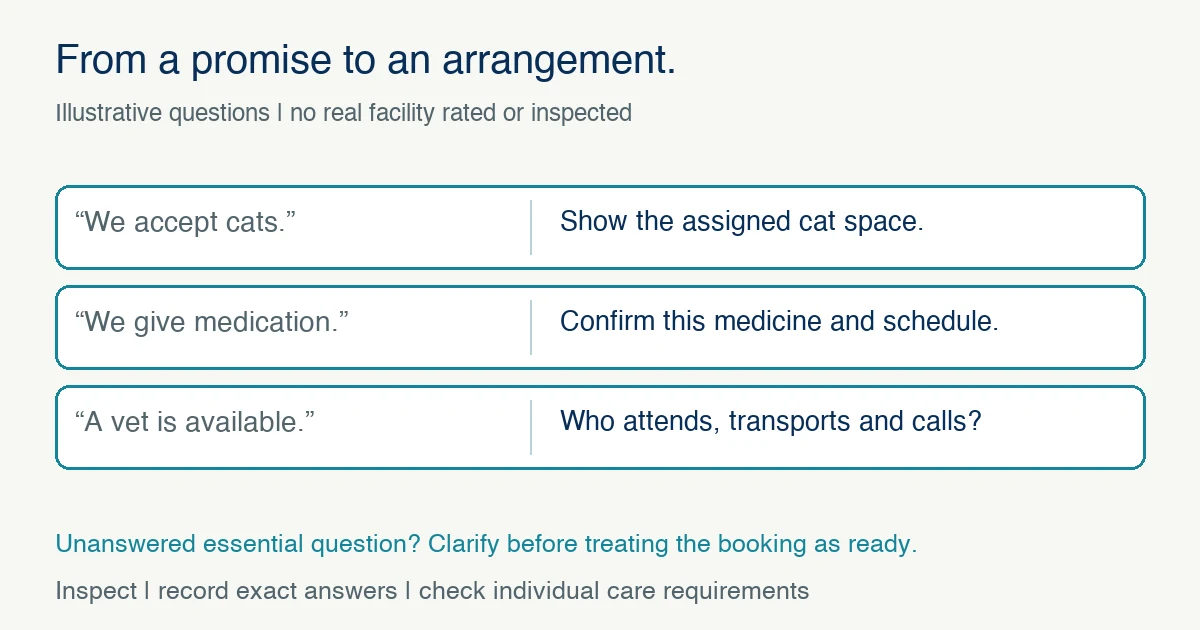
Choose for the care your cat actually needs
Before paying a deposit, visit the proposed cat accommodation and confirm the feeding, medication, monitoring and emergency arrangements in writing. A photo of a large suite or a reassuring “cat friendly” label leaves those questions unanswered. This guide helps you compare answers; it does not rank businesses, certify a facility or report a site inspection.
Start with your cat's existing routine and needs. Cats Protection describes home visits and boarding as different options, with familiar surroundings often helpful for nervous cats [1]. Home care still needs a reliable person and workable access. Boarding still needs an actual environment and staff capable of the required care. Neither label establishes the right choice for every cat.
If there are current health concerns or complex medication needs, discuss the proposed arrangement with your veterinarian before booking. UC Davis suggests considering veterinary-hospital boarding or on-site veterinary support for special medical needs [2]. Ask what that support means during your dates; a building beside a clinic does not establish overnight clinical supervision.
Visit the space your cat would use
Ask to see the accommodation category you would book, not only a reception room or a promotional suite. UC Davis recommends a visit and attention to cleanliness, ventilation and how staff treat animals [2]. Write down what you saw and what staff explained separately. A quiet tour at one time is not proof that all operating hours are quiet.
Cats Protection recommends checking escape prevention and separation between cats [1]. Ask how the cat room relates to dog areas, which doors are opened during cleaning and transfer, and where a carrier is opened on arrival. If there is out-of-enclosure time, ask where it happens and whether unfamiliar cats share it. A feature described as social play needs explanation rather than automatic credit.
RSPCA's general boarding advice includes suitable monitoring during the day and evening and enough staff for the animals present [4]. Ask who checks your cat, what is checked and what happens when a change is found. “We have cameras” does not tell you whether anybody reviews footage or can attend promptly.
Keep the inspection practical: where would the cat hide or rest, where are the food, water and litter, and how is care provided to a cat reluctant to approach? Ask staff to describe their process. Do not demand that a resident cat be pulled from hiding to demonstrate friendliness.
Compare specific answers, not amenities
Use the same few essential questions for each candidate. The following is an example comparison method, not a score awarded to any real business.
| Question | A useful answer should establish | An answer still needing clarification |
|---|---|---|
| Where will this cat stay? | Booked space, separation and safe transfer procedure | “All pets get a luxury room” without identifying the cat area |
| How are food and litter observations recorded? | Individual cat, observation time and staff response | Photos of a full bowl without knowing which cat ate |
| Who can give the prescribed medication? | Applicable staff, times, instructions and missed-dose contact | “We give medicine” without checking this route or schedule |
| What happens if the cat becomes unwell at night? | Who receives the alert, can attend, and obtains veterinary care | A vet's name without an attendance or transport arrangement |
An unanswered essential question is a reason to follow up or choose another option. It should not be cancelled out by extra toys, a webcam or attractive décor. RSPCA advises continuing to look when a boarder will not answer questions or cannot provide the needed care [4].
For US facilities, verify any applicable licensing through the relevant local authority. CFA's boarding article notes that requirements depend on the state or location [3]. UK licence advice in Cats Protection and RSPCA should not be presented as one US national rule. Nor does PurrAtlas infer current licence status from a business's website badge.
Confirm food and medication before arrival
CFA recommends establishing what food is served, whether the cat's usual or prescription food can be supplied, and the feeding schedule; it also stresses that staff must be capable of the actual medication method [3]. Send the proposed instructions before booking. Ask explicitly about a schedule the facility cannot match, refrigerated items or other special requirements, and take unresolved medical questions back to the clinic.
UC Davis advises medication in the original containers, written dose and timing instructions, and notification of the last dose [2]. At intake, hand over the actual labelled products and record the most recent administration. This page supplies no medicine dose and does not instruct untrained staff to perform an injection or other procedure.
Agree how staff will document a refused meal, incomplete medication administration or another concern and who they contact. Do not write “medication given” merely because it was placed in food. If the facility cannot provide the monitoring your veterinarian says is needed, select a care arrangement that can.
Use the care handover guide for product details, contacts and factual records. Here the decision is whether the facility can accept and carry out the plan; the handover document alone cannot create that capability.
Check shared accommodation and admission requirements
UC Davis says sharing may suit cats that get along in close quarters [2]. Living at one address is not enough information: describe the cats' actual relationship and separate feeding or other needs. Ask whether they can be separated if the proposed shared arrangement does not work, and confirm what that changes in the booking.
Get the facility's current vaccination and health-admission policy and review it with the clinic well before drop-off. UC Davis notes that policies differ and recommends discussing questions with a veterinarian [2]. A facility's admission checklist is not an individual vaccine prescription, and this article does not assign a universal lead time or a guarantee against infection.
Ask what happens if a cat shows illness before arrival or during the stay. Establish the facility's acceptance and care procedures, who decides whether veterinary assessment is needed and how the owner is contacted. Do not conceal a recent symptom to avoid a cancellation; give the clinic and facility the relevant facts.
Agree the booking and emergency handoff
Request an itemised written quote for the exact dates and accommodation, including any medication, additional-cat, pickup or other charges the business identifies. Check arrival and collection windows, cancellation terms and what happens if your return is delayed. This is a request for clarity, not a claim about normal prices or consumer-law rights in every location.
CFA recommends written permission for obtaining veterinary care when the owner cannot be reached [3]. Discuss the facility's form with the clinic where necessary: contacts, transport, payment arrangements and treatment decisions need to be understood. A signature should not be described as a universal legal authorisation or a promise that a particular emergency service is available.
An invented unresolved booking note: “Usual food accepted; medication timing confirmed; nighttime attendance not explained; quote excludes any emergency transport cost.” The next action is to clarify those last two items before treating the reservation as ready. Do not silently turn missing information into “included.”
Collect a care record when the cat comes home
Ask for what staff actually recorded: food offered and eaten, medication administrations, concerns, veterinary visits and any care changes. Bring unresolved observations to the veterinary team rather than assuming every change is merely boarding stress. The vet visit record helps organise those facts without supplying a diagnosis.
Store the confirmed booking terms and intake instructions for reference, then update them before another stay. Staff, policies and your cat's needs can change. A satisfactory previous visit helps your decision, but does not replace checking the arrangements for the next one.