
Decide what the collar is meant to accomplish
A cat collar is optional equipment with possible benefits and real risks. PDSA advises against collars because of trapping, rubbing and injury risks [1]. Cats Protection and Blue Cross explain how to reduce risk if an owner nevertheless chooses one: use a correctly fitted quick-release design and maintain identification through a microchip [2][3]. None of these sources establishes that a collar is risk-free.
Start with the purpose. Is it visible contact information, a cat-flap key, a tracker or decoration? A cat's comfort and escape mechanism matter more than whether the accessory looks attractive. This guide does not certify a product or rank models we have not tested.
Compare the purpose with an alternative
Visible ID may let a finder contact you without first arranging a scan, but a collar or tag can be lost. Keep the microchip registration and contact record current whether or not the cat wears a collar [2][3]. Neither an ID tag nor a chip physically contains the cat.
For a cat flap, check whether a compatible microchip-operated alternative meets the need. Blue Cross notes that a collar-operated key can be lost with the collar, leaving the cat unable to get back through the flap [3]. Review both admission and return access rather than only whether the key opens the door during a demonstration.
A tracker needs its own specification review. Confirm how it determines and communicates location, its coverage requirements, battery management and attachment instructions. These are questions for the exact device; a generic “tracking collar” description does not establish how a particular model works. If a breakaway collar comes off, the device may follow the collar rather than remain on the cat. Do not replace the release mechanism merely to keep an expensive accessory attached.
If the only purpose is decoration, avoiding the accessory avoids its collar-related risks. For parasite treatment, discuss the exact product and your cat's needs with your veterinary team rather than select treatment because it resembles an ordinary collar.
Identify the release mechanism before purchase
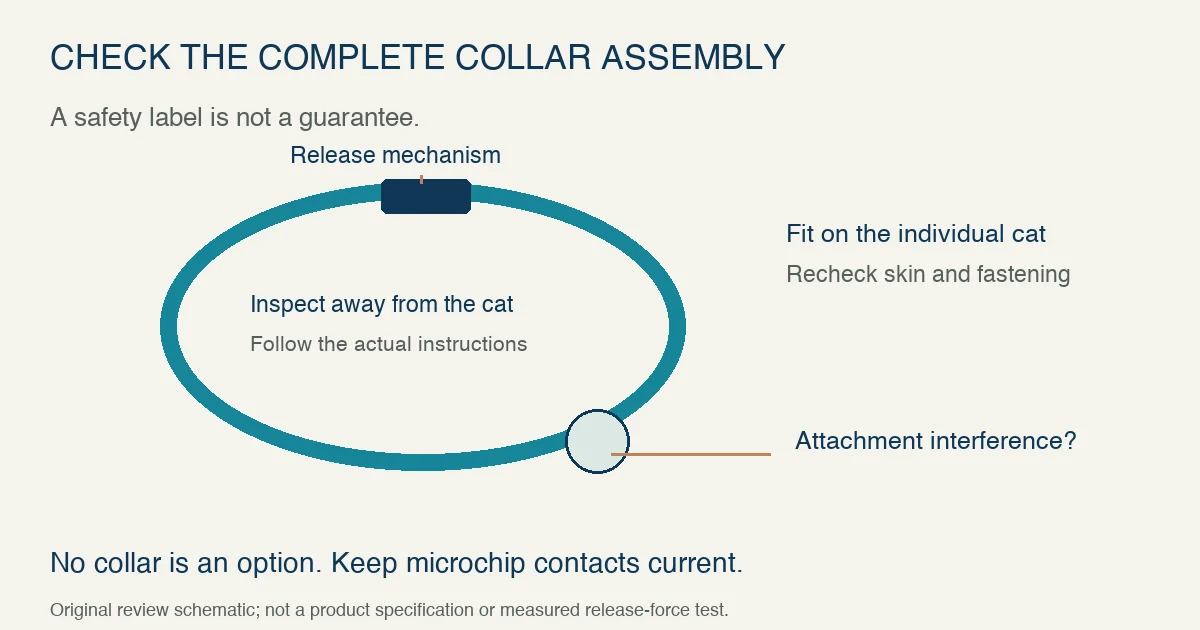
Look for an actual quick-release or breakaway fastening, not just a label saying “safety.” Blue Cross advises checking before fitting that the collar separates when its sides are pulled; it discourages non-breakaway and elastic collars [3]. Ask the seller or manufacturer for instructions for that exact design if its operation is unclear.
Do the check away from the cat. Do not pull on a fitted collar to test whether a cat can escape. A buckle that opens when a person presses a button is not, on that fact alone, proof that it releases when snagged. Check which action the instructions describe.
Consider the complete assembly: the collar plus tag, bell, tracker holder or flap key. Attachments must not interfere with release or normal movement [3]. A large accessory can change the practical setup even if the bare collar has suitable instructions. Avoid modifying or securing the fastening with tape, ties or an extra buckle.
A home check establishes only what you observed under those conditions. It is not an injury-prevention certification or a measured release-force test. If you cannot resolve the mechanism or attachment compatibility, choose another setup or no collar.
Fit the actual cat and recheck after it settles
Cats Protection describes a fit allowing two fingers snugly beneath the collar [2]. PDSA advises checking again after a few minutes because a cat may hunch during initial fitting [1]. Do not estimate neck fit through a thick coat or use another cat's adjustment as the measurement.
An overly loose collar can allow the jaw or a leg to become caught; an overly tight one can cause discomfort or skin problems [1]. If you cannot check fit calmly, get help before leaving it on. A kitten's changing size is a reason to reassess fit, not to leave growing room by making a collar very loose.
Observe the cat's response and check the skin and fur underneath. Persistent rubbing, hair loss, redness, struggling or a jaw or limb caught in the collar needs prompt action and veterinary advice where there is injury. Do not force continued wear because the cat has not yet “got used to it.” If the cat is trapped or injured and you cannot release it safely, contact a veterinarian urgently rather than pull against the trapped area.
Keep the release usable as the collar ages
PDSA warns that dirt and grease can obstruct a quick-release mechanism [1]. Inspect the fastening and clean only as its instructions allow. Check fit, damage, loose threads and skin regularly; Blue Cross recommends routine collar inspections [3]. Recheck after changing attachments or adjusting the size.
A collar that repeatedly comes off is not a reason to defeat the safety function. Review fit and compatibility and reconsider the need for it. A replacement of the same brand may still require a fresh check; previous satisfactory use does not prove the new assembly operates correctly.
An ID tag should carry reachable, current contact information. Keep a recent photograph and other identification records separately. If the cat disappears, use the lost indoor cat guide for an actual search and reporting plan rather than wait for a tracker alert.
Separate visibility, containment and walking
Reflective material can be useful only when light reaches it and the reflection is noticed; Blue Cross explains these limits [3]. It is not proof that a driver will see the cat or that road access is safe. Review the cat's access arrangements independently of the collar.
Do not use an ID collar as a walking restraint: PDSA advises attaching a lead to a cat harness rather than a collar if walking is chosen [4]. The cat harness guide covers gradual preparation and a separate decision about whether harness use suits the cat. A breakaway collar intended to release when caught has a different job from a properly used cat harness.
Similarly, a bell or a visible marker is not a containment system. If a household needs to prevent access to an unsafe door or window, address that route with the door and window safety guide. Adding accessories should not replace fixing the actual access problem.
Record what was checked, not a blanket safety claim
Before using a collar, retain its instructions and note the intended purpose, fitted size, attachments and observed release check. Review whether you can keep up with fit, skin and fastening checks. If that is not practical, reconsider the collar rather than assume that purchasing a breakaway design completes the decision.
No collar is an equally real choice. Whichever option you use, keep identification current and preserve the cat's ability to move comfortably. The useful outcome is an understood setup with its limits visible, not an unsupported promise that an accessory can never cause harm.