
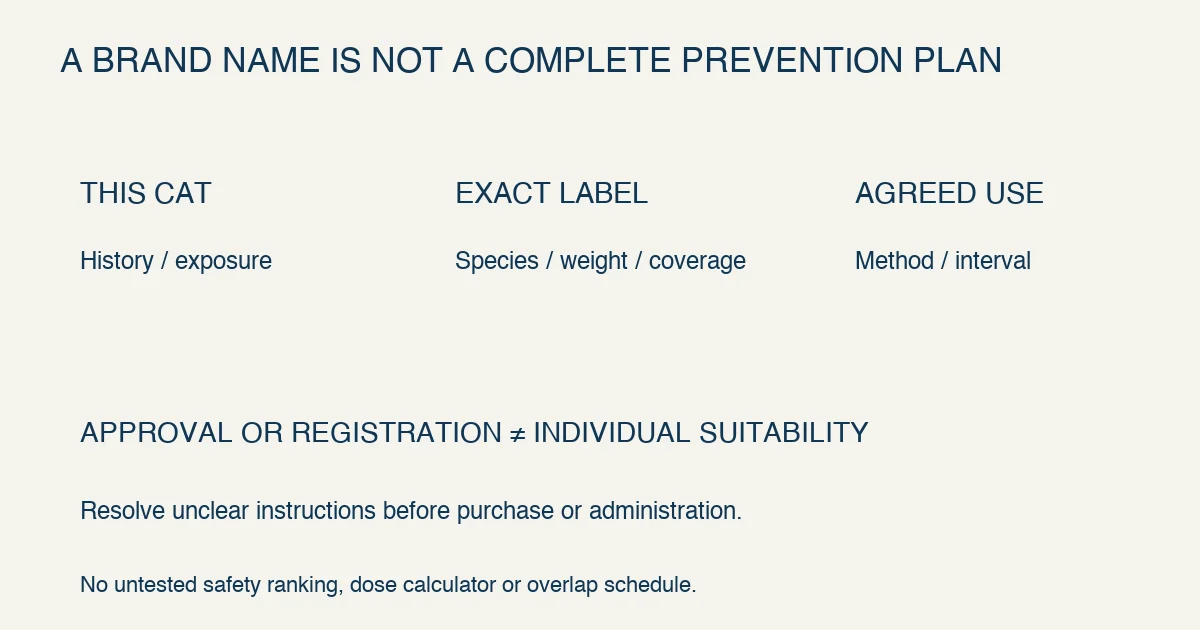
Choose parasite prevention with your veterinary team using the cat's history and the exact product label. “For pets,” a familiar brand name or a popular search result is not enough. Species, life stage, weight, covered parasites and instructions all have to match the intended use. Never use a dog-only product on a cat. [1][2]
This is a US-focused label-reading guide, not a ranking of tested products. It helps you prepare a comparison and resolve uncertainties before purchase or administration. It does not supply doses or make an individual safety decision.
Start with the protection the cat actually needs
Tell the team where the cat lives, whether it goes outdoors, travel destinations, contact with other animals and any previous parasite findings. Include current medicines, previous reactions, age and a current weight. Do not assume that indoor living means every parasite risk is absent, or that every outdoor cat needs the same combination.
Ask which parasites the recommended plan addresses and what remains outside it. A package that says flea treatment is not automatically a tick, intestinal-worm and heartworm product. Record coverage using the actual label's wording, including named species where relevant. FDA explains that approved products in one medicine class have differing additional parasite indications; shared classification does not make coverage identical. [3]
If the plan has more than one product, ask why each is included and whether the combination is appropriate. Do not independently add a collar because a spot-on does not list a parasite you are worried about. Resolve the gap with the team first.
Compare exact versions, not brand families
Keep the full product name, formulation, active ingredients, country-market label and pack size in your notes. A brand can have dog and cat versions, different ingredients and different intervals. A shop's short title or an image of an older box cannot substitute for the current insert.
For each candidate, copy the following fields into a comparison note:
- Cat indication and minimum age or weight.
- Weight band and actual dose instructions.
- Parasites covered and any limitations stated.
- Administration method, repeat interval and precautions.
- Warnings relevant to this cat's health and previous reactions.
- Regulating-agency identifier and the source of the label.
Do not award points merely for a longer parasite list. An unnecessary ingredient, an administration method the household cannot carry out, or a warning requiring further advice may change suitability. Keep unanswered items visibly marked “ask before use,” not inferred from a similar package.
FDA advises involving a veterinarian, disclosing health conditions and other products, and rereading instructions even for a product previously used. EPA likewise emphasizes species and size restrictions. [1][2] Neither an old uneventful dose nor another owner's experience proves this use will be appropriate.
Check US approval or registration accurately
FDA distinguishes animal drugs it approves from pesticides EPA registers. An FDA-approved product label includes a NADA or ANADA identifier with its approval statement; an EPA-regulated pesticide carries an EPA registration number. The agency's page also explains checking the EPA product-and-label system. [4]
Keep that identifier with the exact product name. A seller's phrase “FDA registered” does not by itself establish an approved animal drug, and an agency number is not a personalized recommendation. If the label, package or source is inconsistent, ask the manufacturer or team before use. FDA also warns that counterfeit pet pesticides exist. [4]
This page does not authenticate a seller or certify a particular package. Do not mistake a photographed number on a shop listing for verification that the tube in your hand is genuine. Keep the receipt and original packaging so a discrepancy can be investigated.
Make the administration plan workable
Ask for a demonstration if the method is unfamiliar. Confirm how the product should reach the skin or be given orally, and how to handle an uncertain or missed dose. A liquid left mostly on the coat, a tablet spat out and a completed administration are different events; do not automatically repeat a full dose after uncertainty.
For topical products, plan how to prevent other animals from licking the treated area and follow the actual contact and drying precautions. Keep children away as directed. Never apply a household or yard pesticide directly to the cat. [1][2]
Use one household administration record with the cat, exact product, amount prescribed, time given, person responsible and next due date based on the instructions. In a hypothetical household, an empty tube on the counter does not show which of two cats received it. Record completion at the time, rather than relying on the used packaging as the log.
Keep products in their labeled packaging and secure storage. Before switching, tell the team the previous product and administration date. A calendar month is not automatically interchangeable with every labeled interval, and this page cannot calculate a safe overlap for different medicines.
Discuss warnings without turning them into a blanket verdict
FDA reports potential neurologic adverse events with isoxazoline medicines, including tremors, incoordination and seizures; events may occur without an earlier seizure history. It also states that the class is considered safe and effective and has been used safely in most dogs and cats. Discuss the cat's history and alternatives with the team rather than interpreting the warning as either “risk-free” or “all products must be avoided.” [3]
A prescription choice can be reasonable and still require monitoring. Ask which changes should trigger a call, who is available outside opening hours and what information to bring. No precise adverse-event rate or comparative brand risk is asserted here.
If the cat becomes unwell after treatment, contact the veterinarian promptly with the product, amount and time. Report what occurred without assuming the product was certainly the cause. FDA directs owners to contact their veterinarian for a bad reaction and describes decontamination as dependent on the product and whether bathing is safe; EPA's pesticide guidance gives immediate washing advice. Seek urgent product-specific instructions rather than force-bathing a collapsing or seizing cat. [1][2]
Clinical help comes before incident paperwork. Retain packaging and ask about reporting to the manufacturer and the agency identified on the label. [3][4]
Revisit the plan when circumstances change
Review after travel, a new household animal, weight or health changes, a reaction, or persistent parasites. Bring the administration log so the team can separate suitability, application and exposure questions.
If fleas are already in the home, coordinate pet treatment and environmental cleanup. If a tick is attached, use a tool-appropriate removal method or get help. Buying another preventive is not a substitute for either immediate task.