
Start with a usable resting route
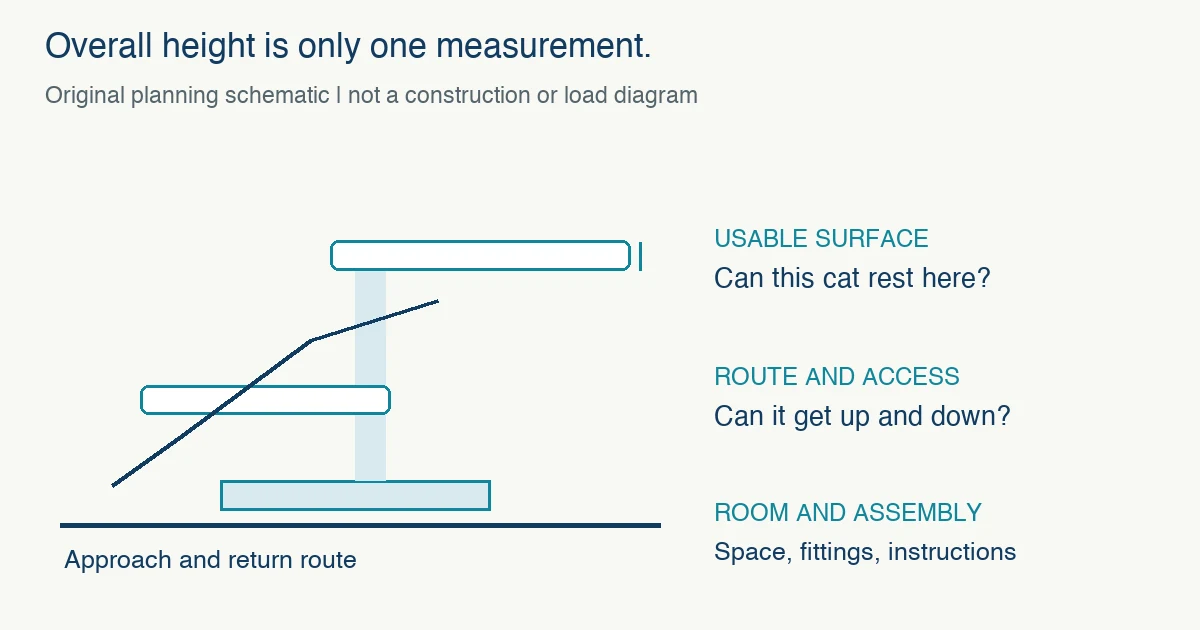
Choose a cat tree by matching its resting surfaces, entrances and route up and down to the actual cat, then confirming that it can be assembled and placed safely in your room. Height alone does not show whether the cat can reach a perch, stretch on it or leave without another cat blocking the way.
The AAFP/ISFM environmental guidelines describe perches large enough for a cat to stretch, separate safe places and accessible lower levels or ramps for cats with limited mobility [1]. This supports assessing the whole route. It does not establish a universal step height, a load rating or a requirement to buy a particular tower.
Observe where your cat currently rests and how it reaches that place. Record actual choices: a broad sofa back, a low secluded bed, an upright scratching surface or an elevated lookout. If there is a new reluctance to jump, report the change to your veterinary team rather than assuming the next piece of furniture will resolve it. A shopping guide cannot diagnose the reason.
This page compares selected manufacturer specifications, without hands-on testing. We have not tested tipping, load capacity, material durability or comfort. The named products illustrate which information helps a decision and which questions remain unanswered; neither is a proven best choice for your cat.
Measure the room and the resting surface separately
Use the candidate's full assembled dimensions to check placement, then ask for the usable size of each resting surface and hideaway. A product's width is not automatically the width available for a cat to lie down. Posts, edges and openings can change how that space is used.
Mark the proposed footprint temporarily on the floor, without leaving loose tape or materials accessible to your cat. Open nearby doors and check ordinary walking routes. Include space for a person to assemble, inspect and clean it, and for the cat to approach and descend. A tower fitting between two objects does not necessarily leave a usable landing area.
Keep dimensions in a consistent unit and retain the manufacturer's labels. If a listing provides three numbers without saying which is height, width or depth, ask instead of treating the ordering as certain. Similarly, ask whether the quoted footprint covers every projecting platform or only the base.
Do not position the tree as an accidental route to an unsafe window, an unstable shelf or a door swing. Review door and window safety alongside any proposed window lookout. An attractive view does not make an unverified window barrier safe.
Two specification examples and their unanswered questions
Catit's Vesper Base family page identifies the High Base walnut version as #52045 and lists 121.5 × 56 × 56 cm in its measurement section [2]. Its descriptive paragraph rounds the height to 121 cm. The Giant is a separate #52125 model, with 136.5 × 89 × 64 cm explicitly labelled height × width × depth [3]. Do not confuse the family name or round one model into the other.
| Information to compare | Vesper High Base #52045 | Vesper High Base Giant #52125 |
|---|---|---|
| Published overall measurements | 121.5 × 56 × 56 cm; confirm axes and room fit | 136.5 × 89 × 64 cm, labelled H×W×D |
| Published hideaway description | Two openings | Three openings |
| Selected documented materials | MDF with laminate, seagrass posts and sisal mat | MDF with walnut-look laminate, seagrass posts and sisal mat |
| Still needed for an individual fit | Usable perch/den size and route spacing | Usable perch/den size and route spacing |
Sources: Catit family and Giant product pages [2][3]. The pages describe replaceable components. Check the correct regional parts listing rather than assuming every replacement is available immediately. No prices, current stock, measured carrying capacity or independently verified anti-tip result are established by this comparison.
The Giant page markets its larger structure for large breeds and multiple cats [3]. Treat that as the manufacturer's intended audience, not evidence that every large cat fits or several cats can share it without difficulty. The extra overall width creates a larger placement requirement; it does not answer whether the particular resting platform or route works for your household.
An invented comparison: a shopper has room for the standard footprint but cannot confirm that the preferred perch fits their cat's resting posture. A second shopper can accommodate the Giant yet has a cat that avoids high jumps. Neither decision is resolved by selecting the larger product. Both need the missing usable dimensions and route information.
Check assembly and stability before access
Obtain the exact assembly instructions before purchasing. Catit's linked High Base manual is a visual parts-and-assembly sheet for that model [4]; it should not be used as the Giant's assembly guide. Check that your delivered parts and fittings match your own manual, and resolve a missing or damaged component with the supplier.
Follow the specified order and fittings. Do not invent bolt torque, maximum cat weight or a wall-fixing system from a photograph. Ask the manufacturer about any recommended securing method and its requirements for the actual product and location. If your wall or floor cannot support the specified installation, obtain suitable advice or choose another arrangement.
Before allowing access, check that the assembled unit sits as instructed, its connections are secure and its surfaces and pads are positioned correctly. If it rocks, slips, has a damaged fitting or cannot be assembled as specified, keep it out of use while the problem is resolved. This is a practical acceptance check, not a laboratory stability test. Do not use a cat to test a questionable structure.
Recheck after moving it, changing components or noticing movement during use. Loose or worn parts are a reason to inspect, not a reason to mask the problem with an improvised brace. Keep the correct instructions and part identifiers so repairs refer to the actual model.
Trace the route for each cat
Think of the first landing, intermediate surface, resting place and descent as one route. Ask for their measurements where they are not published. Avoid assigning a universal safe jump distance: age, mobility, confidence and the actual surface matter.
The environmental guidelines advise low or ramp-accessible safe places for kittens and older cats with limited mobility [1]. If mobility is affected, discuss suitable access with your veterinary team and consider senior-cat home products. The highest perch need not be the useful resting option. Preserve an accessible alternative while evaluating a new setup.
For several cats, look beyond the number of platforms. The same guidelines recommend separate safe places and more than one entry to reduce the possibility of another cat blocking access [1]. A tall shared tower remains one location. Observe who approaches, who waits, who leaves when another arrives, and whether a route is guarded. Lack of a fight does not establish equal access.
Compare a proposed shared tower with other resting places around the home. Use multi-cat homes to review resource distribution. If one cat can only reach a perch by passing another's resting spot, extra height may leave the underlying access problem unchanged.
Make cleaning and actual use part of the decision
Before buying, find how pads, mats and posts detach, which surfaces can be cleaned by the specified method, and which replacement belongs to the model. Do not infer a cushion's washing instructions from the word “removable.” Ask if the correct care method is unclear.
After installation, let the cat approach and leave voluntarily. Retain familiar resting and scratching options instead of removing them to force use of the new purchase. Record which levels are used, whether access is comfortable, where scratching occurs and any movement of the structure. Do not label a cat's avoidance stubbornness or a product's acceptance guaranteed.
If the cat continues scratching furniture, assess surface direction, location and stability through the separate scratching-furniture guide. A tower's posts may not match that task. The right next action could be a better-positioned scratcher or a more accessible resting surface, rather than another larger tower.
A useful purchase decision ends with known room fit, known usable surfaces, a workable route, correct assembly and manageable maintenance. Leave unresolved load, installation or fit claims as questions for the manufacturer. Specification comparison narrows the choice; observation of the actual cat and setup determines whether it meets the intended household task.